From Blogg to Book: Turning a Year of AI‑Generated Posts into a Flagship Lead-Generating Asset


Most teams treat their blog like a stream: posts flow by, some get traffic, a few convert, and then everyone moves on.
But if you’re using an AI-powered platform like Blogg, you’re quietly building something much more valuable than a stream of posts: you’re building a library.
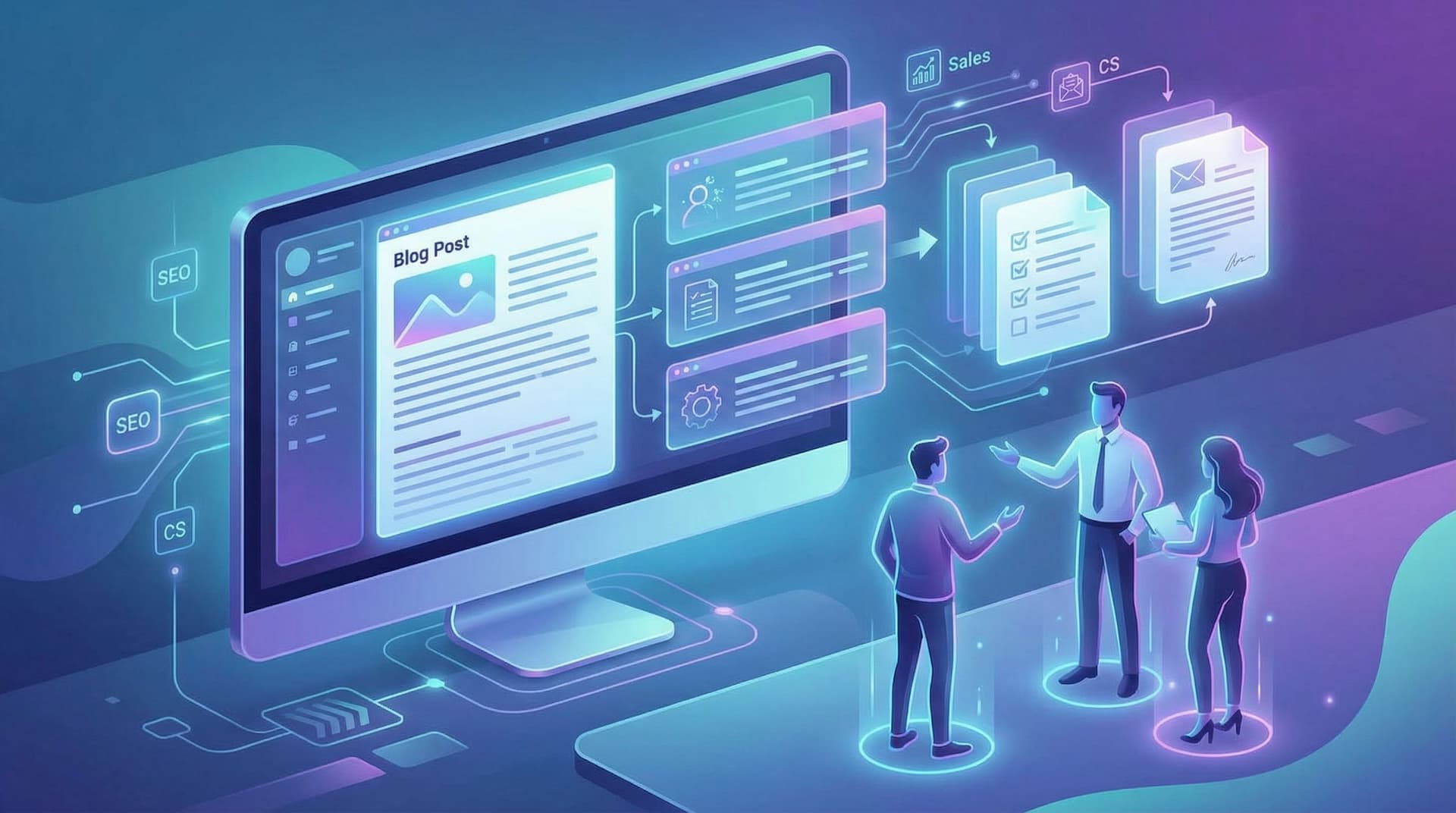
A year of consistent, on-topic, SEO-optimized posts is enough raw material to create a flagship asset—a book, guide, or playbook—that anchors your brand, captures high-intent leads, and arms your sales team with a “must-read” resource.
This post walks through how to turn that always-growing library into a book that:
- Positions you as the definitive authority in your niche
- Becomes the centerpiece of your lead generation strategy
- Feeds back into sales enablement, onboarding, and nurture sequences
And you’ll do it without disappearing for six months to “go write a book.” Instead, you’ll let Blogg do what it does best—ideation, drafting, and scheduling—while you curate, structure, and lightly enhance.
Why a Book Is the Natural Next Step After a Year of AI Blogging
If your blog is already humming—especially if Blogg is publishing 4–20 posts a month for you—you’re sitting on:
- Dozens of posts mapped to different stages of the buyer journey
- Repeated coverage of your core themes and differentiators
- Real search data showing what topics and angles resonate
Turning that into a book isn’t about vanity publishing. It’s about leverage.
A flagship book gives you:
- A premium lead magnet – A 120-page guide converts better than a generic checklist. You can gate it, partially gate it, or use it as the core offer in ads and outbound.
- Category authority – “We literally wrote the book on this” is a powerful line for sales, PR, and partnerships.
- A single source of truth – One asset that aligns marketing, sales, and customer success messaging (for more on this alignment, see From Blog to Briefing Doc: Turning AI‑Generated Posts into Sales and Customer Success Enablement).
- Content for a year of campaigns – Every chapter can spin out into webinars, email sequences, LinkedIn posts, and workshops.
The best part: if you’ve been running an AI-first content strategy (like the ones we walk through in From “We Should Blog More” to Revenue: Building a Simple AI-First Content Strategy for Non-Marketers), you’ve already done 70–80% of the work.
Step 1: Decide What Kind of Book You’re Creating
Not every book needs to be a 300-page manifesto. Start by choosing the job you want this book to do.
Common, high-leverage formats:
-
The Definitive Guide
A comprehensive overview of how to solve a core problem in your market.- Great for: top-of-funnel lead gen, category education, PR
- Example: “The Service Business Guide to Scaling Nationally with AI-Powered Content” (built from posts like From Local to National: How Service Businesses Use AI Blogging to Expand Beyond Their Zip Code).
-
The Playbook
A practical, step-by-step system with checklists, templates, and workflows.- Great for: mid-funnel leads, sales enablement, onboarding new customers
- Example: “The One-Person Marketing Team’s AI Content Playbook” (perfect if you’re already using frameworks from The One-Person Marketing Team’s Playbook: Running a Full-Funnel Blog Strategy with Blogg and 2 Hours a Week).
-
The Transformation Story
A narrative-style book that walks through a journey: from problem to solution, with case studies and before/after snapshots.- Great for: high-ticket services, consulting, and category-creation plays
Questions to clarify before you start:
- Who is the primary reader? (Title, role, company size, buying power)
- What decision do you want them to make after reading? (Book a call, start a trial, champion you internally)
- Where will this book sit in your funnel? (Cold lead magnet, sales follow-up, customer success resource)
Write this down in a short creative brief. It will anchor every decision you make from here.

Step 2: Audit Your Year of Posts for Book-Worthy Material
Now it’s time to mine your content library.
If you’ve been running with Blogg for 6–12 months, you likely have 40–200 posts. You don’t need all of them. You just need the right 20–40.
2.1. Pull Your Content Inventory
Export a list of posts from your CMS or analytics tool with:
- URL
- Title
- Publish date
- Category or tag
- Traffic (pageviews)
- Conversions (if you track form fills or demo requests per URL)
A simple spreadsheet is fine here.
2.2. Tag Posts by Theme and Buyer Stage
Create two columns:
- Theme – e.g., “AI blogging basics,” “search intent,” “sales enablement,” “content operations.”
- Buyer stage – Awareness, Consideration, Decision, Post-purchase.
Many teams already use a system like this (or an automated variant) if they’ve implemented ideas from Search Intent Mapping on Autopilot: Using AI to Align Every Blog Post with a Buyer Journey Stage.
You can:
- Manually tag 50–100 posts, or
- Export titles and meta descriptions into an AI prompt and ask it to suggest theme + stage tags, then review.
2.3. Identify the Strongest Candidates
For each theme, look for posts that are:
- High traffic + decent engagement – People clearly care about the topic.
- Aligned with your book’s core promise – If it doesn’t support the transformation you’re promising, leave it out.
- Evergreen or easily updated – You don’t want a book that feels stale in six months.
Mark these as A-tier posts. You’re looking for 3–6 strong posts per future chapter.
Step 3: Design a Book Structure That Actually Converts
Your book isn’t a random anthology of blog posts. It’s a guided journey.
Think in terms of chapters as milestones:
- Context – Why the old way is broken, what’s changed, and what’s now possible.
- Foundation – Core concepts, definitions, and mental models.
- System – Your step-by-step framework or methodology.
- Execution – Detailed how-tos, checklists, and examples.
- Proof – Case studies, stories, and before/after snapshots.
- Next steps – How to implement, common pitfalls, and what to do first.
For each chapter, ask:
- What is the one big idea this chapter should deliver?
- Which 2–5 existing posts best support that idea?
- What new connective tissue (introductions, transitions, examples) do we need?
Create a simple outline:
Part I – Why This Matters
  Chapter 1 – The Hidden Cost of Inconsistent Content
  Chapter 2 – Why AI-First Content Strategies Win

Part II – The System
  Chapter 3 – Mapping Search Intent to Buyer Journeys
  Chapter 4 – Building a Lightweight AI Content Operation
  Chapter 5 – Turning Posts into Revenue Assets

Part III – Implementation
  Chapter 6 – The 90-Day Rollout Plan
  Chapter 7 – Common Pitfalls and How to Avoid Them
Once the outline feels right, you’re ready to start stitching.
Step 4: Turn Posts into Cohesive Chapters (Without Rewriting from Scratch)
This is where most teams get stuck. They imagine they need to rewrite every post into “book voice.” You don’t.
Instead, think of each chapter as a remix of existing material.
4.1. Assemble a Rough Chapter Draft
For each chapter:
- Paste the relevant blog posts into a single document in a rough order.
- Add a short intro paragraph that:
- Recaps the previous chapter
- States what this chapter will help the reader do
- Add a short closing paragraph that:
- Summarizes key takeaways
- Teases the next chapter
If your posts came from Blogg, they likely share a consistent structure and voice already, which makes this stitching process much smoother.
4.2. Use AI as Your Book Editor, Not Just a Writer
Now bring AI back in—but with a different job description.
Feed it a compiled chapter draft and ask it to:
- Remove redundant explanations
- Unify terminology and tone
- Flag sections that feel repetitive or off-topic
- Suggest clearer transitions between sections
You’re not asking it to “rewrite everything.” You’re asking it to smooth the seams.
4.3. Layer in Stories, Examples, and POV
Books live or die on specificity. This is where you add the human layer:
- Short anecdotes from your own customers or experience
- Before/after snapshots (“Here’s what this looked like at 3 posts/month vs. 20 posts/month with AI.”)
- Clear opinions (“We recommend you stop proofreading every single post and instead…”)—this pairs well with frameworks from Founders, Stop Proofreading Every Post: A Lightweight Review Workflow for High-Volume AI Blogging.
You can draft these additions yourself or prompt AI with:
“Suggest 3 realistic examples of a B2B SaaS team implementing this workflow, with concrete metrics and outcomes.”
Then edit for accuracy and fit.

Step 5: Bake Lead Generation Directly into the Book
A book is not just a long PDF. It’s a conversion engine disguised as a resource.
Design it so that reading naturally leads to action.
5.1. Add Conversion Moments in Every Chapter
You don’t need aggressive CTAs on every page. You do need contextual invitations.
Examples:
-
After explaining a framework:
“Want to see this mapped to your own funnel? Book a 20-minute walkthrough.” -
After a case study:
“If your metrics look similar to the ‘before’ column, we should talk.” -
After a checklist:
“You can implement this manually, or let Blogg handle the heavy lifting in the background.”
Place these as chapter-end callouts, not intrusive popups.
5.2. Use Companion Assets and Tools
Turn the book into a mini product ecosystem:
- Downloadable worksheets and templates
- A Notion or Google Sheets version of your frameworks
- Short Loom videos walking through key processes
Gate these behind simple forms:
- “Get the Chapter 3 worksheet” → email capture
- “Copy our 90-day rollout template” → email + role
Now your book isn’t just a one-time download. It’s a sequence of micro-conversions that reveal who’s most engaged.
5.3. Align With Your CRM and Nurture
Work with sales and RevOps to:
- Create a “Book Reader” lead source or tag
- Trigger tailored nurture sequences based on:
- Which chapter resources they requested
- Their role and company size
- Whether they’re net new or existing subscribers
Then reuse your original blog content again to power those sequences (if you need a system for this, see Beyond the Blog: Using AI-Generated Posts to Power LinkedIn, Newsletters, and Lead Nurture Sequences).
Step 6: Decide on Format, Design, and Distribution
You don’t need a hardcover on bookstore shelves for this to work. You do need a clean, credible package.
6.1. Choose Your Primary Format
Most teams start with:
- Designed PDF – Easy to gate, share, and reference.
- Web book – A series of interlinked pages or a long-form guide on your site for SEO.
Later, you can expand into:
- Print-on-demand copies for events and VIP prospects
- A Kindle or ePub version for extra authority
6.2. Keep Design Simple but Polished
Key elements to invest in:
- A strong, clear cover (title + subtitle that speaks to outcomes)
- Consistent typography and spacing
- Pull quotes, callout boxes, and diagrams for key frameworks
- Simple chapter openers with 1–2 sentences of positioning
You can brief a designer, or use tools like:
- Canva for layouts and covers
- Figma for more custom design systems
- Beacon or Designrr to convert blog posts into eBooks quickly
6.3. Build a Distribution Plan
Think of your book as a campaign, not a static asset.
Channels to consider:
- Homepage feature – A prominent section offering the book as your main value exchange.
- Blog CTAs – Swap generic “subscribe” boxes for “Get the book” on high-intent posts.
- Email list – Launch sequence + evergreen onboarding for new subscribers.
- Sales sequences – A tailored version of the book as a follow-up for specific segments.
- Partnerships – Co-branded versions or cross-promotions with complementary tools.
Because Blogg keeps your blog publishing on autopilot, you can afford to spend a few weeks focusing on this launch without sacrificing content velocity.
Step 7: Keep the Book Alive as Your Blog Evolves
A static book slowly loses power as your product, market, and positioning evolve.
The advantage of an AI-powered blog is that your source material keeps improving:
- New posts reveal fresh objections and questions
- Search data shows which topics are heating up
- Case studies accumulate
Use that to your advantage.
7.1. Set a Simple Update Cadence
Twice a year, schedule a book review sprint:
- Review your top 20–30 posts from the last 6 months.
- Identify anything that:
- Contradicts the book
- Adds a new angle or case study
- Updates stats or best practices
- Decide whether each item:
- Replaces an existing section
- Becomes an added sidebar or callout
- Just informs a minor wording tweak
7.2. Version Your Book Like a Product
Treat your book like software:
- Label versions (v1.1, v1.2, v2.0).
- Keep a simple changelog (“New case studies in Chapter 4,” “Updated search strategy in Chapter 6”).
- Let your list know when a new version is out—this alone can drive re-engagement and repeat pipeline from existing subscribers.
Blogg keeps the content flywheel turning; your job is to periodically harvest the best from that flywheel into each new edition.
Recap: Turning a Year of Posts into a Flagship Asset
To pull it all together:
- You don’t need to start from scratch. A year of AI-generated, on-strategy posts is more than enough raw material for a credible, useful book.
- Clarify the book’s job first. Decide whether it’s a definitive guide, a playbook, or a transformation story—and who it’s for.
- Audit and organize your library. Tag posts by theme and buyer stage, then pick the top 20–40 that support your core narrative.
- Stitch, then smooth. Combine posts into chapter drafts, use AI as an editor, and layer in human stories and POV.
- Engineer for leads. Add contextual CTAs, companion assets, and CRM-integrated nurture paths so the book becomes a conversion engine.
- Package and promote. Choose simple, polished formats and treat the book like a campaign, not a file.
- Keep it alive. Use your ongoing AI blogging to fuel regular updates and new editions.
If your blog is already powered by Blogg, you’re closer to “we wrote the book on this” than you think.
Your Next Step
You don’t need to “go write a book.” You need to:
- Export your last 12 months of posts. Even 6 months is enough to start.
- Spend 60 minutes tagging themes and buyer stages. Look for the patterns that naturally want to become chapters.
- Draft a one-page book outline. Title, subtitle, target reader, chapter list.
From there, you can let Blogg keep your publishing cadence steady while you carve out a few focused working sessions to assemble your first flagship asset.
If you’re not using Blogg yet but want a blog that practically writes the book for you over the next year, now is the time to set it up. Define your topics, plug it into your CMS, and let the system start building the library your future book will come from.
Twelve months from now, you can either have another scattered archive of posts—or a book that your best-fit buyers download, read, and bring into their next internal meeting with your name on the cover.
Which sounds more useful for your pipeline?