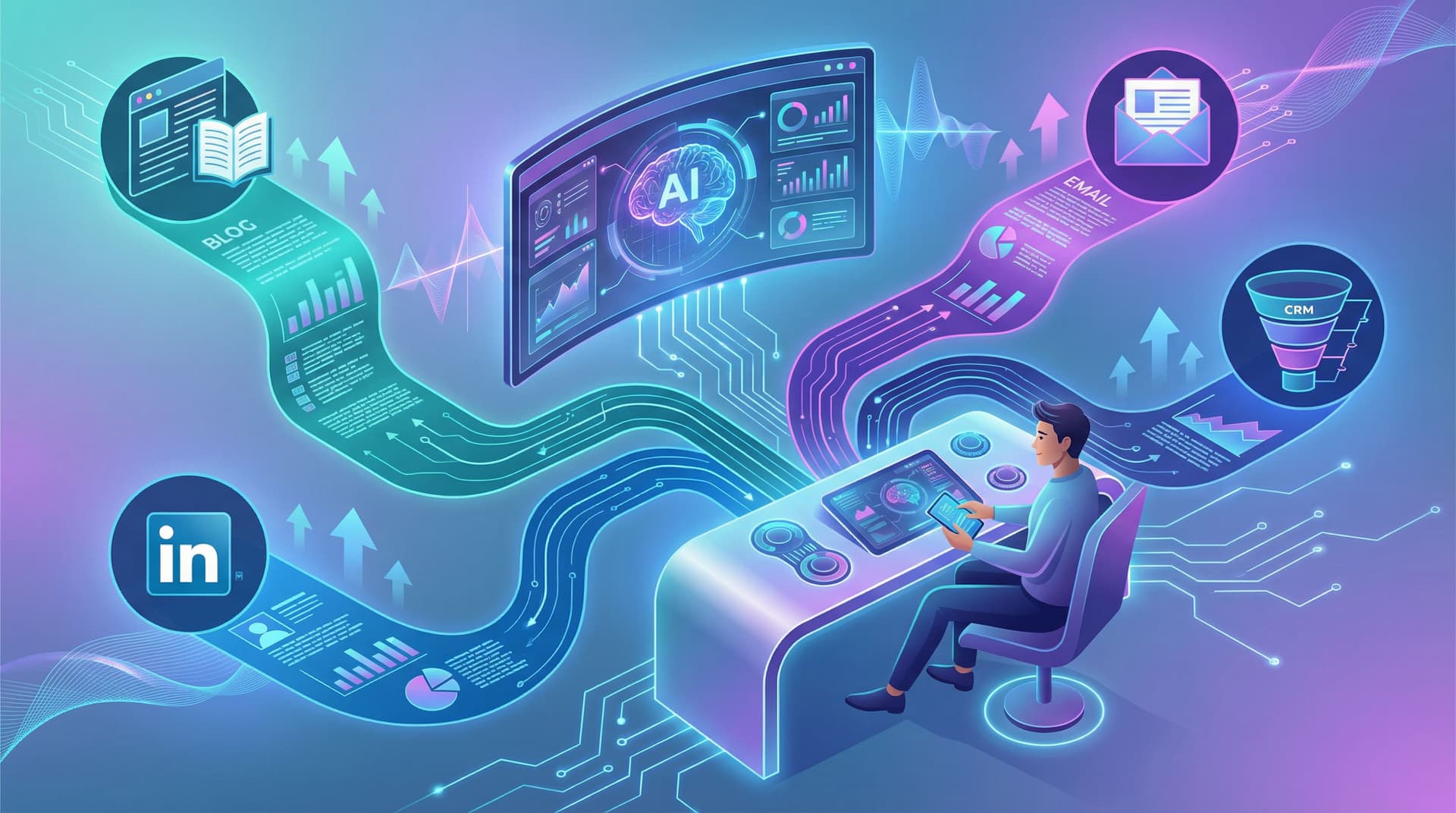
From Local to National: How Service Businesses Use AI Blogging to Expand Beyond Their Zip Code

For most service businesses, growth used to mean opening a new office, hiring local reps, and buying more billboards or mailers.
Now, your next market isn’t the neighboring suburb—it might be three states away.
If you sell anything that can be delivered remotely (consulting, coaching, legal or financial services, creative work, SaaS-like services, training, specialized trades with travel fees, etc.), you’re no longer limited to people who can drive past your storefront. The real limiter is whether those buyers can find you and trust you enough to start a conversation.
That’s where AI-powered blogging comes in.
Platforms like Blogg let you consistently publish search-optimized, authority-building content without turning yourself into a full-time writer. And that consistency is exactly what lets a local brand quietly become a national player.
Why Expanding Beyond Your Zip Code Starts With Search
When someone in another state needs help, they don’t know your brand name yet. They search for:
- “virtual bookkeeping for construction companies”
- “remote HR compliance help for 50–200 employee companies”
- “online speech therapy for adults post-stroke”
- “B2B cold calling agency for SaaS startups”
If you only publish the occasional “company update” or generic blog post, you’ll rarely show up for those high-intent searches.
A steady stream of focused, useful content does three things for a service business trying to grow beyond its local market:
-
Captures non-branded demand
You stop relying on people who already know you and start attracting people searching for problems you solve. -
Builds national authority
When prospects in other regions see that you’ve written dozens of specific, practical articles on their exact challenges, you feel less like a small local shop and more like a specialist. -
Shortens the trust gap
Buyers who can’t meet you in person need proof. Blog posts, case studies, and how-tos become your remote trust-building engine.
AI doesn’t replace your expertise here—it scales it. A platform like Blogg lets you encode what you know into a content machine that works 24/7, in every market you care about.
Step 1: Redefine Your “Service Area” in Terms of Problems, Not Geography
Most local service businesses think in zip codes and drive times:
“We serve clients within 30 miles of Denver.”
To expand, you need to start thinking in problems and profiles instead:
“We help multi-location dental practices reduce no-shows and increase hygiene rebooking rates.”
Ask yourself:
-
Who can we realistically serve outside our city or state?
- Remote or hybrid services (consulting, coaching, advisory, creative, IT, bookkeeping, therapy, training, etc.) can usually go national quickly.
- On-site services can still expand regionally or nationally if your margins support travel fees, or if you can productize parts of the service (e.g., remote audits, virtual assessments, standardized installations with local subcontractors).
-
What problems do those non-local buyers wake up worrying about?
Think in terms of outcomes, not your service menu:- “We keep your OSHA training compliant across all locations.”
- “We reduce revenue leakage from unbilled hours.”
- “We help you hire licensed clinicians in all 50 states.”
-
Which of those problems can we credibly own online?
You don’t need to rank for everything. You need to dominate a clear slice of problems for a clear slice of buyers.
Document this in a one-page positioning sheet. It becomes the north star for your AI blogging strategy.
Step 2: Turn Your Expertise Into a National Topic Map
Once you know who you’re trying to reach and what you solve, the next step is mapping that into content.
Instead of random blog ideas, you want a topic map that mirrors how a buyer researches their problem from first Google search to signed contract.
A simple way to do this:
-
List your core services as “pillars.”
For example, a remote bookkeeping firm might have:- Construction bookkeeping
- SaaS startup bookkeeping
- Multi-location franchise bookkeeping
-
Under each pillar, list 10–20 specific questions buyers ask.
Use:- Sales call notes and email threads
- Support tickets or FAQs
- Questions you hear at conferences or networking events
-
Map each question to a buyer stage.
- Early: “Do we even have this problem?”
- Middle: “What are our options? How do they compare?”
- Late: “Why you vs. other providers? How does it work?”
If you want a deeper dive on this, we break down a full framework in Search Intent Mapping on Autopilot: Using AI to Align Every Blog Post with a Buyer Journey Stage.
This map becomes the blueprint you feed into an AI platform like Blogg. Instead of asking for “blog post ideas,” you’re asking it to systematically cover every meaningful question your ideal buyers have—across all regions.
Step 3: Localize National Reach Without Being “Local SEO Only”
You’re not abandoning local search; you’re layering national reach on top of it.
Think of your content in three tiers:
1. Problem-First, Location-Agnostic Content (Your National Engine)
These posts don’t mention geography at all. They’re designed to rank for:
- “how to standardize HR policies across multiple states”
- “bookkeeping for construction retainage accounting”
- “virtual interior design for commercial offices”
They build your authority with anyone, anywhere, who has that problem.
2. Industry + Region Content (Bridging Local and National)
Here you marry your expertise with target regions or regulatory environments:
- “HR compliance checklist for multi-state employers (California, Texas, Florida focus)”
- “How New York law firms can use virtual assistants without violating confidentiality rules”
These posts:
- Show you understand regional nuance.
- Help you rank for more specific, less competitive searches.
3. Hyper-Local Proof Content (Trust Builders)
Even national buyers want to see proof that real companies work with you. Create:
- Case studies: “How we helped a 12-location dental group in Ohio cut no-shows by 27%”
- Story-driven posts: “What we learned rolling out remote IT support for a 300-employee manufacturer in North Carolina”
These may not be huge SEO drivers, but they’re powerful for:
- Sales follow-ups
- Proposal links
- Retargeting campaigns
You can then repurpose many of these assets into email, LinkedIn, and nurture flows—see Beyond the Blog: Using AI-Generated Posts to Power LinkedIn, Newsletters, and Lead Nurture Sequences for a full system.
Step 4: Use AI to Maintain a Consistent Publishing Rhythm
National reach isn’t built on one heroic blog post. It’s built on compounding consistency.
The challenge for most service businesses: no one has time to write weekly.
This is where an AI-first workflow shines:
-
Set your themes and frequency once.
In a platform like Blogg, you can:- Define your core topics (those pillars and questions from your topic map).
- Set voice, tone, and brand guidelines.
- Choose a cadence (e.g., 1–3 posts per week).
-
Feed it real inputs from your business.
- Sales call transcripts
- Proposal templates
- Onboarding docs
- Internal SOPs
These turn generic AI into your AI, grounded in how you actually work.
-
Review, edit, and approve instead of writing from scratch.
Your team’s job shifts from “author every word” to:- Spot-check accuracy
- Add specific examples and stories
- Layer in your point of view
If you’re a tiny team, this kind of lightweight workflow is exactly what we walk through in Content Operations for Tiny Teams: Building a Lightweight AI‑First Workflow Without Adding Headcount.
Step 5: Make Your Content Feel National, Not Generic
Publishing more often is not enough. To win buyers outside your home market, your content needs to feel:
- Specific
- Credible
- Grounded in real experience
Here’s how to do that without adding hours of work:
Add Real Stories and Micro-Case Studies
Instead of writing, “We help businesses improve their onboarding,” write:
“A 40-person SaaS team in Austin came to us with a 30% new-hire churn rate. Within six months of implementing our standardized onboarding playbook, that dropped to 10%. Here’s how we approached it.”
You can brief AI with anonymized details and ask it to structure the story, then you tweak for accuracy.
Show You Understand Regional Nuance
Even if you serve clients remotely, mention:
- Time zones and scheduling flexibility
- State-specific regulations or norms
- Industry concentrations in certain regions (e.g., tech hubs, manufacturing belts)
Example:
“Most of our healthcare clients in the Northeast struggle with X because of Y state regulations. Here’s how we adjust our process for them vs. our clients in the Southeast.”
Use Clear, Service-Specific CTAs
Each post should gently guide non-local readers to the next step, such as:
- “See how we work with clients outside our home state.”
- “Book a 20-minute fit call—no obligation, no hard pitch.”
- “Download our checklist for multi-location operators.”
You don’t need to sell hard. You need to make the path forward obvious.
If you’re using a platform like Blogg, you can standardize these CTAs so they’re consistent across posts, while still adjusting them by topic or intent.
Step 6: Connect Your Blog to Email and Sales
Traffic from other states is useless if those visitors read one post and disappear.
To turn national readers into real pipeline:
-
Capture email with relevant offers.
- Checklists, calculators, templates
- Short industry-specific guides
- Webinar or workshop signups
-
Nurture with content you’re already publishing.
If your blog is running on AI, you have a steady stream of posts that can be:- Curated into a monthly “what’s new” email
- Turned into drip sequences by topic (e.g., “New multi-location operators” series)
We break down how to do this even with a small list in Small List, Big Results: Using AI Blogging to Turn 500 Email Subscribers into a Reliable Revenue Channel.
-
Arm your sales team with relevant articles.
Train reps to:- Send 1–2 specific posts after discovery calls (“Here’s a deeper dive on the issue you mentioned.”)
- Use blog content to answer objections (“We wrote about what to consider when hiring a remote bookkeeping firm vs. local.”)
- Share case-study-style posts with prospects in similar regions or industries.
This is where your blog stops being “just marketing” and becomes a sales enablement engine.
Step 7: Measure Progress in Markets, Not Just Pageviews
If your goal is to grow beyond your zip code, your metrics should reflect that.
In addition to basic SEO stats, track:
-
Sessions by geography
Are you seeing more visitors from target states or regions over time? -
Leads by geography
Add a “state” or “country” field to your forms. Watch how the mix shifts as your content library grows. -
Pipeline and revenue from non-local clients
Even a handful of new retainers or projects can justify the entire AI blogging investment. -
Rankings for region-agnostic and region-specific keywords
Use tools like Ahrefs, Semrush, or even Google Search Console to see:- Which problem-first keywords you’re winning nationally.
- Which region-specific phrases you’re starting to own.
Over time, you should see:
- More traffic from outside your home state.
- A higher percentage of leads and deals from those regions.
- Stronger rankings for long-tail, high-intent queries that match your services.
If you’re unsure how aggressive your publishing cadence should be for your goals and markets, check out Are You Overpublishing? Finding the Right AI Blogging Cadence for Your Niche, Budget, and Goals.
Putting It All Together: A Simple 90-Day Expansion Plan
Here’s how a local service business could realistically start going national in about three months using AI blogging:
Weeks 1–2
- Clarify positioning: who you serve, what problems you own.
- Build your topic map (pillars, questions, buyer stages).
- Set up Blogg with your topics, voice, and publishing cadence.
Weeks 3–6
- Publish 1–2 problem-first posts per week.
- Add at least one region- or industry-specific post per month.
- Start capturing email with a simple lead magnet tied to your core problem.
Weeks 7–10
- Layer in micro-case studies and story-driven posts.
- Train sales to use blog posts in follow-ups.
- Repurpose top posts into LinkedIn and newsletter content.
Weeks 11–13
- Review analytics by geography and keyword.
- Double down on topics that are driving non-local traffic and leads.
- Refine your topic map based on real search terms and sales questions.
By the end of this period, you won’t “own” the whole country—but you’ll see clear signals that buyers beyond your zip code are:
- Finding you through search.
- Engaging with your content.
- Reaching out for conversations.
From there, it’s a matter of continuing the system, not reinventing the strategy every quarter.
Quick Recap
Service businesses that grow from local to national with AI blogging do a few things differently:
- They define their market by problems and profiles, not just geography.
- They build a topic map that mirrors the buyer journey and feed it into an AI platform like Blogg.
- They balance problem-first, region-aware, and proof-driven content.
- They use AI to maintain a steady publishing rhythm while humans add stories, nuance, and POV.
- They connect the blog to email and sales, so national traffic turns into real pipeline.
- They measure success by markets and revenue, not just pageviews.
Do that consistently, and your blog becomes more than a marketing asset. It becomes the quiet engine that pulls you out of your local bubble and into the national conversation.
Your Next Step
If you’ve been “meaning to blog more” but haven’t found a way to do it consistently, this is your moment.
You don’t need a content team. You don’t need to become a writer. You need a system.
Here’s a simple way to start this week:
- Write down the three biggest problems you solve for clients you could serve anywhere in the country.
- Under each problem, list five questions prospects ask before they buy.
- Take that list into Blogg and set up your first 30 days of posts around those questions.
- Block 30 minutes a week to review and lightly edit drafts before they publish.
Do that for one quarter, and you’ll be miles ahead of competitors still relying on word-of-mouth and local referrals alone.
Your next client doesn’t have to live down the street. With the right AI-powered blogging system, they can be anywhere in the country—and still feel like you’re the obvious choice.