From Blog Post to Playbook: Using AI to Turn Every Article into Internal Sales and Success Training Material

Most teams still treat the blog as “marketing’s problem.” Posts get published, promoted on LinkedIn, and maybe mentioned once in a sales Slack channel—then forgotten.
Meanwhile, sales and success are scrambling for:
- Better talk tracks
- Clearer onboarding flows
- Examples, stories, and proof points for specific use cases
You’re already creating that material. You’re just shipping it as blog posts instead of as structured, reusable internal training.
This is where AI changes the game. With the right workflow, every strong blog post can become:
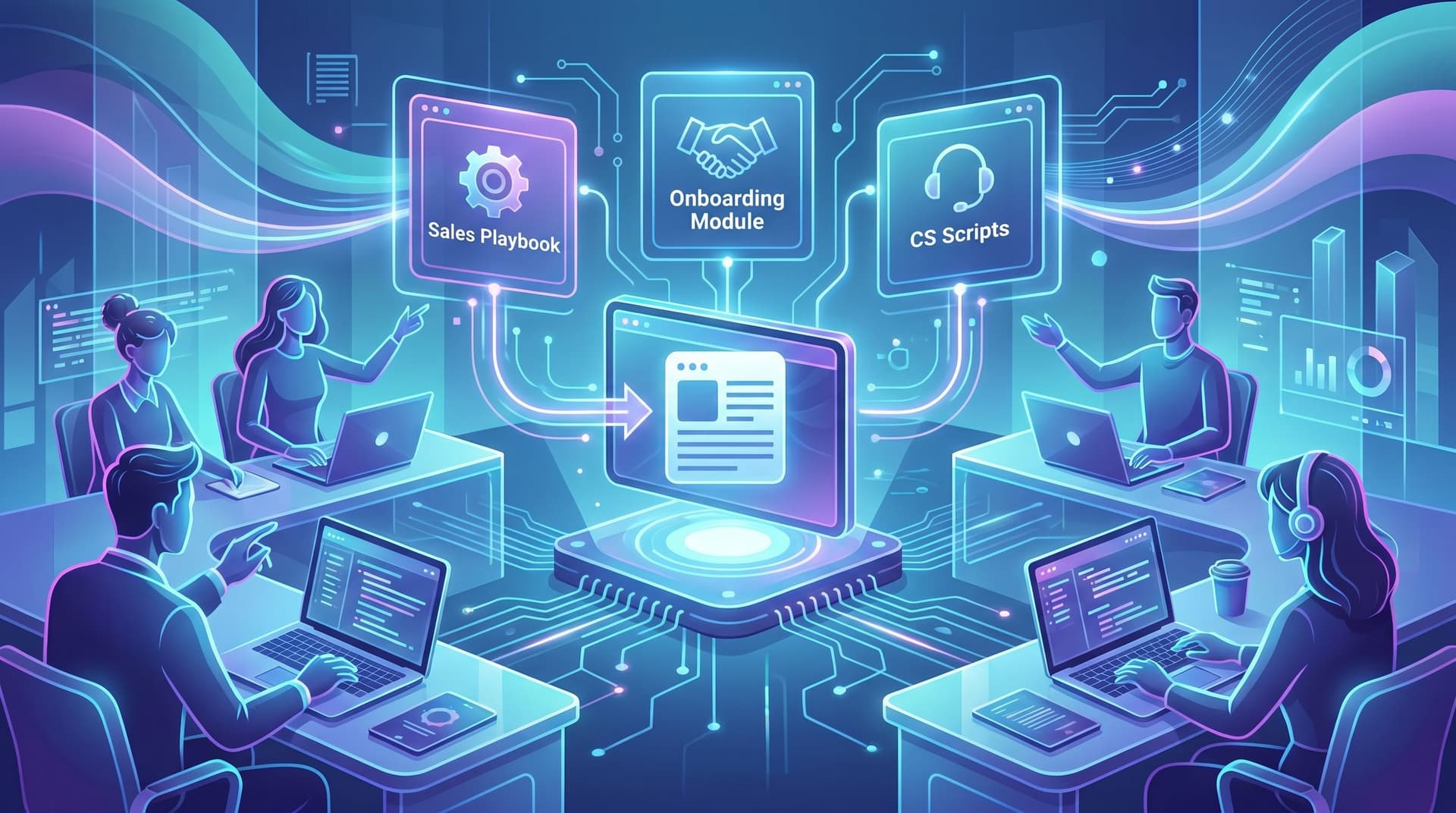
- A mini sales play
- A micro-onboarding module
- A quick-hit training asset for new reps and CSMs
…without asking your team to build a second content factory.
And if your blog is powered by an engine like Blogg, you already have a steady stream of structured, SEO-ready content that’s perfect for repurposing.
Why this shift matters for revenue teams
Turning blog posts into internal playbooks isn’t just a nice-to-have. It directly affects:
1. Ramp time for new hires
New reps and CSMs don’t just need product knowledge—they need context:
- What problems do we actually solve?
- Which phrases resonate with specific personas?
- How do we handle common objections?
Your best blog posts already explain this in buyer-friendly language. Turning them into training artifacts means new hires can learn from the same narratives your buyers see.
2. Consistency across sales and success
When marketing, sales, and CS all work from different decks, docs, and one-off Slack threads, you get:
- Mixed messaging in the field
- Confused customers hearing different stories
- Fragmented feedback loops
Using the blog as a shared source of truth—and AI to structure it into plays, talk tracks, and checklists—keeps everyone aligned.
3. Content ROI beyond traffic
If a post only drives pageviews, you’re getting one dimension of value. But if that same post also:
- Trains three new reps
- Reduces onboarding time by a week
- Gives CS a better way to explain a tricky feature
…you’ve multiplied its return without creating anything “net new.”
This is the same mindset behind posts like Beyond the Blog: Using AI to Spin Every Blogg Draft into Social, Email, and Sales Enablement Assets. Here, we’re going one level deeper: not just repurposing for more channels, but codifying blog insights into internal playbooks.
The core idea: one external story, two internal artifacts
Every strong post can be treated as three things:
- External story – the public article buyers read.
- Sales enablement asset – talk tracks, objection handling, and proof points.
- Success/onboarding asset – checklists, walkthroughs, and “how we explain this to customers.”
Instead of writing separate content for each, you:
- Let Blogg generate or host the external post.
- Use AI (including the same engine) to transform that post into structured internal material.
Done right, your content calendar becomes a training calendar.

Step 1: Design posts with internal reuse in mind
If you want to turn posts into playbooks, you have to write like a playbook author from the start.
When you’re planning topics (especially if you’re using something like the Question-First Content Engine), ask:
- Which sales conversations does this post support?
- Discovery for a new vertical?
- Objection handling for a specific feature?
- Competitive differentiation?
- Which success milestones does it reinforce?
- Onboarding step?
- Adoption of an advanced feature?
- Expansion motion?
Then structure the post so it’s easy for AI to slice:
- Clear sections with descriptive headings
- Bulleted lists for steps, pros/cons, and use cases
- Concrete examples tied to specific personas or scenarios
The more structured the post, the easier it is for AI to:
- Extract “plays” (if persona = X and problem = Y, recommend Z)
- Summarize into talk tracks
- Turn lists into checklists or SOPs
If you’re using Blogg, this is where features like topic templates, persona notes, and keyword briefs help you bake structure in from the start.
Step 2: Build a simple tagging system for internal use
Your AI can’t repurpose what it can’t find.
Before you worry about prompts, set up a simple tagging system for posts that are good candidates for internal training. For each published article, tag it with:
- Persona: e.g., “RevOps leader,” “Head of Support,” “Field technician”
- Stage: e.g., Awareness, Consideration, Decision, Onboarding, Expansion
- Use case: e.g., “Ticket deflection,” “Multi-region rollout,” “Compliance reporting”
- Internal use: e.g., “Sales play,” “Onboarding module,” “Renewal script”
You can store this in:
- Your CMS or AI platform (if it supports custom fields)
- A simple spreadsheet or Notion database
- A knowledge base your AI is connected to
When you later ask AI to “generate a playbook from all posts tagged ‘Sales play’ and ‘Decision’ for Persona X,” it has a clear starting point.
If this feels familiar, it’s the same mindset as the Source Stack Audit: you’re mapping which content exists, where it lives, and what it’s good for—just now with a specific lens on internal enablement.
Step 3: Create a reusable AI prompt for “post → sales play”
Next, you want a standard way to turn a single post into a sales asset.
Here’s a reusable prompt you can adapt inside Blogg or any AI workspace:
“You are a senior B2B sales enablement leader. I’ll paste a blog post below. Turn it into a concise sales play for AEs and SDRs. Include:
- A one-paragraph summary in plain language
- 3–5 key problems this content addresses, phrased as customer statements
- Recommended discovery questions
- A talk track (2–3 paragraphs) that explains our approach in conversational language
- 3–5 objection/concern responses based on the post
- 2 short customer stories or examples drawn from the post (or inferred from it)
- A quick-reference bullet list: ‘Use this play when…’
Keep it skimmable. Assume reps will read this minutes before a call.”
Paste your post, run the prompt, and you’ve got a usable play.
To make this sustainable:
- Save the prompt as a template in your AI tool.
- Attach the resulting plays to the relevant CRM records, Notion docs, or enablement platform (e.g., Highspot, Seismic).
- Link back to the original post so reps can read the full narrative when they have time.
Over a quarter, you’ll build a library of plays that map directly to your external content.
Step 4: Create a reusable AI prompt for “post → success training”
Success and onboarding need different outputs than sales.
Here’s a prompt tuned for CS and onboarding teams:
“You are a customer success leader building a training module for new CSMs. I’ll paste a blog post below. Turn it into an internal training asset. Include:
- A short overview: what this concept is and why it matters for our customers
- The ideal customer profile and scenarios where this is most relevant
- A step-by-step checklist for how we guide customers through this concept or motion
- Example phrases CSMs can use to explain this to customers in simple terms
- 3–5 ‘watch-outs’ or common pitfalls to look for
- 3 quiz questions to test understanding
Format this for easy reading inside a knowledge base.”
Again, paste the post, run the prompt, and you have:
- A mini-module for onboarding
- A refresher asset for existing CSMs
- Material you can later surface in your LMS or internal wiki
If you’ve read The Silent Funnel Fix, this is the internal mirror: instead of just deflecting tickets with public content, you’re equipping CSMs with the same narratives so they can proactively teach customers.

Step 5: Standardize where these assets live
The best playbooks fail not because they’re bad, but because no one can find them.
Decide—explicitly—where each type of repurposed asset will live:
- Sales plays → your sales enablement platform, CRM, or a dedicated “Plays” space in Notion/Confluence.
- Success training modules → your CS knowledge base or LMS.
- Quick-reference scripts → pinned posts in the relevant Slack channels or internal chat.
Then, for every new post that gets repurposed:
- Publish the post via Blogg or your CMS.
- Run the “sales play” and “success training” prompts.
- Save the outputs to their designated homes.
- Add links back to the original post in each internal asset.
- Announce them in your sales/CS channels with a short summary and direct links.
If you’re already running something like an Input Inventory Workshop, extend that inventory to include “where internal derivatives live” so nothing gets lost.
Step 6: Close the loop with feedback from the field
AI can structure content, but humans prove whether it works.
Set up simple feedback loops so reps and CSMs can tell you:
- Which plays actually help on calls
- Which talk tracks feel awkward or off-brand
- Which checklists are missing steps customers ask about
Practical ways to do this:
- Add a quick emoji reaction system or 1–5 rating in your enablement platform.
- Create a dedicated #content-feedback Slack channel where reps drop call snippets, questions, and tweaks.
- Run a monthly review where marketing, sales, and CS pick 2–3 plays to refine based on real calls.
Then feed that feedback back into your AI prompts:
- “Revise this talk track to be more concise; reps say it’s too long.”
- “Add a section to this checklist covering X, which customers keep asking about.”
Over time, your AI-generated plays become sharper because they’re grounded in real-world usage, not just copywriting best practices.
Step 7: Plan “playbook-first” campaigns
Once you’ve proven the workflow on a few posts, flip your planning model:
Instead of asking, “What blog posts should we publish this quarter?” ask:
“What are the 3–5 biggest gaps in our sales and success playbooks right now?”
For each gap, define:
- The core motion (e.g., “selling into IT security,” “expansion from team to enterprise”).
- The external content you need (pillar post, supporting posts, FAQs).
- The internal assets you’ll derive (sales plays, onboarding modules, renewal scripts).
Then brief your AI engine—especially if you’re using Blogg—with that full picture:
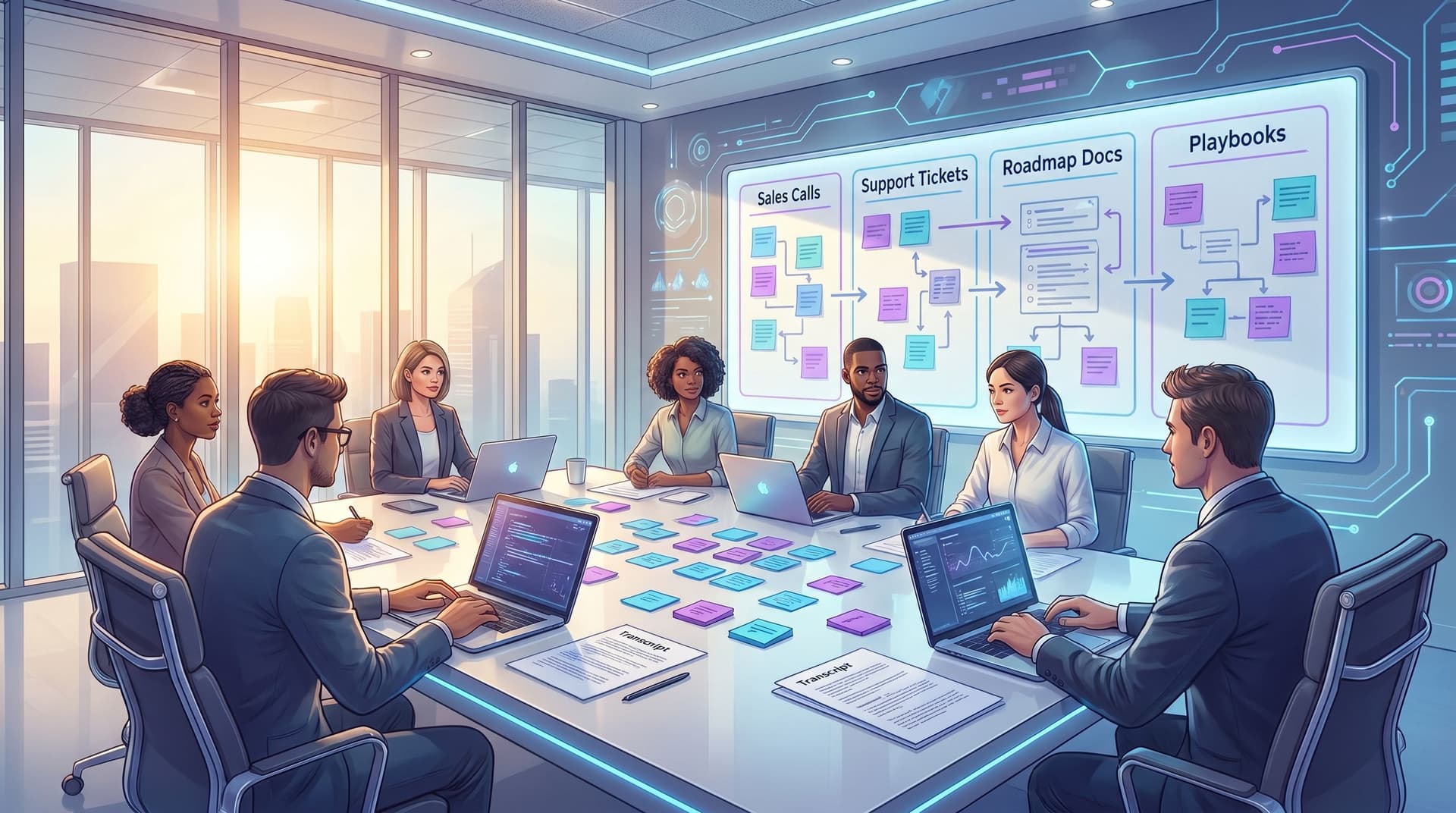
- Source docs (call transcripts, win/loss notes, existing decks)
- Target personas and stages
- Specific internal assets you plan to generate from each post
You’re no longer “just blogging.” You’re running enablement campaigns that happen to produce great SEO content as a side effect.
This pairs nicely with strategies like:
- From ICP Pain Points to ‘Problem Paths’ – use those problem paths as the backbone of both your external series and your internal playbook.
- From Playbook PDFs to ‘Problem Hub’ Posts – reverse the direction: start from internal docs, turn them into public posts, then re-harden them back into structured plays.
Step 8: Measure success beyond traffic
If you want this to stick, you need proof that it’s working.
Alongside classic blog metrics (organic traffic, rankings, conversions), track:
- Ramp time for new reps/CSMs – time from start date to first closed-won or successful onboarding.
- Content-assisted win rate – deals where specific plays/posts were used vs. those where they weren’t.
- Onboarding satisfaction – survey scores from new customers after going through flows informed by these posts.
- Ticket volume on covered topics – for topics where you’ve built both public content and internal training, does support volume drop or resolution time improve?
You can keep this simple—a one-page scorecard, similar to the approach in Metrics That Actually Matter. The goal isn’t to build a BI project; it’s to show that every post now has two jobs: attract buyers and train your team.
Bringing it all together
When you zoom out, the workflow looks like this:
- Plan posts with internal reuse in mind – tie topics to specific sales and success motions.
- Tag posts for internal use – persona, stage, use case, internal asset type.
- Use standard AI prompts to turn each post into:
- A sales play (summary, problems, questions, talk tracks, objections, stories).
- A success module (overview, ICP, checklist, language, pitfalls, quiz).
- Store assets where reps and CSMs already work – enablement tools, CRMs, wikis, LMS.
- Collect feedback from the field and refine prompts and outputs.
- Plan “playbook-first” campaigns so every content initiative ships both external and internal assets.
- Measure impact on ramp time, win rate, onboarding, and support.
With an AI platform like Blogg handling the heavy lifting on ideation, drafting, and scheduling, this becomes a manageable habit—not a side project. You’re simply adding two AI-powered steps after each post ships.
Your next move
You don’t need to rebuild your entire content strategy to start.
Pick one high-performing or strategically important post and:
- Run the “sales play” prompt on it.
- Run the “success training” prompt on it.
- Share both assets with your sales and CS leaders and ask: “If we did this for every key post, would it help?”
If the answer is yes, that’s your signal to bake this into your publishing workflow.
And if you’re not yet running an AI-powered blog engine, this is the perfect moment to try one. With Blogg, every new post you publish is already structured, SEO-ready, and easy for AI to transform into the internal playbooks your revenue teams have been asking for.
Start with one post. Turn it into a play. Then into a training module. From there, you’re only a few repetitions away from a blog that doesn’t just attract buyers—it trains the team that serves them.