From One-Time Visitor to Warm Opportunity: Building a Lightweight Nurture System Around AI Blogg Posts


Most teams have already solved the “publish more” problem.
You’re using AI—or a platform like Blogg—to keep a steady stream of SEO-focused posts going live. Traffic is up. Search impressions look healthy. Your content calendar finally feels under control.
But there’s a quieter, more uncomfortable question underneath all of that:
How many of those new readers ever hear from you again?
For most B2B blogs, the answer is “almost none.” A visitor skims a post, maybe clicks around, then disappears into the ether. No opt-in. No follow-up. No relationship.
This article is about fixing that—without building a heavy, enterprise-grade marketing automation machine.
We’ll walk through how to design a lightweight nurture system around your AI-generated posts so that:
- One-time readers become identifiable subscribers
- Subscribers get context-aware follow-ups that feel helpful, not spammy
- Sales and success teams see a steady trickle of warm opportunities, not just anonymous traffic
And because you’re already using AI (or a platform like Blogg) to publish consistently, you can build most of this system once and let it run with minimal upkeep.
Why Turning Visitors into Warm Opportunities Matters
Before we get tactical, it’s worth grounding the “why.”
Multiple studies over the past few years point to the same pattern: most visitors are not ready to buy on their first visit. Estimates typically land in the 70–80% range for visitors who are still researching, comparing, or just exploring options rather than actively shopping.
That means if your blog only “works” when someone is ready to book a demo on the spot, you’re leaving most of your future pipeline on the table.
A lightweight nurture system changes that by:
- Capturing interest early. When someone shows up with a clear problem (via search, social, or referral), you give them a low-friction way to stay in your orbit.
- Staying present while they research. Instead of hoping they remember your brand weeks later, you show up in their inbox or feed with genuinely useful follow-ups.
- Shortening sales cycles. By the time they talk to sales, they’ve already consumed content that answers basic questions and addresses objections.
- Making your AI content compound. Posts don’t just drive one-off sessions; they become entry points into a longer conversation.
If you’ve read our piece on designing content that actually leads to sales conversations—“Beyond Traffic: How to Design AI-Generated Blog Posts That Trigger Actual Sales Conversations”—this is the natural next step. There, we focused on post-level design. Here, we’re zooming out to the simple system around those posts.
The Core Idea: A “Lightweight” Nurture System
When marketers hear “nurture system,” they often picture:
- 30-email sequences
- Complex lead scoring
- Branching logic diagrams that look like subway maps
You don’t need any of that to turn your AI blog into a reliable source of warm opportunities.
A lightweight nurture system has three characteristics:
- Simple architecture. A small number of entry points, a few reusable sequences, and clear rules for what happens next.
- Content-first, automation-second. The value is in the content, not the complexity of the workflow.
- AI-assisted, human-directed. You use tools like Blogg plus your ESP/CRM to draft, repurpose, and personalize—but humans still set the strategy.
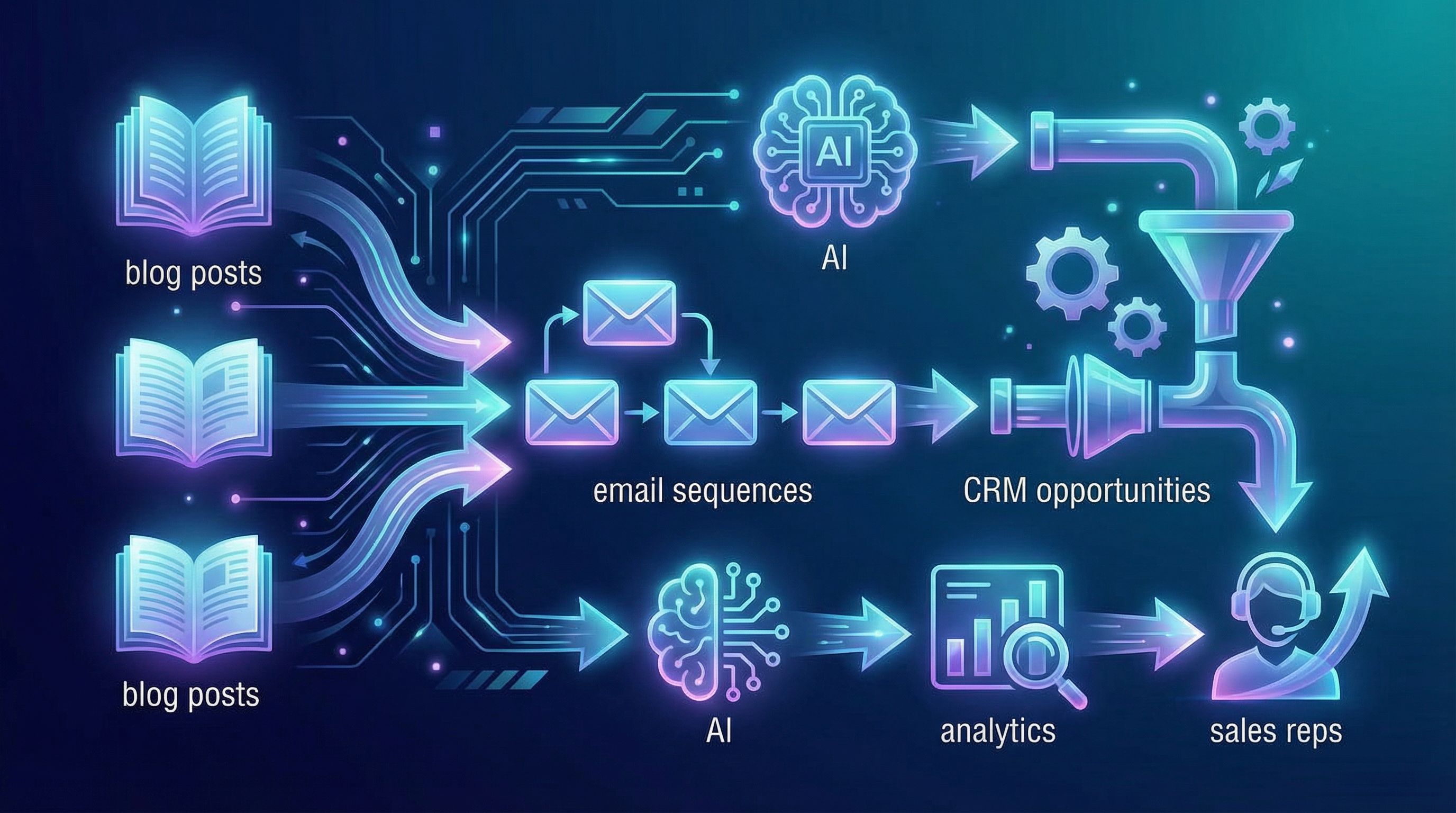
At a high level, here’s what we’re building:
- Intent-aware opt-ins on your AI posts
- A short, focused “orientation” sequence that welcomes new subscribers
- Topic-based micro-nurtures that map to what someone just read
- Lightweight scoring and routing so sales sees the right people at the right time
- A feedback loop that tells you which posts and sequences actually create opportunities
We’ll walk through each of these, with concrete examples and tool suggestions.
Step 1: Turn AI Blog Posts into Intent-Aware Entry Points
If your only opt-in is a generic “Subscribe to our newsletter” box in the footer, you’re missing the biggest lever in this entire system.
Your AI posts—especially if you’re using a structure like the Search Intent Sandwich we break down in “The ‘Search Intent Sandwich’: Structuring AI Blog Posts So Every Section Serves a Buyer Need”—are already aligned to specific problems and stages of the journey.
You want your opt-ins to match that intent.
Add contextual CTAs to each AI post
For each high-traffic or high-intent post generated via Blogg:
-
Identify the primary job-to-be-done.
- "Compare vendors in category X"
- "Understand ROI of solving problem Y"
- "Figure out how to implement workflow Z"
-
Design a small, specific follow-up offer that advances that job. Examples:
- A 2-page checklist
- A short implementation guide
- A teardown or template
- A mini email course (3–5 lessons)
-
Place opt-ins where the reader naturally feels the need.
- Mid-article content upgrades
- End-of-post “keep going” sections
- Slide-ins triggered by scroll depth
Examples of intent-aligned CTAs:
- On a post about “How to evaluate [your category] vendors”: offer a vendor comparison worksheet.
- On a post about “Fixing onboarding churn”: offer a 5-email onboarding sequence template.
- On a post about “Using AI to revive a dormant blog”: offer a 90-day revive plan checklist—and link to “The ‘Dormant Blog’ Revival Plan: Using AI to Turn a Neglected Archive into Fresh SEO Wins” for readers who want a deeper dive.
Use AI to generate the follow-up assets quickly
This is where your existing AI stack (and especially Blogg) shines:
- Start from the AI blog draft.
- Prompt your AI tool to extract:
- Key steps → checklist
- Core arguments → short email sequence
- Examples → swipe file or template pack
If you’re already using a “prompt once, publish everywhere” approach like we outlined in “Prompt Once, Publish Everywhere: Building a Reusable AI Prompt System for Blogg, Email, and Social”, you can extend that system to include nurture assets as additional outputs.

Step 2: Create a Short, High-Value Orientation Sequence
Once someone opts in from a post, don’t drop them straight into a generic newsletter.
Instead, send them through a 3–5 email orientation sequence that:
- Reaffirms the problem they’re trying to solve
- Highlights your best content and resources
- Introduces your product in a low-pressure way
- Sets expectations for future communication
Think of it as the “onboarding flow” for your content.
A simple 4-email orientation template
You can adapt this structure for almost any B2B product or service:
-
Email 1: Welcome + Quick Win
- Subject: “Here’s your [asset] + what to do first”
- Deliver the promised asset.
- Give a 2–3 step action plan they can complete in 10–20 minutes.
- Soft intro to your product: 1–2 sentences about who you help and how.
-
Email 2: Common Mistakes & Myths
- Subject: “3 mistakes we see again and again with [problem]”
- Share 2–3 specific mistakes.
- Link back to 1–2 of your best posts that address these (ideally AI-generated via Blogg).
- Light CTA: “If you’re dealing with this now, here’s how we can help.”
-
Email 3: Story + Social Proof
- Subject: “How [customer] cut [pain] by [result]”
- Tell a short, specific story.
- Emphasize the before/after and the steps they took.
- CTA: link to a relevant case study, demo, or product tour.
-
Email 4: Choose Your Own Adventure
- Subject: “What do you want to improve next?”
- Offer 2–3 links aligned to different intents (e.g., “I’m just researching,” “I’m comparing tools,” “I’m ready to fix this now”).
- Use clicks to segment subscribers into different micro-nurtures.
Use AI to draft these once, then lightly customize them by topic cluster. For example, a “content operations” orientation vs. a “sales enablement” orientation.
Step 3: Build Topic-Based Micro-Nurtures from Your AI Library
This is where your AI-powered blog becomes a nurture engine.
Instead of writing long, bespoke nurture sequences from scratch, you curate and lightly adapt the posts you’re already publishing with Blogg.
Define 3–5 core topics that map to revenue
Look at your:
- CRM opportunities
- Win/loss reasons
- Most common sales questions
Then define a small set of topic clusters that clearly support pipeline. For example:
- “Proving ROI”
- “Implementation & change management”
- “Integrations & technical fit”
- “Use cases by role or vertical”
If you’ve mapped your journey before, this will feel familiar—our article “From Customer Journey Map to Content Map: Using AI to Turn Every Stage of Your Funnel into Blogg Topics” walks through that process in depth.
Turn each topic into a 3–7 touch micro-nurture
For each topic cluster:
- Pick 3–5 of your strongest posts (or schedule Blogg to generate them if they don’t exist yet).
- Assign each post a role in the sequence:
- Email 1: Problem framing + stakes
- Email 2: How-to or framework
- Email 3: Case study or example
- Email 4+: Objections, comparisons, advanced tactics
- Wrap each post in a short email.
- 150–300 words that:
- Tease the core idea
- Add a bit of commentary or context
- Link to the full post
- 150–300 words that:
You can ask your AI assistant to generate these email wrappers by feeding it the post and a short prompt like:
“Summarize this post in 200 conversational words for someone who has this problem: [problem]. End with a soft CTA to read the full post.”
Over time, as Blogg publishes new posts in that cluster, you can add them to the micro-nurture or swap them in for underperformers.
Step 4: Add Just Enough Scoring and Routing
You don’t need a PhD-level lead scoring model. But you do need a simple way to distinguish between:
- Curious browsers
- Engaged learners
- Buyers who are leaning in
A simple scoring model you can set up in an afternoon
Start with a basic point system inside your marketing automation tool or CRM:
- +5 points for each email open
- +10 points for each email click
- +15 points for visiting a high-intent page (pricing, integrations, comparison, demo page)
- +20 points for downloading a high-intent asset (ROI calculator, migration guide)
- +30 points for requesting a demo or trial
Then define 2–3 thresholds:
- 0–24 points: Early-stage researcher
- 25–59 points: Warm prospect
- 60+ points: Sales-ready
Once someone crosses a threshold, trigger a simple action:
- Move them from educational micro-nurtures to more product-focused content
- Notify the account owner or SDR with a short summary of their activity
- Enroll them in a short “is now the right time?” sequence with a clear scheduling CTA
You can even use AI to generate those internal summaries. For example, have your CRM send recent activities to an AI assistant and ask it to produce a 3–4 sentence brief for sales.
Step 5: Close the Loop with Simple Analytics
A nurture system is only as good as your ability to improve it.
You don’t need a dense dashboard; you need a short list of questions you can answer every month:
- Which posts are driving the most opt-ins?
- Which opt-in offers convert readers to subscribers at the highest rate?
- Which micro-nurtures are most likely to produce sales-ready leads?
- Which sequences are underperforming and need a refresh?
In “From Metrics Mess to Clarity: A Simple Analytics Dashboard for Tracking AI Blog Performance”, we break down a minimalist dashboard for AI blogging. You can extend that same philosophy to your nurture system by tracking:
- Opt-in rate per post
- Orientation sequence completion rate
- Micro-nurture click-through and reply rates
- Opportunities created and influenced by each sequence
From there, you can make small, high-impact tweaks:
- Swap weak CTAs on high-traffic posts
- Test alternative subject lines for low-open emails
- Rewrite or replace low-click emails with fresh AI-assisted drafts
Because your underlying content engine (e.g., Blogg) keeps shipping new posts, you always have fresh material to test.
Real-World Tips for Keeping It Lightweight
A nurture system can quietly grow into a monster if you’re not careful. Here are a few guardrails to keep it lean:
-
Cap the number of active sequences. For example, no more than:
- 1 orientation sequence
- 3–5 topic micro-nurtures
- 1 re-engagement sequence for inactive subscribers
-
Reuse patterns, not one-off ideas. Once you have one effective orientation sequence, clone the structure and swap content for other segments.
-
Document your rules in a single page.
- Where can someone enter the system?
- What sequences exist and who they’re for?
- When does sales get notified?
-
Let AI handle the heavy lifting, but keep humans in the loop.
- AI drafts → human edits → AI helps with variations and repurposing.
-
Review once per quarter, not every week.
- Look at metrics.
- Retire what’s clearly not working.
- Plug in your best new posts.
If you’re already using Blogg to maintain a consistent publishing cadence, think of this nurture system as a thin layer on top—not a separate, sprawling project.
Bringing It All Together
Let’s recap the journey from one-time visitor to warm opportunity:
-
AI-generated posts attract the right readers.
- Tools like Blogg keep your blog active with SEO-optimized content aligned to real buyer problems.
-
Intent-aware opt-ins capture interest.
- Contextual CTAs offer small, specific next steps that match the post’s job-to-be-done.
-
A short orientation sequence builds trust.
- New subscribers get quick wins, your best content, and a clear sense of who you help.
-
Topic-based micro-nurtures deepen engagement.
- Existing AI posts become a curated learning path, wrapped in short, thoughtful emails.
-
Simple scoring and routing surface real opportunities.
- Sales sees who’s leaning in, with enough context to start a meaningful conversation.
-
A lightweight analytics loop keeps it improving.
- You track a handful of metrics and adjust CTAs, emails, and sequences over time.
You don’t need a giant marketing ops team or complex funnels to make this work. You just need:
- A consistent AI-powered publishing engine
- A few well-designed opt-in offers
- 3–5 reusable email patterns
- A simple scoring model
Everything else is refinement.
Your Next Step
If your blog is already getting traffic but you’re not sure what happens after someone reads a post, this is your moment to change that.
Here’s a practical first move you can take this week:
- Pick one high-traffic post that’s already performing well.
- Design one intent-specific opt-in that clearly advances the reader’s goal.
- Draft a 3-email orientation sequence using AI to help with the first pass.
- Wire it up in your ESP or marketing tool and set a simple scoring threshold for “warm.”
Once that’s live and working, you can expand to more posts and topics. But even that single flow will start turning anonymous visitors into identifiable, nurtured opportunities.
And if you want the content side to stay on autopilot while you focus on building the nurture layer, explore how Blogg can keep your blog stocked with fresh, SEO-optimized posts that plug directly into this kind of system.
Your traffic is already working hard. A lightweight nurture system makes sure it’s also working smart—quietly turning one-time visitors into the warm opportunities your sales team actually feels.