From ICP to ‘Ideal Content Profile’: Turning Your Best Customers into an AI Blogging Roadmap


Most teams can recite their ICP (ideal customer profile) on command:
“Mid-market B2B SaaS, 50–500 employees, North America, marketing and RevOps buyers…”
That’s helpful for sales targeting. But when you sit down to plan content—especially with AI—it’s not enough.
AI doesn’t need firmographics. It needs specific stories, problems, objections, and phrases from real customers.
That’s where an Ideal Content Profile (ICP 2.0) comes in.
Instead of stopping at “who we sell to,” you go deeper into who your best customers are, what they struggle with, what they say, and how they buy—then turn that into a concrete roadmap for your AI blog.
In this post, we’ll walk through how to:
- Translate your existing ICP into an Ideal Content Profile
- Use real customer data to define what your blog should talk about (and what it shouldn’t)
- Turn that profile into an AI-ready content system using tools like Blogg
- Keep the system updated as your product and market evolve
Why Your ICP Isn’t Enough for an AI-First Blog
Traditional ICPs are great at answering:
- Who should we sell to?
- Which accounts should sales prioritize?
- Where should we focus outbound and paid?
But they’re terrible at answering questions like:
- What topics do our best customers obsess over?
- Which problems actually trigger a buying journey?
- What language do they use to describe those problems?
- What objections stop them from booking a demo?
- What moments in their journey create confusion or delight?
Those are content questions, not targeting questions.
If you feed a generic ICP into an AI writer, you’ll get generic content:
- “5 Benefits of X Software”
- “The Ultimate Guide to Y in 2026”
- “Top 10 Best Practices for Z”
It might rank for low-intent keywords. It rarely drives qualified traffic, pipeline, or retention.
An Ideal Content Profile flips the script:
Instead of asking, “Who is our ideal customer?” you ask, “What does our ideal customer need to read, in what order, to move from unaware → champion?”
When you answer that in detail, AI becomes far more powerful. Platforms like Blogg can stop guessing and start executing against a clear, customer-backed map.
If you want a deeper dive on feeding AI with real buyer language, check out our post on using conversation tools as a content engine: Beyond Keywords: Using Conversation Intelligence Tools to Feed an Always‑On AI Blog Strategy.
Step 1: Start with Your “Best Customer” Snapshot
Before you define an Ideal Content Profile, you need to know whose content needs you’re optimizing for.
Not every customer should shape your content strategy. You want the ones who are:
- Profitable (healthy LTV, not support drains)
- Happy (strong NPS/CSAT, reference‑ready)
- Aligned (using your product the way you intend, in your target use cases)
- Influential (internal champions, active in communities, or strong logos)
Build a short list of 10–20 “model” customers
Pull a quick report from your CRM and billing tools:
- Filter for high LTV / low churn risk accounts.
- Layer in NPS/CSAT or CSM sentiment.
- Add a flag for ideal fit (your sales or CS team’s gut check).
- Pick 10–20 accounts that consistently show up near the top.
For each, jot down:
- Company name and segment
- Primary buyer persona (e.g., “VP RevOps,” “Head of Customer Support”)
- Core use case(s)
- Key reasons they bought
- What “success” looks like for them
This is your Best Customer Set. Your Ideal Content Profile will be built from their reality—not a persona template in a slide deck.
Step 2: Mine Real Conversations for Content Signals
Your Ideal Content Profile should be grounded in actual words from actual customers.
You don’t need a research team to do this. You can get surprisingly far with:
- Call recordings (sales, onboarding, QBRs)
- Support tickets and live chat logs
- Product feedback boards
- Customer Slack or community messages
If you’re already using conversation intelligence tools, we walk through a full workflow in From Feature Requests to Search Traffic: Mining Product Board and Support Tickets for AI-Ready Blog Topics.
What to look for
As you skim these sources, capture:
- Problem statements
- “We’re spending 10+ hours a week trying to…”
- “Our current process breaks when…”
- Objections and fears
- “We’re worried this will take months to implement.”
- “How do we know this won’t create more work for our team?”
- Trigger events
- “We started looking for a tool after our CFO asked…”
- “We lost a big customer because…”
- Success language
- “If you can help us cut this by 30%…”
- “My dream is to never have to manually do X again.”
Put these into a simple spreadsheet or doc. You’re not writing posts yet—you’re building a content vocabulary directly from your best customers.
Step 3: Define Your “Ideal Content Profile” Attributes
Now you’re ready to turn raw customer insights into a structured Ideal Content Profile.
Think of this as a creative brief for your entire blog, not just a single article.
Your profile should cover at least five dimensions:
1. Core problems to prioritize
List 5–10 high‑stakes problems your best customers care about, phrased in their words.
For each, note:
- Impact (e.g., “Costs us ~$50k/year,” “Blocks new revenue,” “Causes churn”)
- Stage (Awareness, Consideration, Decision, Onboarding, Expansion)
- Who cares most (persona)
This becomes your topic hierarchy. If a content idea doesn’t map to one of these, it’s probably a distraction.
2. Buying triggers and milestones
Document the moments that push your best customers to act:
- “New VP joined and wants reporting in 90 days.”
- “Audit or compliance review exposed gaps.”
- “Board asked for a plan to cut costs by X%.”
Each trigger can inspire:
- Problem‑framing posts (“How to Survive Your First 90 Days as a New VP of X”)
- Comparison content (“In‑House vs. Tooling: What Actually Saves Money?”)
- Playbooks (“A 30‑60‑90 Day Plan for Fixing Y Before Your Next Board Meeting”)
3. Objections and anxieties
List the most common fears your best customers had before buying:
- “Will this integrate with our existing tools?”
- “How much time will my team actually spend on this?”
- “What if we don’t have clean data/processes yet?”
These become:
- FAQ‑style posts
- “Myth vs. Reality” breakdowns
- Case studies framed around specific fears
4. Desired outcomes and success metrics
For each best customer, answer:
- What did success look like 3–6 months after go‑live?
- How did they measure it?
Turn those into:
- “From X to Y” transformation stories
- Metric‑driven posts (“How One Team Cut Time on Z by 43% Without Hiring”)
- Expansion content (helping existing customers unlock the next win)
We cover this “journey‑wide” approach more deeply in From Customer Journey Map to Content Map: Using AI to Turn Every Stage of Your Funnel into Blogg Topics.
5. Voice, tone, and vocabulary
Finally, capture how your best customers talk:
- Are they formal or informal?
- Do they use technical jargon or plain language?
- Which phrases show up over and over?
This is gold for AI prompts. You can literally say:
“Write in the voice of a helpful peer to a VP of RevOps who says things like ‘messy Salesforce instance,’ ‘rev ops debt,’ and ‘board-ready reporting.’”
Put all of this into a single, shareable doc: your Ideal Content Profile.

Step 4: Turn the Profile into an AI Blogging Roadmap
An Ideal Content Profile is only useful if it drives consistent publishing.
Here’s how to turn it into a roadmap your AI tools—and your team—can actually follow.
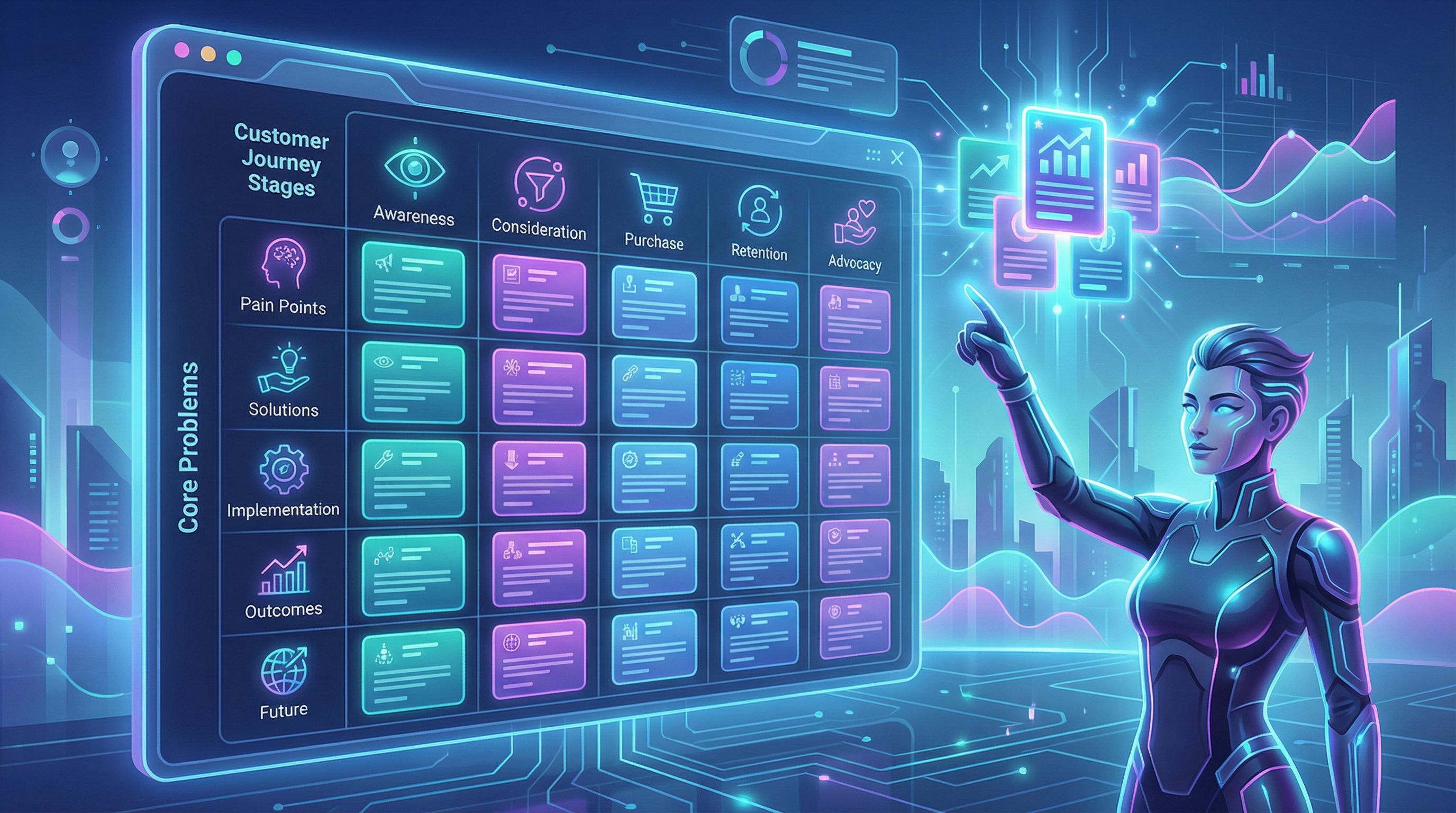
Build a simple content matrix
Create a table with:
- Rows: Core problems from your profile
- Columns: Journey stages (Awareness, Consideration, Decision, Onboarding, Expansion)
Then, for each cell, brainstorm:
- 1–2 post ideas
- Primary search intent (informational, comparison, transactional, etc.)
- Key customer quotes or phrases to include
You’ll quickly see gaps:
- Maybe you have lots of Awareness content but no Decision‑stage posts.
- Or you’re heavy on feature explainers but light on ROI stories.
That’s your roadmap.
Turn each cell into an AI‑ready brief
Before you ask AI to write, turn each idea into a tight brief that includes:
- Target persona
- Stage of journey
- Core problem (from your profile)
- Desired outcome for the reader
- 2–3 real customer quotes or paraphrased statements
- Internal links you want to include
If you want a deeper system for this, we break it down in The ‘No Brief, No Blog’ Rule: Using AI to Turn Loose Ideas into Clear, SEO-Ready Content Briefs.
Let Blogg handle the heavy lifting
This is where a platform like Blogg shines:
- You feed in your Ideal Content Profile (problems, objections, language, examples).
- You queue up briefs mapped to your content matrix.
- Blogg handles ideation, drafting, and scheduling, so every week you’re publishing posts that:
- Speak directly to your best customers
- Cover every stage of their journey
- Stay aligned with your search and revenue goals
Instead of asking “What should we post this week?” you’re asking, “Which high‑impact cell in our matrix should we fill next?”
Step 5: Connect Content Back to Pipeline and Product
An Ideal Content Profile isn’t a one‑time artifact. It’s a living system that should evolve as:
- Your product changes
- Your market matures
- Your best customers shift
To keep it honest, connect it to real performance data.
Track which posts attract and convert your “best customers”
Use your analytics and CRM to answer:
- Which posts do our top accounts actually read before they talk to sales?
- Which URLs show up most often in closed‑won journeys?
- Which posts correlate with higher ACV or faster sales cycles?
You don’t need a perfect attribution model. Even directional signals are enough to:
- Promote winning posts harder
- Create follow‑ups and sequels
- Retire or refresh content that never shows up in successful journeys
For a simple measurement framework, see From Metrics Mess to Clarity: A Simple Analytics Dashboard for Tracking AI Blog Performance.
Feed learnings back into your Ideal Content Profile
Every quarter, review:
- New objections that surfaced in calls
- New features or use cases that are driving deals
- New success stories from your best customers
Update your profile with:
- New problems or triggers
- Updated success metrics
- Fresh language your buyers are using
Then:
- Add new rows/columns to your content matrix
- Create fresh briefs
- Let Blogg generate and schedule the next wave of posts
Your blog becomes a continuous feedback loop between:
- Customer reality
- AI‑generated content
- Measurable revenue outcomes
Step 6: Use Your Ideal Content Profile Beyond the Blog
Once you’ve done the work to define an Ideal Content Profile, don’t stop at blog posts.
The same structure can power:
- Email sequences
- Awareness posts → nurture emails for new subscribers
- Decision posts → pre‑demo sequences for high‑intent leads
- Sales enablement
- Objection‑focused posts → assets reps send after specific questions
- ROI stories → follow‑ups after pricing calls
- Support and onboarding
- Onboarding posts → pre‑empt “how do I…” tickets
- Expansion posts → help CSMs drive adoption of underused features
If you’re already using AI to repurpose content, your Ideal Content Profile becomes the source of truth for what gets repurposed and why.
Platforms like Blogg make this easier by giving you a central place to:
- Store your content pillars and briefs
- Generate blog posts optimized for search
- Spin out variations for email and social using the same underlying logic
For a deeper dive into repurposing workflows, see Prompt Once, Publish Everywhere: Building a Reusable AI Prompt System for Blogg, Email, and Social.
Bringing It All Together
Let’s recap the shift from ICP to Ideal Content Profile:
- ICP tells you who to target.
- Ideal Content Profile tells you what those people need to read—and in what order—to become successful, long‑term customers.
To build it, you:
- Identify your best customers based on fit, profitability, and satisfaction.
- Mine real conversations for problems, triggers, objections, and success language.
- Define profile attributes: core problems, triggers, objections, outcomes, and vocabulary.
- Map those attributes into a content matrix across the customer journey.
- Turn each cell into AI‑ready briefs and let a platform like Blogg handle ideation, drafting, and scheduling.
- Close the loop with analytics, updating your profile as you learn what actually drives pipeline and retention.
- Extend the system beyond the blog, into email, sales, and success.
Do this, and your AI blogging stops being “more content for the sake of content.” It becomes a structured, always‑on system that:
- Speaks your buyers’ language
- Answers their real questions
- Shows up at the right moments in their journey
- Quietly moves the right readers toward real revenue
Your Next Step
You don’t need a six‑month project plan to start.
This week, you can:
- Pick 10–20 of your best customers.
- Review 3–5 recent calls or tickets from each.
- Write a one‑page Ideal Content Profile draft with:
- Top 5 problems
- Top 5 objections
- 3–5 trigger events
- 3–5 success outcomes
- Turn just one row of that profile into a simple content matrix.
- Use Blogg or your AI tool of choice to draft 2–3 posts from that matrix.
Once you see how much more specific, relevant, and buyer‑aligned those posts feel, you’ll never want to go back to generic ICP‑only content planning.
Your best customers have already written the outline for your blog. An Ideal Content Profile—and an AI engine like Blogg—is how you finally publish it.