The ‘Always-On’ Launch: Using Blogg to Drip Out Strategic Posts Before, During, and After Every Campaign


Launches are rarely failing because of the offer.
They’re failing because attention is treated like a one‑day event.
You ship a new feature, promo, or product. Marketing rallies around a single week: announcement email, landing page, social push, maybe a webinar. Then the calendar flips, everyone moves on, and your “big launch” becomes just another line in the changelog.
Meanwhile, prospects are still:
- Searching for the problem your launch solves
- Comparing alternatives
- Asking questions in sales calls
- Wondering if now is the right time to switch
An always‑on launch fixes that.
Instead of a one‑and‑done blast, you design a drip of strategic blog posts that go live before, during, and long after launch week. And instead of trying to manually orchestrate that content, you let an AI platform like Blogg handle the heavy lifting—ideation, drafting, and scheduling—so your team can stay focused on the campaign itself.
This post walks through how to build that always‑on launch system step by step.
Why launches need an “always‑on” content engine
Most launch plans have two problems:
-
They’re too announcement‑heavy.
- One hero blog post.
- One press‑style announcement.
- Maybe a recap.
-
They’re too short‑lived.
- Content spikes for a week.
- Search visibility never really develops.
- Six months later, almost nothing on your blog speaks to that launch.
But launches aren’t one‑week events. They’re multi‑month buying journeys wrapped around a moment in your roadmap. Your blog is the perfect place to support that journey—if it’s treated as a campaign asset, not a side project.
When you attach an always‑on blog plan to every launch, you:
- Warm the market before launch with problem‑aware and solution‑aware posts.
- Capture peak interest during launch with comparisons, deep dives, and FAQs.
- Turn the launch into evergreen SEO afterward with how‑to content, use cases, and outcomes.
If you’ve read our post on The ‘Evergreen Launch’ Strategy: Pairing Every New Feature or Offer with an AI-Powered Mini Blog Campaign, this is the next level up: not just one mini‑campaign per feature, but a reusable, AI‑powered playbook for every launch you run.
What an “always‑on launch” looks like in practice
Let’s make this concrete.
Imagine you’re launching a new analytics feature in your SaaS product.
Instead of:
- One announcement post on launch day
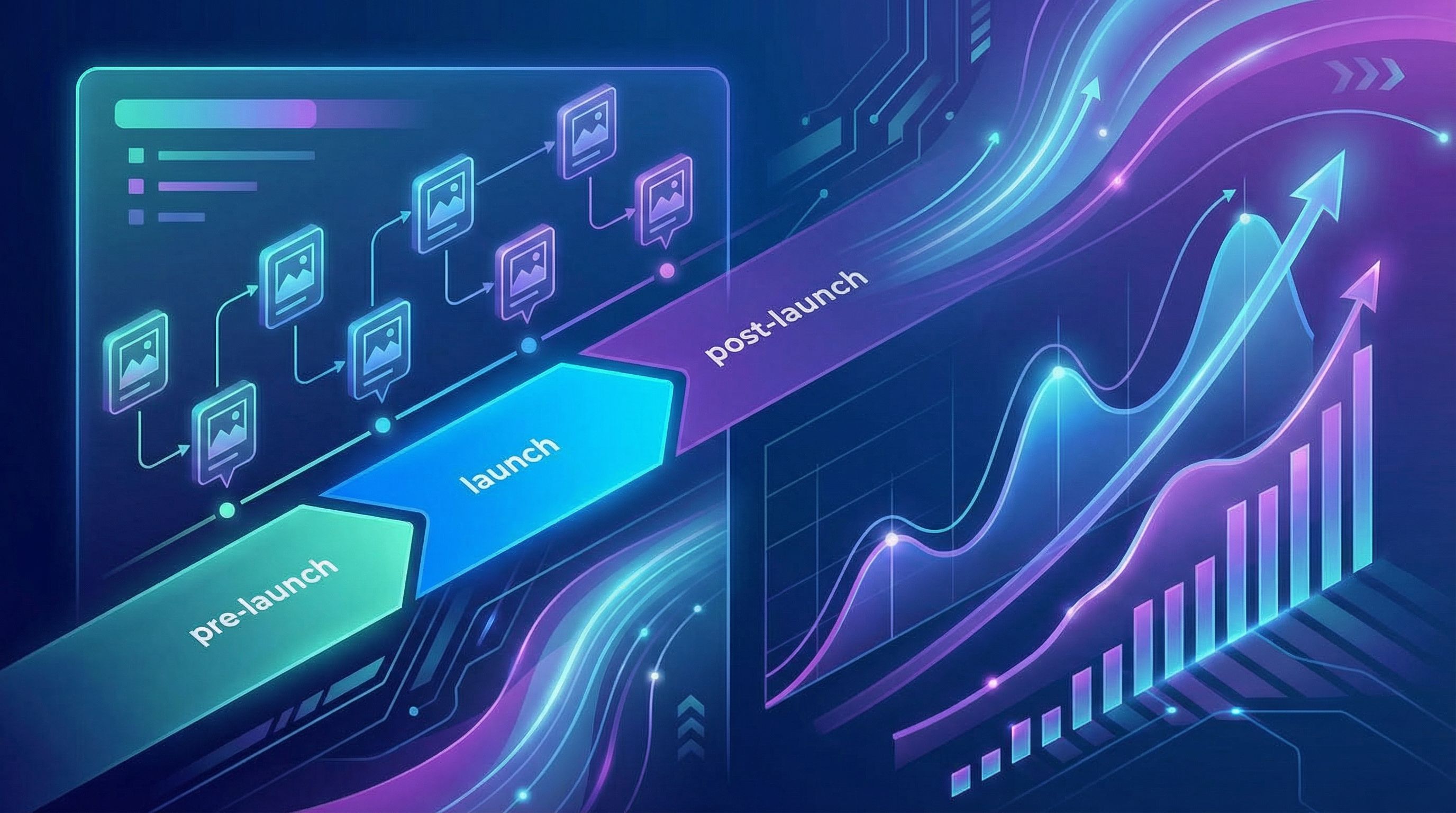
You ship a sequence of 10–20 posts across three phases:
Phase 1: Pre‑launch (2–6 weeks before)
Goal: Warm up demand and set the narrative before you ever say “we’re launching X.”
Types of posts:
- Problem explainers ("Why attribution is still broken for B2B SaaS")
- Stakes and consequences ("The hidden cost of flying blind on marketing ROI")
- Current workaround critiques ("Why spreadsheet reporting falls apart at scale")
- Early thought leadership ("What ‘good enough’ analytics will look like in 2026")
These posts rarely mention the feature by name. They’re about:
- The pain your launch solves
- The patterns you see in your best customers
- The worldview shift you want your market to adopt
Phase 2: Launch window (launch week + 1–2 weeks)
Goal: Capture and direct peak attention.
Types of posts:
- Announcement & story ("Why we built X and what it unlocks for you")
- Deep‑dive walkthroughs ("How to set up your first dashboard in under 10 minutes")
- Comparisons ("X vs. manual spreadsheets: what actually changes")
- Pricing & packaging explainers
- Objection‑handling content ("Do you really need another analytics tool?")
This is where your blog works hand‑in‑hand with your sales and success teams. If you’ve explored Pricing, Comparisons, and ‘Best Of’ Posts: Using AI to Tackle Bottom-of-Funnel Blog Content Without Going Off-Brand, you already know how powerful these BOFU posts can be during a launch.
Phase 3: Post‑launch (3–12+ months after)
Goal: Turn the launch into a long‑term growth asset.
Types of posts:
- Use‑case spotlights by role or industry
- “How we use it ourselves” posts
- Customer stories and mini case studies
- Integration guides ("Using X with HubSpot / Salesforce / Notion")
- Optimization tips ("Advanced workflows power users love")
This is where your launch stops being a moment and becomes evergreen traffic and pipeline.
The catch: doing this manually for every launch is exhausting.
That’s where Blogg comes in.

How Blogg turns launches into repeatable content systems
Most teams don’t lack ideas; they lack capacity and consistency.
Blogg is built to solve exactly that: you set topics, guardrails, and timing, and it handles ideation, drafting, and publishing. For launches, that means you can:
- Design a reusable launch content template once
- Feed it high‑level inputs for each new campaign
- Let Blogg drip out posts automatically around your timeline
Here’s how to set that up.
1. Start with a launch brief, not a keyword list
Before you open any tool, clarify four things:
- Who is this launch really for?
- Segment, role, industry, stage of awareness.
- What pain are you solving?
- In their words, not your feature language.
- What behavior change do you want?
- Start a trial? Switch tools? Use an under‑adopted feature?
- What’s your main narrative?
- The story you want every piece of content to reinforce.
You can keep this in a simple doc or a campaign brief. This becomes the source of truth you’ll feed into Blogg.
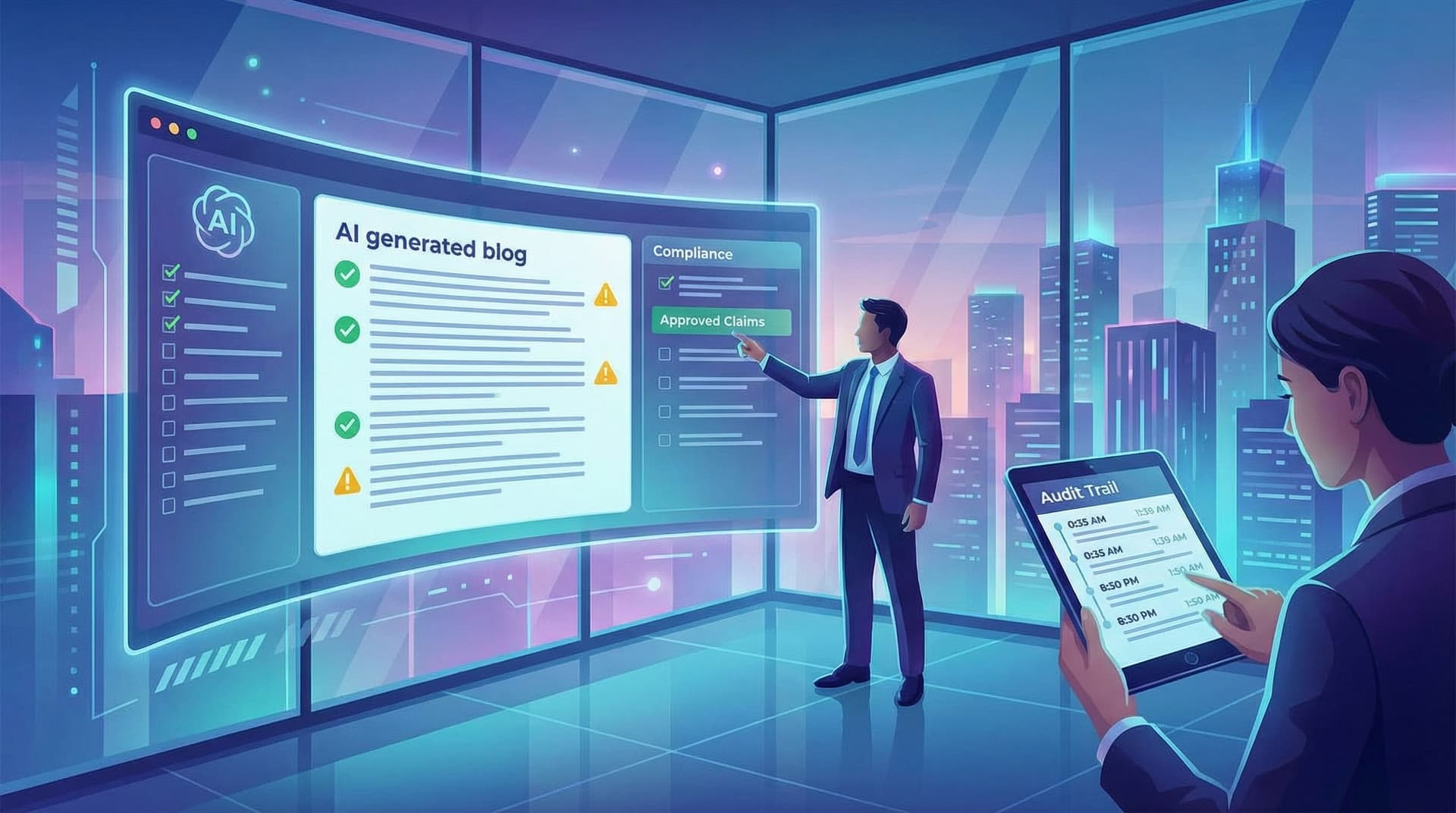
If you’re in a regulated space, this is also where you define what can’t be said—claims, wording, or topics that need extra care. Our post on AI Blogging in Regulated Industries: Guardrails for Compliance-Ready Content at Scale goes deeper on how to encode those rules into your AI workflows.
2. Map your pre‑, during‑, and post‑launch content lanes
Think in lanes, not individual posts. For example:
- Pre‑launch lanes
- Pain & stakes
- Status‑quo critique
- Future‑state vision
- Launch‑week lanes
- Announcement & story
- How‑it‑works deep dives
- Objection handling & comparisons
- Post‑launch lanes
- Use cases & role‑based workflows
- Integrations & stack fit
- Customer stories & outcomes
For each lane, define:
- 2–4 core angles
- Who the post is for
- The primary CTA (demo, trial, signup, etc.)
You now have a launch content matrix—a grid that can easily turn into 10–20 posts.
3. Turn the matrix into a reusable template inside Blogg
Inside Blogg, you can treat each lane as a topic cluster and each angle as a prompt pattern.
For example, for a “Pain & stakes” pre‑launch lane, you might standardize prompts like:
- "Explain the hidden costs of [pain] for [role] in [industry], using real‑world scenarios and metrics they care about."
- "Write a narrative post from the POV of a [role] who struggles with [pain], leading into why they start looking for a better way."
For a “Use cases & workflows” post‑launch lane:
- "Create a step‑by‑step guide to how a [role] in [industry] can use [feature] to achieve [outcome] in under 30 days, including common pitfalls."
Save these as reusable instructions or templates in Blogg. Next launch, you just swap in the new:
- Audience
- Pain
- Feature
- Outcomes
…and the system can generate a fresh campaign.
Building the actual drip schedule
Once your lanes and templates are in place, you can design the calendar.
Step 1: Anchor on the launch date
Start with your target launch date and work backward/forward:
- Pre‑launch content: 2–6 weeks before
- Launch‑week content: launch day ± 7–10 days
- Post‑launch content: 3–12+ months after
Step 2: Choose your publishing cadence
For many teams, a simple cadence works well:
- Pre‑launch: 2 posts/week
- Launch window: 3–4 posts/week (shorter, focused pieces are fine)
- Post‑launch: 1–2 posts/week for 8–12 weeks, then 1/month for evergreen upkeep
The goal isn’t volume for its own sake; it’s steady, compounding coverage across your lanes.
Step 3: Assign lanes to time windows
A sample schedule might look like:
- T‑6 weeks to T‑3 weeks
- Pain & stakes posts
- Status‑quo critique
- T‑3 weeks to T‑1 week
- Future‑state vision
- Early “coming soon” narratives
- Launch week
- Announcement
- Deep‑dive walkthrough
- Objection‑handling post
- Comparison or pricing explainer
- Weeks 1–4 after launch
- Role‑based use cases
- Integration guides
- Months 2–6 after launch
- Customer stories
- Advanced workflows
- “How we use it internally” posts
In Blogg, you can:
- Add each post idea to the queue
- Attach it to the right lane/template
- Set the publish date
Then, instead of manually hustling to hit every deadline, you’re reviewing and refining drafts on a predictable schedule.
Making sure every launch post actually supports revenue
An always‑on launch isn’t just about shipping more content. It’s about shipping content that:
- Matches real search intent
- Aligns with sales conversations
- Leads naturally to next steps
Here are three levers to get that right.
1. Ground topics in sales and CRM data
Your best launch content ideas are often already written—in your CRM and call notes.
- Common objections to the new feature
- Confusions about pricing or packaging
- Industries where the feature lands especially well
Our post Your CRM as a Content Goldmine: Mining Deal Notes, Lost Reasons, and Win Stories for AI-Ready Blog Topics breaks down how to systematically convert those insights into blog topics. With Blogg, you can feed those patterns into your prompts so every launch post feels eerily aligned with what prospects are already asking.
2. Design CTAs that fit each phase
Not every launch‑related post should push the same CTA.
- Pre‑launch
- Light asks: join the waitlist, subscribe for launch updates, download a related resource.
- Launch week
- Primary asks: start a trial, book a demo, attend a live session.
- Post‑launch
- Contextual asks: try a specific workflow, explore a use‑case library, read a customer story.
Use Blogg to standardize CTA patterns per lane (e.g., “For pre‑launch pain posts, close with X type of CTA”). That way, your AI‑generated drafts don’t just inform—they move readers to the next logical step.
3. Wire content to your analytics and pipeline
An always‑on launch becomes truly powerful when you can answer:
“Which posts from the last three launches are actually driving pipeline?”
If you haven’t yet, read From Blogg Queue to Sales Queue: Connecting Your AI Content Calendar Directly to Pipeline Targets. It shows how to:
- Tag posts by launch, lane, and intent
- Track which URLs show up in opp creation and closed‑won deals
- Use that feedback to refine your next launch content matrix
Pair that with a simple blog analytics view (see From Metrics Mess to Clarity: A Simple Analytics Dashboard for Tracking AI Blog Performance) and you’ve got a loop: every launch makes your content system smarter.
Guardrails to avoid “AI launch spam”
There’s a real risk when you turn on an always‑on AI content engine: bland, repetitive posts that annoy your audience.
You can avoid that by putting a few guardrails around your use of Blogg:
-
Every lane needs a distinct angle.
Don’t let pre‑launch and post‑launch posts say the same thing in slightly different words. Define what belongs where. -
Opinion is not optional.
Bake your point of view into your templates. If you haven’t yet, study our guidance in The Opinionated AI Blog: How to Use Prompts, Examples, and Guardrails to Avoid Generic, Forgettable Posts and apply it to your launch prompts. -
Human review on the highest‑leverage posts.
Let AI handle more of the mid‑funnel and long‑tail pieces. Have humans heavily edit (or co‑write) the:- Main announcement
- Pricing and comparison content
- First flagship use‑case posts
-
Refresh instead of reinventing.
For recurring launches (annual promos, seasonal campaigns), use Blogg to refresh and adapt last year’s best performers instead of starting from zero. Our post on How Often Should You Refresh AI-Generated Posts? A Data-Backed Playbook for Content Updates in 2025 offers a simple framework for this.
Putting it all together: a simple implementation checklist
If you want to pilot an always‑on launch system with Blogg, here’s a straightforward path:
-
Pick one upcoming launch.
Don’t try to retrofit five old ones at once. Start with the next feature, offer, or campaign on your roadmap. -
Write a one‑page launch brief.
Capture audience, pain, behavior change, and narrative. -
Define your three phases and lanes.
- Pre‑launch: 2–3 lanes
- Launch week: 2–3 lanes
- Post‑launch: 3–4 lanes
-
Create prompt templates in Blogg.
For each lane, define 2–3 reusable prompt patterns. -
Draft a 12–16 post matrix.
Map each lane + phase combo to a specific post idea. -
Schedule the drip.
Anchor to your launch date and assign publish dates across 8–12 weeks. -
Wire in CTAs and tracking.
Decide the primary CTA per lane and ensure UTM/tagging is set up. -
Run the campaign—and review monthly.
Look at which posts:- Drove the most qualified traffic
- Showed up in opp creation
- Got referenced in sales calls
-
Turn learnings into a template.
Update your Blogg templates and calendar structure so the next launch starts from a stronger base.
Summary
An “always‑on launch” is the opposite of a one‑week spike.
By pairing your campaigns with a structured, AI‑powered blog sequence before, during, and after launch, you:
- Warm up demand with problem‑ and vision‑driven content
- Capture peak attention with deep dives, comparisons, and FAQs
- Turn launches into evergreen SEO and sales assets that keep working long after the campaign ends
Blogg makes this sustainable. Instead of hand‑crafting every post on a tight deadline, you:
- Define lanes and prompts once
- Feed in your launch brief
- Let the platform ideate, draft, and schedule a drip of posts
- Spend your time editing, aligning with sales, and measuring impact
Do that for every launch, and your blog stops being an afterthought. It becomes the always‑on engine that turns roadmap moments into revenue.
Your next step
You don’t need a massive content team to run always‑on launches. You just need a system—and a tool that can execute it reliably.
Here’s a simple way to start this week:
- Identify one upcoming or recent launch that deserves more than a single announcement.
- Draft a one‑page brief and a rough pre/during/post content matrix.
- Set up a pilot campaign in Blogg: 12 posts over 6–8 weeks, using the lanes and prompts outlined above.
Once you’ve seen what a single always‑on launch can do for traffic, signups, and sales conversations, you’ll never go back to one‑and‑done announcements.
Open your calendar, pick that launch, and turn it into the first campaign your blog keeps amplifying long after the confetti is gone.