Your CRM as a Content Goldmine: Mining Deal Notes, Lost Reasons, and Win Stories for AI-Ready Blog Topics


Most teams plan their blog in a spreadsheet.
They export a keyword list from an SEO tool, sort by volume, and start filling in a calendar.
Meanwhile, the most valuable content ideas are already written — inside your CRM.
- Deal notes from messy sales calls
- “Closed–lost” reasons that keep repeating
- Win stories where a customer finally said, “This is why we chose you”
Those fields aren’t just for reporting. They are raw, high-intent, buyer-language fuel for your blog — especially if you’re using AI or a platform like Blogg to publish consistently.
In this article, we’ll walk through how to turn your CRM into a repeatable source of AI-ready blog topics that:
- Match what real buyers are thinking about before they buy
- Support sales conversations directly
- Feed a consistent, SEO-friendly publishing engine without guesswork
Why Your CRM Belongs in Your Content Strategy
Your CRM is the closest thing you have to a transcript of how people actually buy.
Unlike keyword tools, which show what people type into Google, your CRM shows:
- The objections that actually kill deals
- The questions that come up right before someone signs
- The patterns behind who buys, who stalls, and who walks away
When you mine that data for content ideas, three big benefits show up quickly:
1. Every post is tied to revenue, not just traffic
If a theme shows up across dozens of deals — for example, “implementation risk” or “migrating from Tool X” — you know a post on that topic won’t just bring visitors. It will help sales close deals.
2. You get buyer language for free
Blog posts perform better when they mirror how buyers actually talk. Your CRM is full of phrases prospects use in calls, emails, and forms. Those phrases become:
- H2s and H3s in your posts
- Long-tail keywords that convert
- Copy for CTAs and internal links
3. AI becomes sharper, not just faster
If you’re using AI — or an automated platform like Blogg — the hardest part isn’t generating words. It’s feeding the system the right inputs. CRM-derived prompts give AI:
- Specific scenarios to write about
- Real objections to address
- Concrete outcomes to highlight
That’s how you avoid generic AI content and move toward what we call the opinionated AI blog — something we dig into more in The Opinionated AI Blog: How to Use Prompts, Examples, and Guardrails to Avoid Generic, Forgettable Posts.

Step 1: Decide Which CRM Fields Actually Matter for Content
You don’t need to mine every field. Focus on the ones that capture why deals move — forward or backward.
Look for fields like:
- Deal Stage / Pipeline Stage
- Where do deals stall most often?
- Where do they accelerate?
- Closed–Lost Reason
- Pricing
- Missing feature
- Security / compliance concerns
- “Sticking with current solution”
- Closed–Won Notes
- Why did they choose you over alternatives?
- What problem felt most urgent?
- Primary Use Case / Job-to-be-Done
- How do customers describe the job they hired you for?
- Industry / Segment / Company Size
- Which combinations show the healthiest win rates?
- Key Stakeholders / Roles
- Who championed the deal? Who blocked it?
If these fields are messy or sparsely filled, that’s not a blocker — it’s a signal. You might need a quick alignment with sales to tighten CRM hygiene so your content engine has better inputs.
Quick win: Create a simple internal doc called “Content-Relevant CRM Fields” and share it with sales and RevOps. Highlight 5–7 fields you’ll regularly mine for topics. That clarity alone makes future content workflows smoother.
Step 2: Pull a “Content Snapshot” from Your CRM
You don’t need a full data warehouse to start. A simple export is enough for a powerful first pass.
Ask RevOps or your CRM admin for a CSV of deals from the last 6–12 months with columns like:
- Deal name
- Deal size
- Stage
- Closed date
- Closed–won / closed–lost
- Closed–lost reason
- Win reason (if tracked)
- Primary use case
- Industry / segment
- Owner
- Deal notes or call summary field
Once exported, you can:
- Open it in Google Sheets or Excel
- Use simple filters and pivot tables
- Highlight recurring phrases and themes
If you’re using call recording tools like Gong or Chorus, layer in:
- Call summaries
- Snippets of quotes
- Common topics detected by their AI
The goal isn’t perfect analytics. It’s to get a human-readable snapshot of what actually happens in deals.
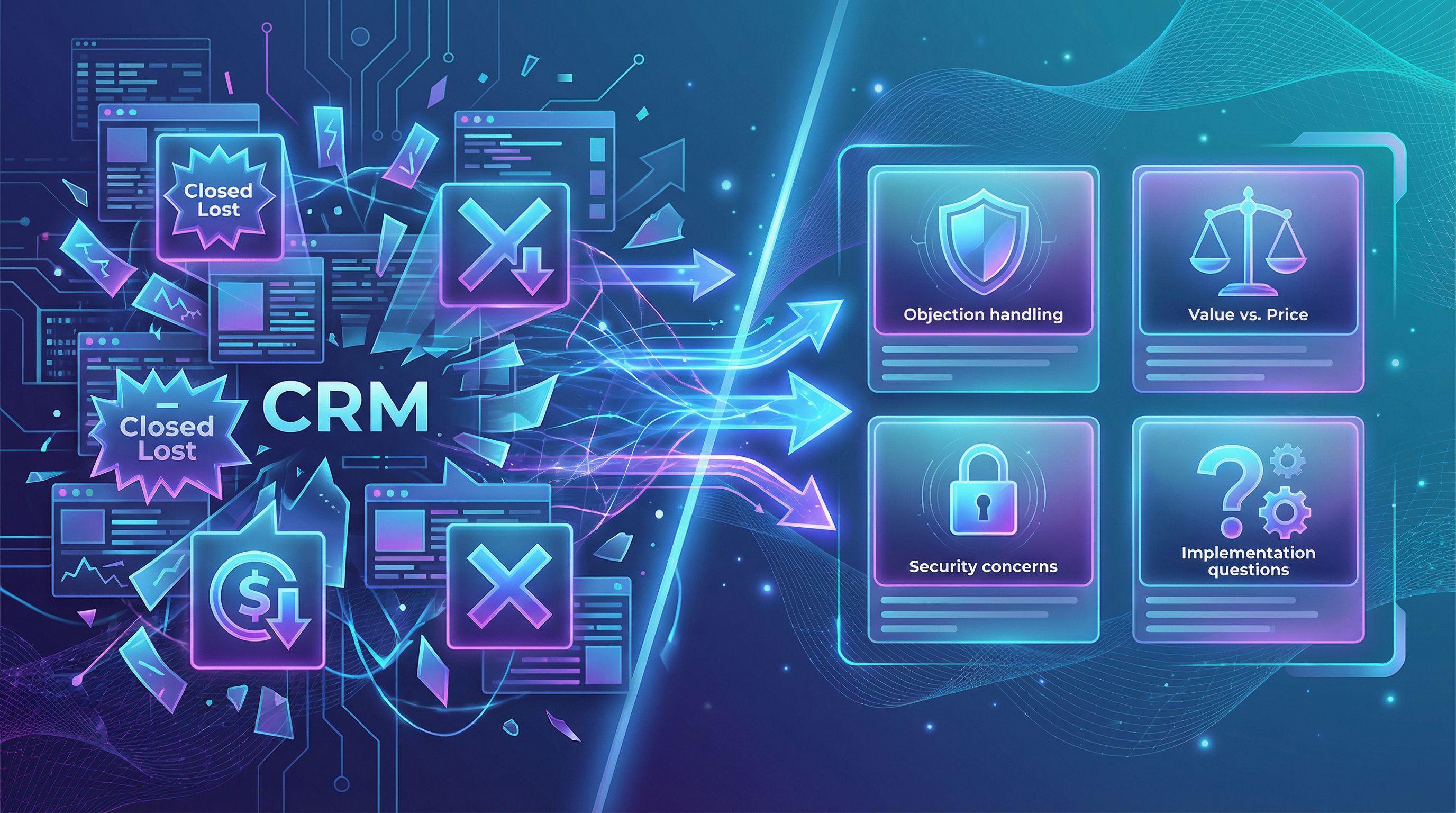
Step 3: Turn Lost Reasons into “Objection-Slaying” Content
Your “closed–lost reason” field is one of the highest-ROI inputs for blog topics.
Identify your top 3–5 lost reasons
Use a pivot table or simple count to see which reasons show up the most. Typical patterns:
- “Too expensive / went with cheaper option”
- “Missing feature X”
- “Not the right time / no urgency”
- “Sticking with current vendor / in-house solution”
Each of these can become a content cluster, not just a single post.
Example: “Too expensive”
Potential posts:
- “Is [Category] Software Really More Expensive Than Doing It In-House? A 3-Year Cost Breakdown”
- “How to Evaluate ROI on [Category] Tools Without Getting Lost in Feature Lists”
- “What Our Most Cost-Conscious Customers Look at Before They Buy”
Example: “Missing feature X”
Potential posts:
- “Do You Actually Need [Feature X]? A Practical Checklist Before You Overpay for Software”
- “How Teams Work Around [Feature X] Using [Your Product’s Approach]”
- “Why We Chose Not to Build [Feature X] (Yet) — and What We Recommend Instead”
These posts can sit squarely at the bottom of the funnel. If you want more ideas on handling that kind of content with AI, see Pricing, Comparisons, and ‘Best Of’ Posts: Using AI to Tackle Bottom-of-Funnel Blog Content Without Going Off-Brand.
Feed lost reasons directly into AI prompts
Instead of asking AI for “blog ideas about pricing,” try prompts like:
“We lose deals because prospects think we’re more expensive than their current in-house process. Generate 10 blog post ideas that help a skeptical CFO evaluate total cost of ownership over 3 years. Include comparisons to doing nothing and to cheaper tools.”
Platforms like Blogg let you turn those prompts into structured topic lists and full posts, then schedule them over weeks — so you’re steadily chipping away at the objections that hurt you most.
Step 4: Turn Win Stories into High-Intent Case Content
Where lost reasons give you objections, win stories give you proof.
Look at your closed–won deals and ask:
- What patterns show up in the “why we chose you” notes?
- Which use cases appear in your largest or fastest-closing deals?
- Which industries or segments consistently renew and expand?
Translate win patterns into repeatable content formats
For each high-value pattern, you can create:
- Narrative case studies
- “How a 15-Person Agency Cut Proposal Time by 60% with [Your Product]”
- Playbooks and how-tos
- “The 5-Step Workflow Our Most Successful Agencies Use to Implement [Your Product] in 30 Days”
- Buying guides
- “What High-Growth Agencies Look for in a [Category] Tool (Based on 50+ Deals)”
These posts don’t have to be long or complex. With a tool like Blogg, you can:
- Feed in anonymized details from 3–5 similar win stories.
- Ask AI to generate a composite story or playbook.
- Have a sales rep or CSM quickly review it for accuracy and nuance.
Over time, you’ll build a library of segment-specific content that sales can:
- Attach to outbound sequences
- Drop into live deal threads
- Use as follow-up after demos
Step 5: Mine Deal Notes for Questions, Phrases, and Micro-Topics
Deal notes are where nuance lives.
Even short notes like “Worried about migrating from HubSpot” or “Needs SOC 2 before Q4” can unlock:
- Long-tail keywords
- FAQ-style content
- Search-intent-aligned posts
A simple workflow for extracting topics from notes
- Export deal notes for the last 3–6 months (even a few dozen is enough to start).
- Paste them into an AI assistant and ask it to:
- Cluster similar notes
- Extract recurring questions and fears
- Highlight exact buyer phrases
- Turn each cluster into a mini content set, such as:
- One detailed blog post
- A short FAQ or checklist
- A follow-up email template for sales
For example, if you see many notes like “worried about losing data during migration,” that could become:
- “A No-Drama Migration Plan: How to Switch from [Old Tool] to [Your Product] Without Losing Data”
- “7 Questions to Ask Any Vendor About Data Migration (Before You Sign)”
This is also where you can apply the idea of battle-testing topics before publishing. Once you’ve drafted a post idea from deal notes, you can use the approach from Battle-Testing Your Blog Ideas: Using AI to Simulate Search Intent, Objections, and Reader Questions Before You Publish to:
- Stress-test the angle
- Surface missing questions
- Ensure the post actually aligns with what buyers want to know
Step 6: Map CRM-Derived Topics to Search Intent
Not every CRM insight will have obvious search volume — and that’s okay.
Some of your highest-ROI posts will target low-volume, high-intent phrases that show up in late-stage deals. (We go deeper on that in Low-Volume, High-Intent: Using AI Blogging to Dominate ‘Unpopular’ Keywords That Still Drive Revenue.)
To make the most of each topic:
-
Classify the intent
- Problem-aware: “How to get sales and marketing aligned on lead quality”
- Solution-aware: “Best CRM for agencies with complex approvals”
- Product-aware: “[Your Product] vs [Competitor] for multi-brand teams”
-
Decide the post type
- Guides and explainers for problem-aware
- Comparisons, pricing, and checklists for solution-aware
- Case studies and feature deep-dives for product-aware
-
Layer SEO on top, not the other way around
Start from the CRM insight, then:- Use an SEO tool to find related keywords and questions
- Add them as subheadings, FAQs, or sections
This way, your content stays rooted in real deals — but still has a path to organic discovery.
Step 7: Systematize It with an AI-Powered Publishing Engine
A one-off CRM mining session is helpful. A recurring CRM-to-content workflow is where the compounding gains show up.
Here’s a simple monthly rhythm you can adopt:
-
Week 1 – CRM Review (90 minutes)
- RevOps pulls a fresh export of closed–won and closed–lost deals
- Marketing and sales skim:
- Top lost reasons
- New win patterns
- Notable deal notes
- Together, you shortlist 10–20 promising content ideas
-
Week 1–2 – AI Topic Expansion (60 minutes)
- Feed each idea into your AI assistant or Blogg
- Ask for:
- Title variations
- Outline options
- Recommended internal links and CTAs
-
Week 2–3 – Drafting and Review
- Let AI generate first drafts
- Have subject-matter experts:
- Add specific examples and numbers
- Insert real (anonymized) customer stories
- Adjust tone and positioning
-
Week 3–4 – Scheduling and Enablement
- Schedule posts through Blogg so they go live automatically
- Create a simple internal doc for sales:
- “New posts this month”
- When to share each one
- Email/Slack snippets they can copy-paste
Over time, your blog stops being a separate “marketing thing” and becomes an extension of your pipeline — reflecting what’s actually happening in your CRM every month.
Bringing It All Together
When you treat your CRM as a content goldmine, your blog shifts in three important ways:
- From generic to specific — Posts mirror the exact questions, fears, and goals your buyers express in deals.
- From traffic-first to revenue-first — Topics are chosen because they influence pipeline, not because they look impressive in an SEO report.
- From guesswork to system — A recurring CRM-to-content workflow, supported by AI and tools like Blogg, keeps ideas flowing without burning out your team.
You don’t need a huge content operation to start. You just need:
- A clear list of CRM fields to mine
- A simple monthly export
- A willingness to let real deals, not random keywords, drive your editorial calendar
Next Step: Turn One Month of Deals into Your Next 10 Posts
Here’s a concrete first move you can take this week:
- Export the last 30–60 days of closed–won and closed–lost deals.
- Highlight the top 3 lost reasons and top 3 win themes.
- For each of those 6 patterns, brainstorm 2–3 post ideas.
- Feed those ideas into an AI assistant or plug them directly into Blogg to generate outlines and drafts.
- Schedule at least 4 of them over the next month.
By this time next month, you could have a mini-library of posts that:
- Answer the objections that are actually costing you deals
- Showcase the outcomes that actually win you deals
- Give your sales team assets they’ll want to share
If you’d like a platform that connects those dots for you — from CRM-inspired topics to AI-written, SEO-optimized posts that publish on autopilot — explore how Blogg can keep your blog active while you stay focused on running the business.