From “We Have a Blog” to “We Have a Channel”: Turning Blogg Into a Always-On Content Engine

Most companies stop at, “Yeah, we have a blog.”
Posts go up when someone has time, when there’s a launch, or when a founder gets inspired on a Sunday night. Then… silence. Weeks or months go by. Traffic stalls. Search rankings slip. Sales keeps answering the same questions manually.
That’s a blog as a project.
What you actually need is a channel:
- It runs every week whether or not someone is “feeling creative.”
- It’s tied to your pipeline, not just your pageviews.
- It pulls from the rest of your go‑to‑market motion instead of competing with it.
- It’s powered by systems, not heroics.
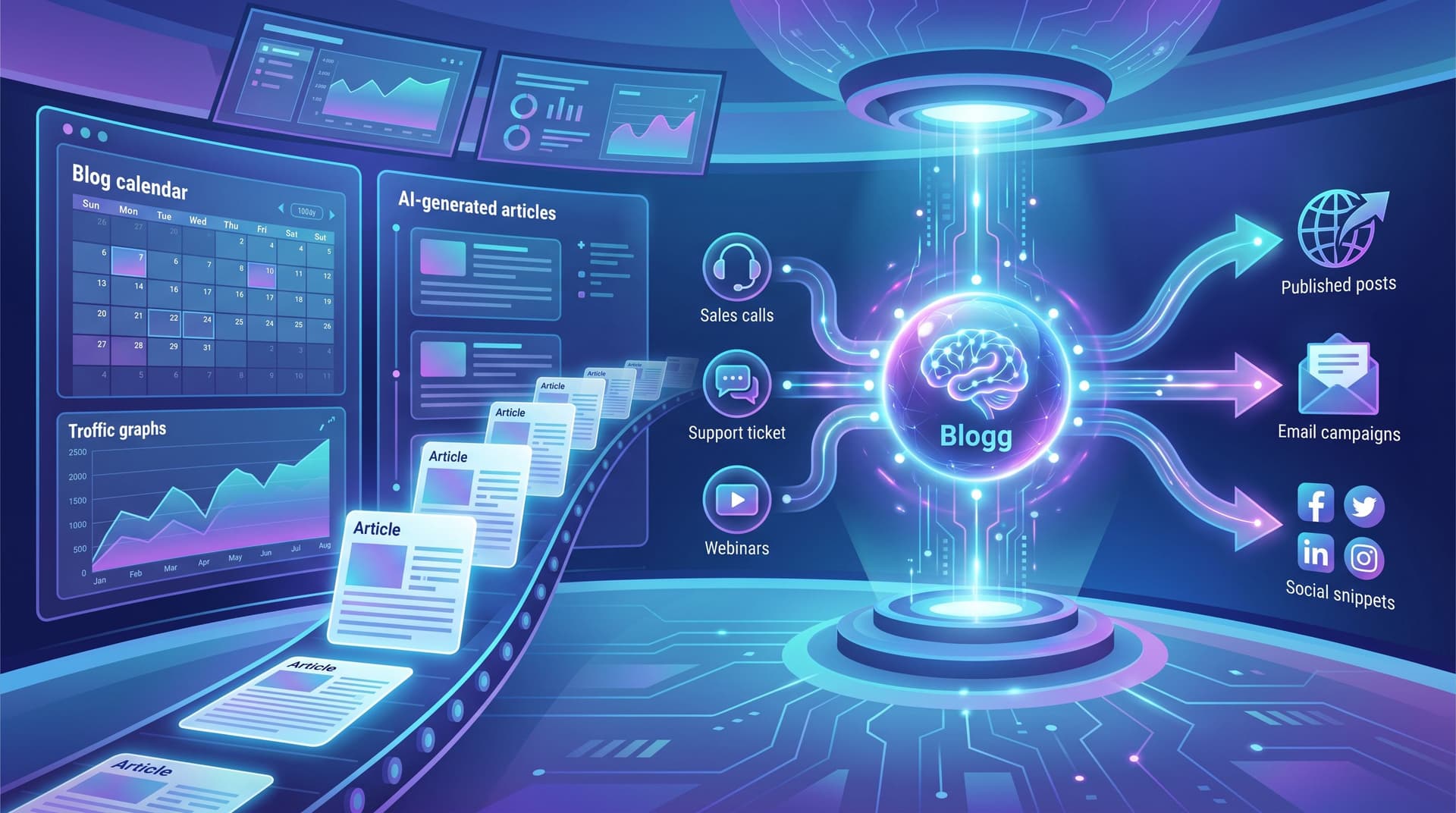
This is where an AI platform like Blogg changes the game. Instead of treating AI as a one‑off writing helper, you treat Blogg as the engine behind an always‑on content channel—one that continually turns your inputs (topics, data, events, customer conversations) into search‑optimized posts that ship on schedule.
In this article, we’ll walk through how to make that shift—step by step.
Why “Channel Thinking” Matters More Than Ever
When you treat your blog like a channel, a few important things happen:
1. You protect your pipeline, not just your traffic.
A predictable stream of SEO‑optimized content is one of the best insurance policies you can have when ads underperform or outbound slows down. We unpack this idea in detail in The ‘SEO Safety Net’: How Automated Blogging Protects Your Pipeline When Campaigns Flop.
2. You stop wasting the content you’re already creating.
Webinars, sales calls, support tickets, product updates—these are raw materials for content. A channel mindset says: nothing gets wasted. Your job is to route those inputs into Blogg, not start from a blank Google Doc every time.
3. You adapt to search that doesn’t always send the click.
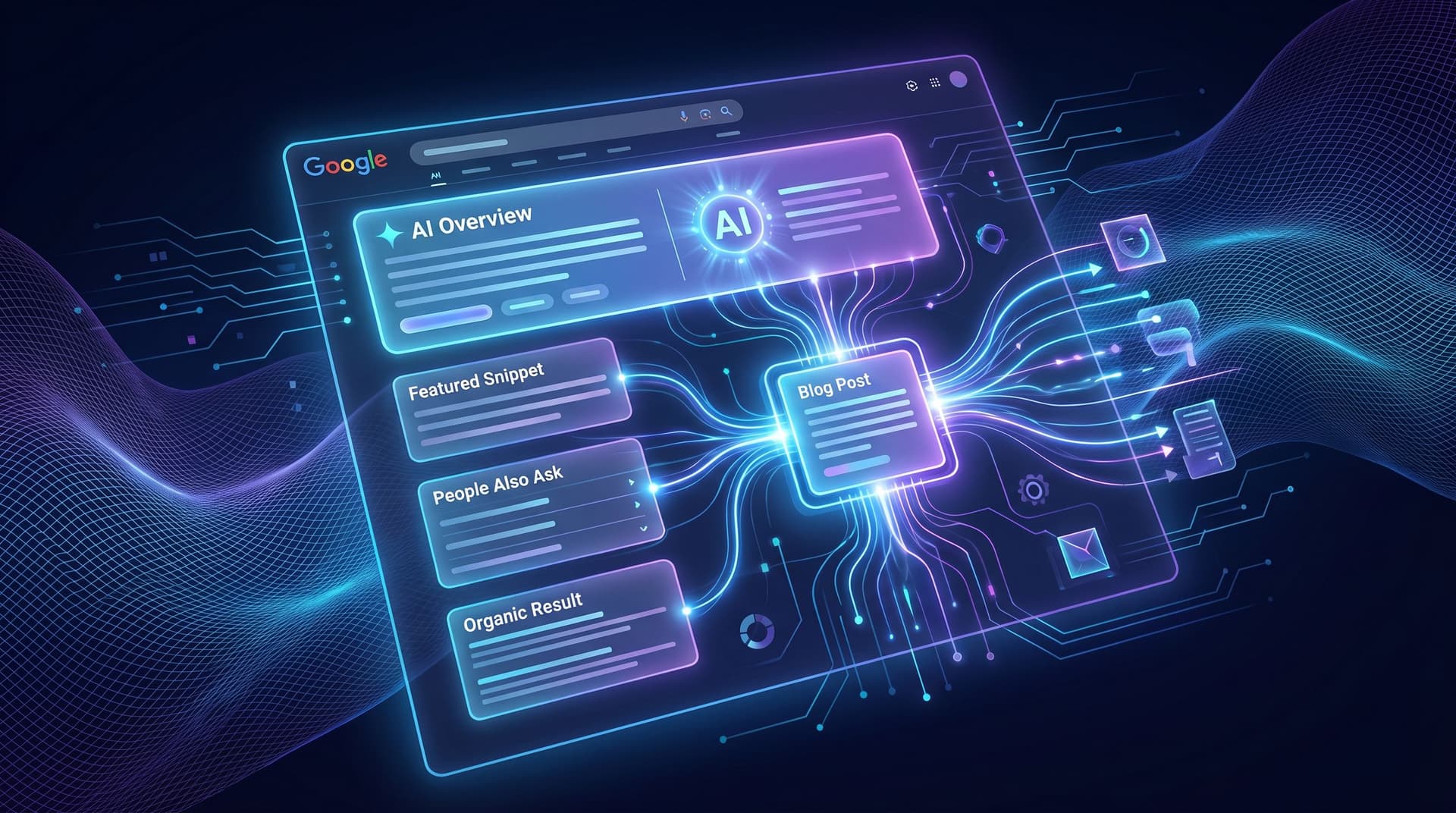
Between AI Overviews, answer boxes, and zero‑click results, some percentage of your hard‑won rankings will never turn into visits. That makes it even more important that what does get through is:
- Rich enough to be worth the click
- Structured to feed answer engines
- Designed to capture and nurture the visitors you do win
If you haven’t already, read The ‘Search-Aware’ AI Blog: Structuring Posts to Survive SGE, AI Overviews, and Zero-Click Results for a deeper dive on this.
4. You finally separate “publishing” from “bandwidth.”
With Blogg handling ideation, drafting, and scheduling, your team’s limited time shifts to:
- Providing inputs (topics, examples, source material)
- Reviewing for accuracy and voice
- Connecting posts to campaigns, sales enablement, and nurture flows
The result: a blog that behaves like a channel, not a side project.
Step 1: Decide What Your Channel Is For
Before you turn on any automation, you need a clear job description for your channel.
Ask: “If this channel works, what changes in our business six months from now?”
Common answers:
- More inbound demos from high‑intent keywords
- Shorter sales cycles because prospects educate themselves on your site
- Fewer repetitive support tickets on common questions
- Better coverage of key product narratives or category stories
Translate that into 2–3 concrete priorities. For example:
- Own the problem space around 3–5 core pains your product solves.
- Arm sales with links that answer the top 20 objections and questions.
- Expand into new segments (industries, geos, use cases) through tailored content.
Those priorities will guide everything else: which inputs you feed into Blogg, how you score ideas, and how you measure success.
Step 2: Turn Your Inputs Into a Repeatable Content Feed
A channel needs a steady feed of raw material. The good news: you already have it.
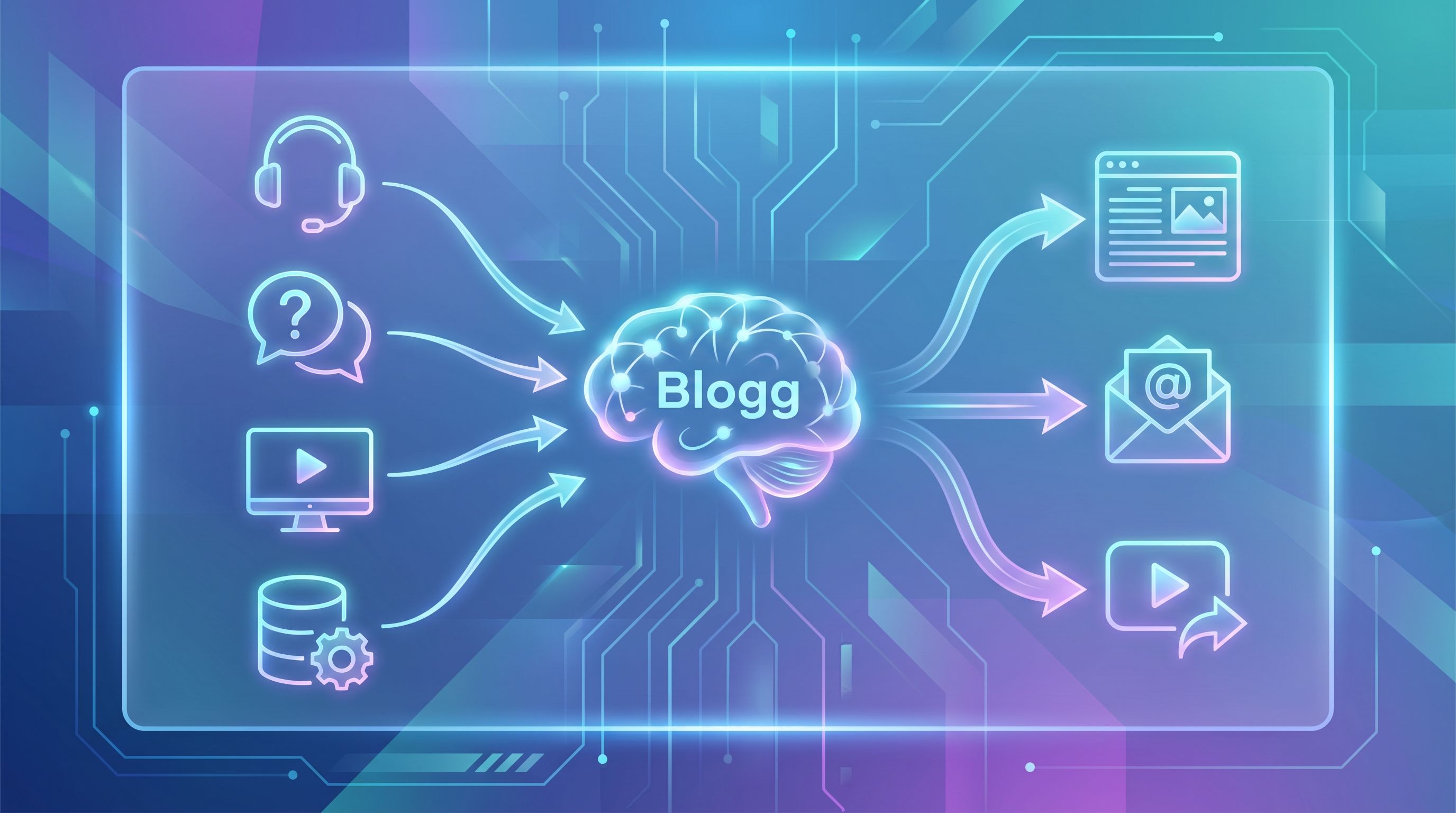
Here are the most common input streams you can wire into Blogg:
- Lead and prospect data – CSVs from tools like ZoomInfo, Apollo, or Clearbit, CRM segments, and intent lists. These can be mined for patterns (industries, roles, problems) that become SEO topics. For a deep dive on this, see From Lead Lists to Blog Topics: Using AI to Turn Prospecting Data into SEO-Ready Content Ideas.
- Sales and success conversations – Call recordings, transcripts, and notes from tools like Gong, Chorus, or Zoom. These are gold for real objections, phrases, and use cases.
- Support tickets and feature requests – The questions people ask repeatedly are perfect candidates for detailed, search‑friendly posts.
- Events and campaigns – Webinars, conferences, workshops, product launches. Each one can spawn a cluster of posts.
- Internal docs and assets – Sales decks, onboarding guides, FAQs, product one‑pagers.
Your goal isn’t to “use everything.” It’s to design a simple, repeatable routing system. For example:
- Sales ops drops a weekly export of new opportunities into a shared folder.
- RevOps adds 3–5 notes on common themes or objections that week.
- Marketing tags a subset as “content inputs” and feeds them into Blogg with a few prompts: target persona, problem, and desired outcome.
- Blogg turns those into topic ideas and outlines, then drafts posts on a pre‑set schedule.
You’ve just turned chaos into a content feed.
Step 3: Design the “Always‑On” Publishing Cadence
A channel is defined by its cadence. The exact number isn’t magic, but consistency is.
For most B2B teams, a strong starting point with Blogg looks like:
- 2–3 posts per week targeting search questions and long‑tail keywords
- 1 deeper, narrative post per month tying content back to product and positioning
- Quarterly clusters around launches, events, or new verticals
With Blogg, you don’t set this by hand every week. Instead, you:
- Define your publishing lanes (for example: “SEO explainers,” “use‑case stories,” “local SEO posts,” “sales enablement pieces”).
- Assign each lane a target frequency.
- Load your inputs and topics into Blogg with lane tags.
- Let the platform handle scheduling and balance across lanes.
Over time, you’ll adjust the mix based on what actually drives results. That’s where a simple scoring system helps—something we walk through in From Topic Ideas to Traffic Assets: A Simple Framework for Scoring AI Blog Concepts by Business Impact.
Step 4: Wire in Guardrails So Volume Doesn’t Kill Quality
An always‑on engine without guardrails is a liability. You need lightweight controls that keep content on‑brand and low‑risk without slowing everything down.
A practical setup with Blogg usually includes:
1. A clear voice and style profile
Feed Blogg samples of your best content—founder emails, strong landing pages, or your favorite posts. Then codify:
- Tone (e.g., “direct, specific, no fluff, friendly but not cute”)
- Jargon to avoid
- Phrases and frameworks you want to reuse
If you’re still shaping this, From Founder Voice to Brand Voice: Training Your AI Blog to Sound Like a Real Person (Not a Robot) is a helpful companion.
2. A simple review workflow
Not every post needs the same level of scrutiny. A common pattern:
- Tier 1: Low‑risk SEO explainers → spot‑check only (or post‑publish QA).
- Tier 2: Product‑adjacent, comparison, or pricing content → mandatory review by product marketing or leadership.
- Tier 3: Thought leadership or controversial takes → co‑written or heavily edited by a human.
Platforms like Blogg make it easy to route drafts by tag or lane, so reviewers only see what actually needs their eyes.
3. Clear “do not touch” zones
Some topics—compliance, regulated claims, legal language—should be tightly controlled. Mark them as such in your content plan so Blogg doesn’t generate new posts there without explicit briefs.
For a deeper look at this philosophy, see Guardrails, Not Handcuffs: Simple Review Systems That Keep High-Volume AI Blogs On-Brand and Low-Risk.
Step 5: Connect Your Channel to Real Revenue Moments
An always‑on content engine is only as valuable as its connection to real go‑to‑market moments.
Here’s how to make sure your channel isn’t just “publishing into the void”:
Tie posts to sales and CS workflows
For every new post, ask:
- Which objection or question does this answer?
- Where in the sales cycle does it belong? (early discovery, evaluation, procurement)
- Which playbooks should link to it? (outbound sequences, follow‑up emails, onboarding flows)
Then:
- Add links to relevant posts in your sales templates and snippets.
- Train reps to use posts as follow‑up assets after calls.
- Build simple internal indexes: “Posts to send when someone asks about X.”
Use content clusters to support launches and campaigns
Instead of a single “launch post,” build mini content clusters around key initiatives:
- A core announcement or narrative piece
- 3–5 supporting SEO posts on related problems and use cases
- 1–2 comparison or “how we’re different” pieces
Feed the whole cluster into Blogg as a campaign with:
- Target personas
- Priority keywords and questions
- Launch dates and sequencing
Now your channel is amplifying launches instead of lagging behind them.
Build light nurture around your posts
Once your channel is humming, the next step is not just to get visits—but to turn those visits into relationships.
Even a lightweight nurture system can go a long way:
- Simple, relevant content upgrades (checklists, templates, calculators) on high‑intent posts
- A short welcome sequence that surfaces your best posts by role or problem
- Occasional round‑up emails that highlight new or updated posts from your Blogg engine
We go deeper on this in From One-Time Visitor to Warm Opportunity: Building a Lightweight Nurture System Around AI Blogg Posts.

Step 6: Measure Like a Channel, Not a Content Calendar
If you only measure “posts published” and “sessions,” you’ll never see the full impact of an always‑on engine.
Instead, track metrics that answer three questions:
1. Is the engine actually always on?
- Posts per week/month vs. target cadence
- Coverage by lane (SEO, sales enablement, product, local, etc.)
- Time from idea → published with Blogg
2. Is the channel earning and keeping attention?
- Organic traffic and impressions for target topic clusters
- Click‑through rate from search
- Time on page, scroll depth, and return visits
- Assisted conversions (demo requests, signups, trials) where a blog post was part of the journey
3. Is content reducing friction for sales and support?
- Fewer repetitive support tickets on documented topics
- Shorter sales cycles for opportunities that engage with content
- Rep feedback: “Top posts I send every week”
The point isn’t to build a 40‑page dashboard. It’s to close the loop between your Blogg engine and the revenue story your leadership cares about.
Step 7: Evolve the Channel Without Rebuilding It
Once your always‑on engine is running, your job shifts from “get this off the ground” to “keep making it smarter.”
Here are a few ways to do that without tearing everything down:
- Refresh instead of rewrite. Use Blogg to identify posts that are slipping in rankings or conversions and generate updated versions with new data, examples, and internal links.
- Spin up new lanes, not new systems. Want to expand into local SEO, multi‑location content, or event‑led growth? Add lanes and inputs rather than starting from scratch. (If that’s on your roadmap, you’ll find AI Blogging for Event-Led Growth: Turning Webinars, Conferences, and Podcasts into a Year of Search Traffic especially relevant.)
- Feed it better source material. As you see which posts perform best, double down on similar inputs: more transcripts, more detailed product docs, more real customer quotes.
- Periodically tune your voice. Every few months, update Blogg with fresh examples of your best‑performing content so the engine keeps learning what “great” looks like for your brand.
The engine stays the same. The fuel and the steering get sharper.
Bringing It All Together
Turning Blogg from “AI that writes some posts” into an always‑on content channel comes down to a few big shifts:
- You give your blog a clear job in your go‑to‑market story.
- You treat your existing data, conversations, and events as inputs, not afterthoughts.
- You design a cadence and lane structure that Blogg can execute against week after week.
- You add guardrails so higher volume doesn’t mean lower quality.
- You wire the channel directly into sales, support, and nurture, so posts move real numbers—not just vanity metrics.
- You measure and refine like operators, not just writers.
Do that, and “We have a blog” quietly becomes “We have a channel that’s always working for us.”
Your Next Step
If your blog currently depends on someone “finding time” to write, you don’t have a channel yet—you have a risk.
The first step to fixing that is simple:
- List the inputs you already have (sales calls, support tickets, lead lists, events).
- Decide on a minimum viable cadence you’d be proud to sustain for six months (for example, 2 posts per week).
- Use Blogg to turn those inputs into an automated publishing schedule.
You don’t need a huge team or a brand‑new strategy. You need an engine—and the commitment to let it run.
If you’re ready to turn “We have a blog” into “We have a channel,” start by connecting your existing inputs to Blogg and setting that first six‑month cadence. Six months from now, you’ll be glad you did.