AI Blogging for Event-Led Growth: Turning Webinars, Conferences, and Podcasts into a Year of Search Traffic

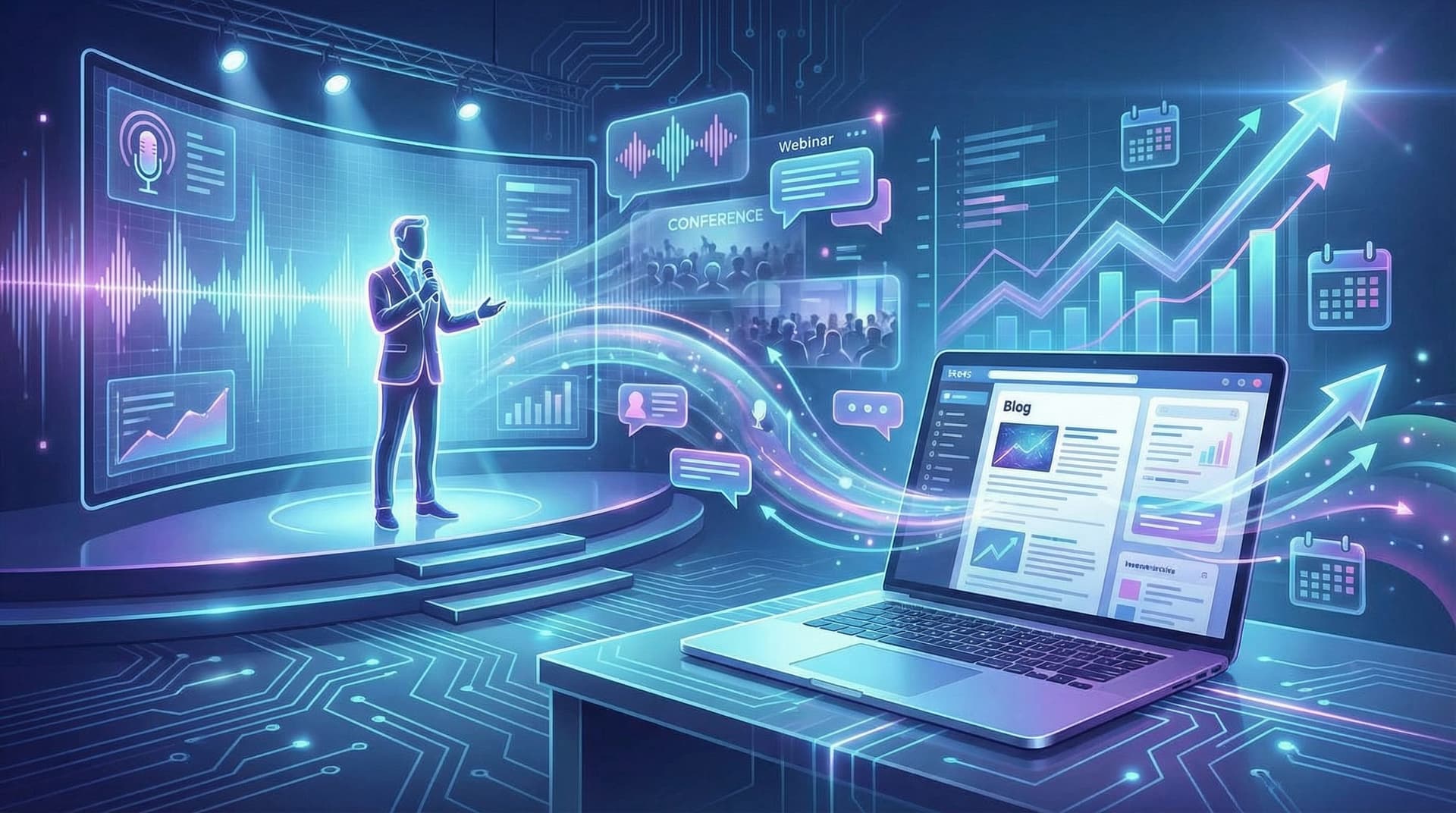
If you run webinars, speak at conferences, or host a podcast, you’re already doing the hardest part of content marketing: creating original, high-intent material.
The problem is what happens next.
Most of that content lives and dies in three places:
- A one-off live event
- A recording that gets a few replays
- A slide deck or transcript no one ever revisits
Meanwhile, your blog—one of the best long-term levers for organic growth—stays underfed.
AI blogging changes that equation. When you treat every event as a source rather than a moment, you can turn a single webinar into a month of search-focused posts, or a conference season into a year-long content engine.
This article is about how to do exactly that—with a repeatable system, not heroic effort.
Why Event-Led Blogging Is Such a Big Opportunity
Webinars, conferences, and podcasts are already packed with the ingredients of great SEO content:
- Real buyer language – Questions from Q&A, objections, and stories that mirror how your audience actually talks.
- Topical authority – Deep dives on specific problems, frameworks, or use cases.
- Built-in differentiation – Your speakers, your examples, your point of view.
When you combine that with AI-powered blogging (through a platform like Blogg), you get three big advantages:
-
Compounding search traffic from one-time events
Instead of a spike of registrations and then silence, each event becomes:- Multiple SEO posts
- Comparison pages
- Thought-leadership pieces
- FAQ-style articles that rank for long-tail questions
-
Alignment with what actually drives pipeline
Events are rarely random. They’re usually tied to:- Product launches
- Seasonal campaigns
- Common sales objections
- Vertical-specific use cases
That makes them perfect candidates for a search strategy that’s built around buyer intent, not just keywords. (If you want to go deeper on that concept, see From “Stuffed with Keywords” to “Built for Questions”.)
-
A realistic way to keep your blog active
You’re already investing time and budget into events. Using AI to mine those assets means you don’t need a separate, heavy content machine to keep publishing.
Step 1: Design Events with Search in Mind (Before You Go Live)
Most teams treat SEO as a post-production task. A better approach: bake search intent into the event itself.
Here’s how to do that without turning your webinar into a keyword-stuffing exercise.
Start with search questions, not just a theme
When you’re planning the event, list out:
- The primary problem your audience is trying to solve
- 5–10 questions they’d type into Google or ask an AI assistant about that problem
- 3–5 objections they raise on sales calls
Then structure your agenda around those questions and objections. This gives you natural sections that can later become standalone posts.
Build clear segments you can reuse later
Instead of a 45-minute monologue, structure your event like this:
- Context and stakes (why this matters)
- Framework or model
- Step-by-step walkthrough
- Case study or example
- Live Q&A
Each of those can map cleanly to:
- A deep-dive framework post
- A how-to guide
- A case-study style post
- An FAQ or objection-handling article
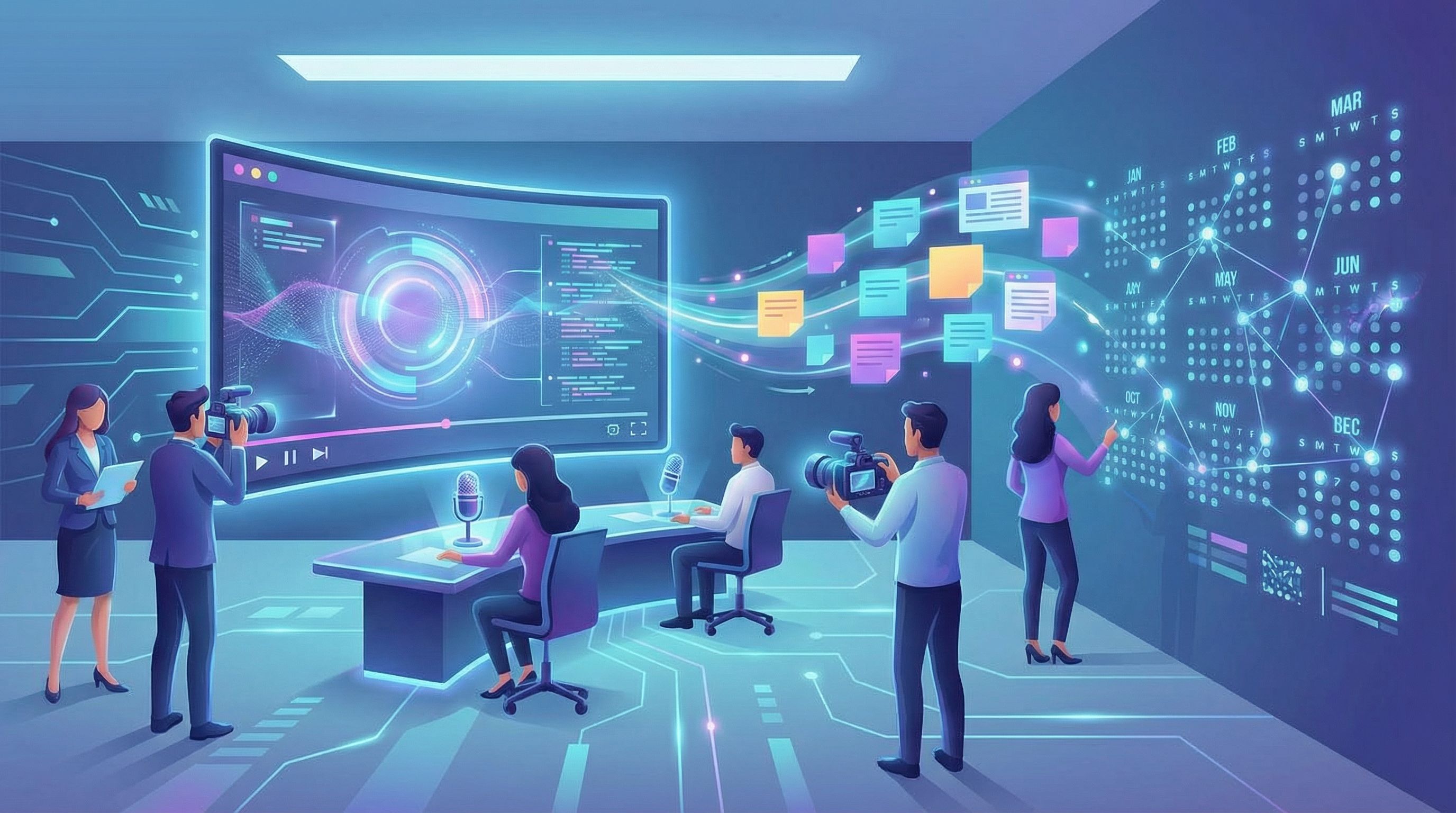
If you’re using Blogg, you can even pre-tag these segments in your prep doc so your AI system knows what to extract and expand later.
Step 2: Capture Clean Inputs (So AI Has Something Worth Mining)
AI is only as good as the material you feed it. Garbage in, garbage out; gold in, compounding returns out.
For each event, make sure you capture:
- High-quality audio and video – Even if you don’t publish the video, a clean recording makes transcripts more accurate.
- Full transcript – Use tools like Zoom’s built-in transcription, Otter.ai, or Fathom to get text.
- Chat log and Q&A – These are gold for long-tail, question-driven posts.
- Slides and visuals – Framework diagrams and step lists often become great blog graphics or section headers.
Then, centralize everything. A simple folder structure works:
/Events/2026-04-RevOps-Webinar/recording.mp4/Events/2026-04-RevOps-Webinar/transcript.txt/Events/2026-04-RevOps-Webinar/chat.csv/Events/2026-04-RevOps-Webinar/slides.pdf
If you’re following the “No Net-New Ideas” mindset, this is exactly the kind of asset library an AI platform like Blogg can mine before you ever brief a new topic. We unpack that in detail in The ‘No Net-New Ideas’ Framework.
Step 3: Turn Each Event into a Structured Content Map
Before you ask AI to “write a blog post,” ask it to analyze and map the event.
You can do this manually with your own prompts, or set it up as an automated workflow in Blogg. The goal is a structured inventory of potential posts.
What your event content map should include
For each webinar, conference talk, or podcast episode, extract:
-
Core topic clusters
Example for a webinar on RevOps dashboards:- Building an executive dashboard
- Common reporting mistakes
- Aligning metrics across sales, marketing, and CS
-
Search-intent questions
Pulled from Q&A and chat, such as:- “How do we measure pipeline velocity across multiple regions?”
- “What’s the best way to combine product usage data with CRM data?”
-
Frameworks and step lists
These become “pillar” or “playbook” posts. -
Stories and examples
Each one is a potential case-study-style article.
Example: One webinar → 8–12 blog posts
From a single 60-minute webinar, your map might surface:
- A pillar post: “The Complete Guide to Building a RevOps Executive Dashboard”
- A how-to: “How to Combine Product Usage Data with CRM Data for Better Forecasting”
- A mistake-driven piece: “7 Common RevOps Reporting Mistakes (and How to Fix Them)”
- A framework explainer: “The 3-Layer Metrics Model: Team, Funnel, and Board-Level Views”
- A Q&A roundup: “Your Top 10 Questions About RevOps Dashboards, Answered”
- A vertical spin: “RevOps Dashboards for PLG SaaS vs. Sales-Led Teams: What Changes?”
- A comparison post: “Spreadsheet Dashboards vs. BI Tools: Which Is Right for Your Stage?”
- A short, opinionated piece: “Why ‘More Metrics’ Is Killing Your RevOps Strategy”
Multiply that by a quarterly webinar program, a monthly podcast, and a couple of conference talks—and you suddenly have more than enough fuel for a consistent blog cadence.
Step 4: Use AI to Draft Posts That Still Feel Human
Once you have your content map, AI can do the heavy lifting—but only if you give it the right constraints.
Feed AI the right context
For each post you spin out from an event, your AI brief should include:
- The source segment (transcript excerpt, timestamp range, or slide notes)
- The intended search question (what a user would type or ask)
- The target reader (role, company size, level of sophistication)
- Any non-negotiable opinions or stances from the speaker
This is where a system like Blogg shines: you define these preferences once—tone, audience, product positioning—and let the platform apply them consistently across all event-derived posts.
If you’re doing this yourself with general-purpose AI tools, think in terms of patterns rather than one-off prompts. (We break those patterns down in Beyond ‘Write Me a Blog Post’.)
Structure posts around search intent, not just summary
Event recaps often read like transcripts with paragraph breaks. That doesn’t work for search—or for busy readers.
Instead, shape each post so that:
- The intro hooks a specific problem the reader is trying to solve.
- Each section answers a distinct sub-question (aligned with H2/H3s).
- Examples and stories are pulled from the event, not invented from scratch.
- CTAs match intent—for high-intent queries, that might be a demo; for early research, it might be a template or checklist.
This is where the “Search Intent Sandwich” model is useful: match top-of-post, middle content, and bottom CTA to the same buyer need. You can dig into that structure in The ‘Search Intent Sandwich’ Strategy.
Step 5: Plan a Year of Publishing Around Your Event Calendar
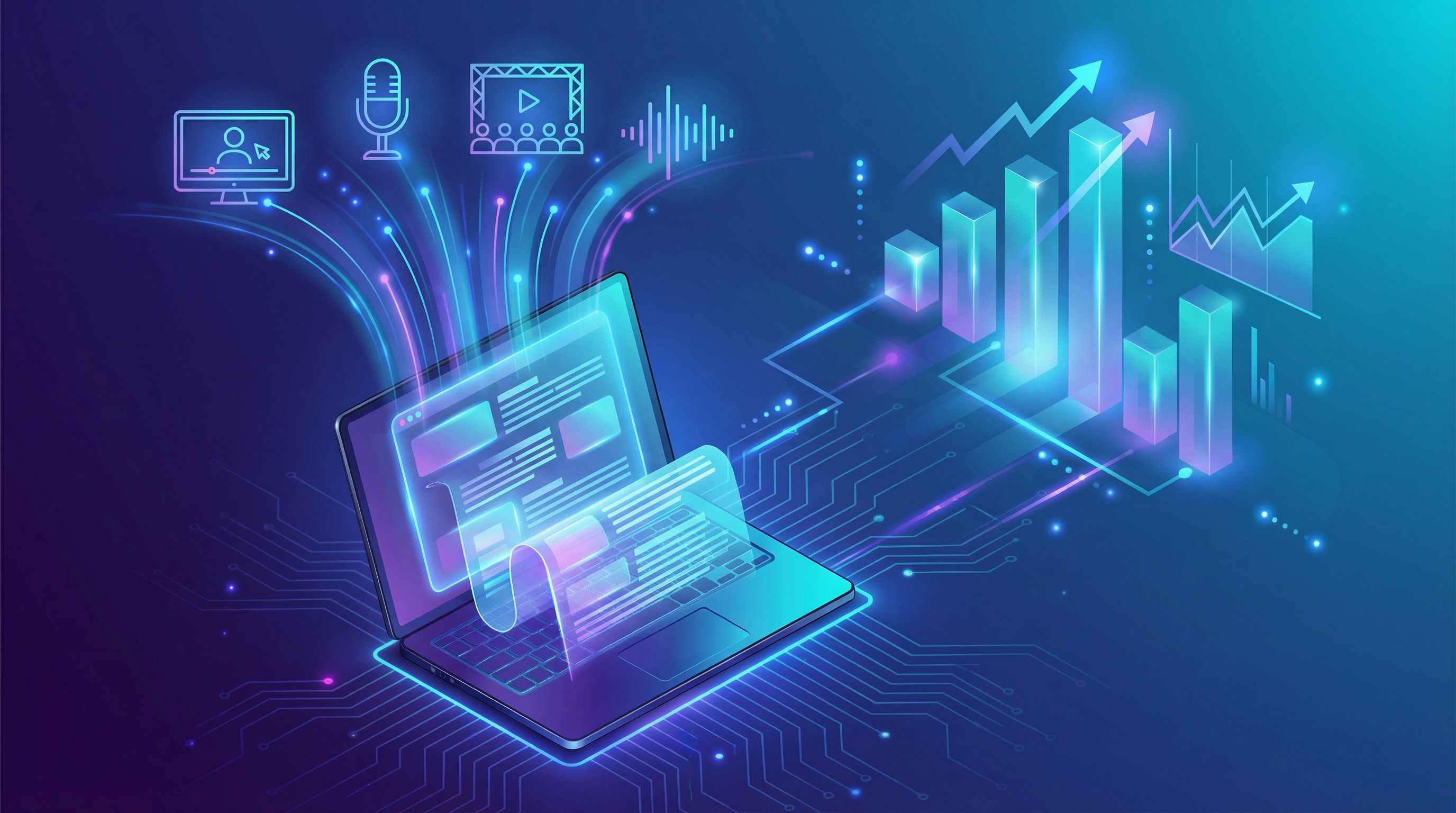
Once you see events as content sources, your editorial calendar starts to look different.
Instead of:
“We should write about X sometime.”
You get:
“From the May product webinar, we’ll ship 6 posts in June and July targeting these 10 questions.”
Build a simple event → blog pipeline
For each major event, define:
- T–2 weeks:
- Publish a pre-event post that tees up the problem and invites registrations.
- T+1 week:
- Publish a recap / highlight post.
- T+2 to T+8 weeks:
- Publish 1–2 deep-dive posts per week derived from segments, Q&A, and stories.
If you already have a content planning framework—like the 90-day plan we outline in Calendars, Clusters, and Cadence—you can plug events directly into those clusters and let AI fill in the gaps.
Use AI to maintain cadence, not just create content
The other advantage of pairing events with AI is predictability.
With a platform like Blogg:
- You can queue event-derived posts in advance, so the blog keeps shipping even when your team is heads-down on the next conference.
- You can mix in non-event posts (like competitive tear-downs or feature deep-dives) without losing the throughline.
- You can define a “quiet quota” of posts per week or month that’s realistic for your team, then let AI help you hit that target.
Step 6: Protect Quality with Lightweight Review Guardrails
If AI is turning every webinar into a dozen posts, how do you avoid:
- Off-brand messaging
- Over-promising or compliance issues
- Repetitive content that frustrates readers
You don’t need a heavy approvals bureaucracy. You do need simple guardrails.
At minimum:
-
Define what AI can publish alone vs. what needs human review.
For example:- AI-only for low-risk FAQ posts
- Human review for anything with strong product claims or competitive comparisons
-
Create a short checklist for reviewers, e.g.:
- Does this post accurately reflect what was said in the event?
- Is the CTA appropriate for the search intent?
- Are examples anonymized or approved for use?
-
Centralize edits back into your AI system.
When you fix phrasing or positioning once, that feedback should inform future drafts.
We go deeper on setting up these systems in Guardrails, Not Handcuffs.
Step 7: Connect Event-Derived Posts to Actual Revenue
Traffic from event-derived posts is great. Pipeline is better.
To close the loop:
-
Tag posts by source event and topic cluster.
This lets you see which webinars or conferences are driving the most:- Organic sessions
- Assisted conversions
- Demo requests or trials
-
Align CTAs with the original event.
For example:- Offer the on-demand recording of the webinar as a lead magnet.
- Invite readers to the next live session in the series.
- Provide downloadable templates or checklists mentioned in the talk.
-
Feed performance data back into event planning.
If posts derived from one type of session (e.g., tactical how-tos) consistently drive more demos than others (e.g., broad thought leadership), use that to shape your next webinar season.
Platforms like Blogg can help here by tying topics, posts, and performance data together—so you’re not guessing which events are worth repeating or expanding.
Bringing It All Together
Let’s recap the playbook:
- Design events around buyer questions and objections, not just themes.
- Capture clean, rich inputs—recordings, transcripts, Q&A, and slides.
- Map each event into a structured set of potential posts (pillars, how-tos, FAQs, stories).
- Use AI to draft posts with clear search intent and human-sounding nuance.
- Plan your publishing cadence around your event calendar, turning spikes of effort into a steady drumbeat of content.
- Add light review guardrails so volume doesn’t come at the expense of trust.
- Measure which event-derived posts drive real sales conversations, then double down.
Do this consistently for a year and your webinars, conferences, and podcasts stop being one-off campaigns. They become the backbone of an always-on search strategy.
Your Next Step
You don’t need to overhaul your entire content operation to start.
Pick one upcoming or recent event and:
- Get the transcript, chat log, and slides into a single folder.
- List 10–15 real questions that came up (or should have come up).
- Turn those into 5–8 blog post ideas.
- Use AI—or a platform like Blogg—to draft the first two posts.
- Ship them with simple review guardrails in place.
Once you’ve seen how one event can power a month of search content, scaling that system across your entire event calendar becomes much less intimidating.
If you’re ready to turn your webinars, conferences, and podcasts into a year of consistent, SEO-ready blog posts—without turning your team into full-time writers—start by feeding your next event into Blogg and see how far a single hour of content can take you.