AI Blogging for Complex Buyer Committees: Mapping One Post to Multiple Stakeholders Without Diluting the Message


Enterprise deals rarely hinge on a single champion anymore. They’re decided by buyer committees: RevOps, Finance, Security, IT, end users, and an executive sponsor all weighing in with different priorities and vocabularies.
That creates a content problem.
Your blog post about “revenue operations automation” might be perfect for a VP of Revenue… but lose the Head of Security, confuse Finance, and bore the end users who actually have to live in the tool.
The instinct is to write separate posts for each persona. That can work—but it’s slow, hard to maintain, and often fragments your story.
There’s a sharper option: design single posts that map cleanly to multiple stakeholders without turning into a generic, everyone-and-no-one piece. And AI can help you do this at scale.
This article breaks down how to plan, draft, and optimize AI-powered blog posts that speak to complex buyer committees—so one URL can move the entire deal forward.
Why One Post for Many Stakeholders Is Worth the Effort
Before we get tactical, it’s worth clarifying why this matters.
1. Buyer committees share links, not decks
Most internal buying conversations start with:
“I found this post that explains it well—dropping it in the channel.”
If that post only speaks to one stakeholder, everyone else has to mentally translate it:
- Finance has to infer the impact on costs and risk.
- Security has to guess at data flows and controls.
- End users have to imagine how this changes their day-to-day.
When a single post anticipates those perspectives explicitly, it becomes the artifact that travels through Slack threads, email forwards, and internal docs—without your team in the room.
2. You reduce message drift across the funnel
If you write separate posts for each persona, you risk:
- Conflicting definitions of the problem
- Different claims about impact
- Misaligned language around features and outcomes
A well-structured, multi-stakeholder post anchors everyone in the same story, then branches into tailored sections. That’s especially powerful when you’re running rebrands or repositioning efforts, where consistency is everything (see how we handle that in-depth in AI Blogging for Rebrands: How to Use Blogg to Redirect Old Traffic Toward Your New Story).
3. AI makes this structure repeatable
Doing this by hand for every topic is exhausting. But with an AI-powered platform like Blogg, you can:
- Encode your buyer committee personas once
- Save repeatable outlines for multi-stakeholder posts
- Generate drafts that already include stakeholder-specific sections
That turns “complex committee content” from a one-off hero effort into a system.

Step 1: Map the Committee Before You Map the Post
You can’t write for a committee you haven’t defined.
Start by building a lightweight “committee map” for your core deals. For most B2B teams, it includes:
- Economic buyer – typically a VP/C-level; cares about business outcomes, risk, and strategic alignment.
- Technical owner – IT, Engineering, or Ops; cares about integration, scalability, and maintenance.
- Security/compliance – Security, Legal, or Risk; cares about data handling, controls, and certifications.
- Functional champion – the team that lives in the product; cares about workflows, usability, and time saved.
- Procurement/Finance – cares about total cost, contract terms, and ROI.
For each role, list 3–5 core questions they bring into a buying conversation. For example:
- Economic buyer
- How does this move revenue, margin, or strategic initiatives?
- What happens if we don’t do this for another 12 months?
- Technical owner
- How does this fit our stack and data model?
- What’s the implementation path and who does the work?
- Security/compliance
- Where does data live? Who can access it? How is it encrypted?
- What certifications, audits, or reports are available?
- Functional champion
- How much of my current workflow changes?
- Will this actually save time or just add another tool?
- Procurement/Finance
- How do we justify this vs. competing priorities?
- What levers do we have on pricing over time?
This “question inventory” becomes the backbone of your multi-stakeholder blog structure.
If you already have detailed internal process docs, you’re ahead of the game. Those SOPs often encode who’s involved and what they care about. You can make them even more AI-ready using the framework from The ‘Search-Ready SOP’ Framework: Writing Internal Processes So AI Can Instantly Turn Them into Blog Posts.
Step 2: Choose a Primary Lens (and Stick to It)
The biggest mistake in multi-stakeholder posts is trying to give every persona equal weight in the core narrative.
That’s how you end up with vague intros like:
“Whether you’re a finance leader, an IT admin, or a sales rep, this platform has something for you…”
Instead:
- Pick a primary reader. Usually the person who finds and shares the post first—often your functional champion or economic buyer.
- Write the headline, intro, and main argument for that person.
- Branch into stakeholder-specific sections later in the post.
For example, if your primary reader is a RevOps leader evaluating an AI-powered content engine, your core angle might be:
- Headline: “How to Turn Your Existing Revenue Ops Data into a Self-Updating Content Engine”
- Intro: speaks directly to RevOps pain (stale enablement, disconnected content, manual reporting)
- Core argument: show how one content engine de-risks pipeline and improves forecasting
Only after that do you explicitly address:
- How IT can integrate it
- How Security can vet it
- How Finance can model ROI
This keeps the spine of the post tight, while still making it a powerful asset for the broader committee.
Step 3: Design a Modular Outline That Mirrors the Buying Conversation
Once you’ve chosen your primary reader, structure the post in modules that map to how a real deal unfolds.
A reliable pattern looks like this:
- Context + stakes (for the primary reader)
- Definition + approach (how you frame the solution)
- Core value narrative (business impact for the primary reader)
- Stakeholder-by-stakeholder deep dives
- Implementation story (what rollout looks like)
- Risk and objection handling
- Next steps and resources
Within that, you can add labeled subsections like:
- For your IT & data team
- For Security & Compliance
- For Finance & Procurement
- For the teams who will live in this tool
Each of these sections should:
- Start with 1–2 sentences acknowledging their role and concerns.
- Answer their top 3–5 questions from your committee map.
- Tie back to the same core narrative, not a new one.
This modular approach pairs beautifully with AI. In Blogg, you can encode this as a reusable outline template, then feed in:
- The primary persona
- The supporting committee roles
- Their top questions
The AI can then draft each module with the right emphasis, instead of guessing from a generic prompt.
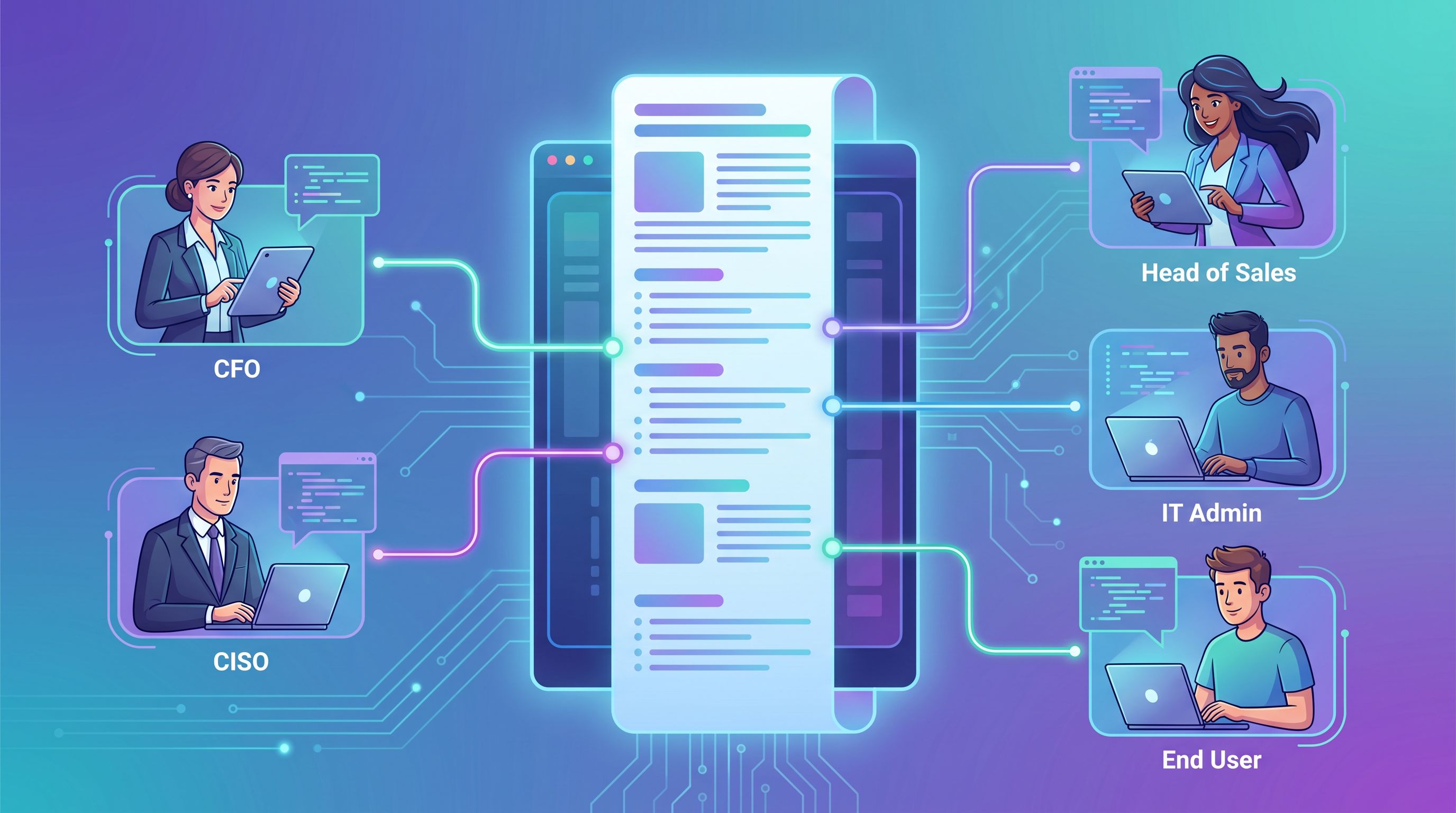
Step 4: Use AI to Generate Persona-Specific Angles—Without Rewriting the Whole Post
Here’s where AI shines: angle variation without narrative drift.
Instead of asking an AI model, “Write a post for Finance, then one for Security, then one for IT,” you:
- Draft (or have Blogg draft) a single, well-structured master post anchored on the primary persona.
- For each stakeholder section, prompt AI with:
- A short description of the persona
- Their top questions
- The relevant portion of the master argument
For example, a prompt pattern for the Security section might look like:
“You are a B2B security architect. You’re evaluating a new AI-powered blogging platform. Here is the core argument of the post and how the system works: [insert summary]. Write a 400-word subsection titled ‘For Your Security & Compliance Team’ that: (1) explains the data flows, (2) addresses access controls, (3) references SOC 2 / ISO 27001 / DPA considerations, and (4) keeps the same tone and claims as the master section. Do not introduce new product claims.”
Key guardrails:
- Don’t let AI invent new promises. Always feed it the constraints: what the product actually does, what’s off-limits, and the claims you’ve already vetted.
- Keep length proportional. A 2,000-word post doesn’t need four 800-word persona sections. Think 250–500 words per stakeholder.
- Re-use examples. Ask AI to explain the same customer story or workflow from different angles, rather than spinning up new ones.
If you’ve already set up an “AI editor-in-chief” layer—style, claims, and guardrails codified for your brand—you’re halfway there. If not, see how to do that in The ‘AI Editor-in-Chief’: Designing Guardrails So Blogg Feels Like Your Best Writer, Not a Robot.
Step 5: Layer in Committee-Friendly Proof, Not Just Marketing Claims
Buyer committees are allergic to vague promises. Each persona wants their kind of proof.
Design your post so each stakeholder section includes at least one concrete artifact:
- For economic buyers
- A simple before/after model: pipeline, revenue, or margin impact
- Benchmarks or ranges, not just adjectives
- For technical owners
- Architecture diagrams (or links to them)
- Supported integrations and APIs
- Performance or scalability ranges
- For Security & Compliance
- Links to trust center, security docs, or whitepapers
- Named certifications (SOC 2 Type II, ISO 27001, etc.)
- Data residency and retention policies
- For functional champions
- Screenshots or GIFs of key workflows
- Time-saved estimates based on real usage
- Quotes from users in their exact role
- For Finance & Procurement
- Pricing model overview
- Example ROI scenarios
- Contract flexibility and renewal levers
AI can help you standardize how you present proof across posts:
- Turn raw customer notes into consistent mini case studies.
- Convert internal metrics into simple, reusable visual metaphors.
- Summarize long security documents into 2–3 buyer-ready paragraphs.
The goal: when a stakeholder skims “their” section, they don’t just see empathy for their worries—they see evidence.
Step 6: Make the Post Easy to Navigate Inside a Slack Thread
Remember how this post is actually used: someone drops it into a channel and tags people.
Design for that moment:
- Clear subheadings that map to roles.
- “For Your IT & Data Team”
- “For Security & Compliance”
- “For Finance & Procurement”
- Anchor links or a mini table of contents. If your CMS supports it, link directly to each section so a RevOps leader can say, “@Alex (IT) see this part” with a jump link.
- Tight summaries at the start of each section. The first 2–3 sentences should answer: “Why should this persona keep reading?”
You can have AI generate these micro-summaries:
“Summarize this 350-word section into two sentences for a time-poor CFO who wants the gist before deciding whether to scroll.”
Think of your post as a bundle of shareable snippets, all living at one URL.
Step 7: Use AI to Keep Committee Content Fresh as Your Story Evolves
Buyer committees are not static. New stakeholders appear, old ones gain influence, and your own story changes as you ship features or move upmarket.
AI-powered blogging gives you a way to keep these multi-stakeholder posts current without rewriting them from scratch.
With a platform like Blogg, you can:
- Set monitoring rules – e.g., “When we add new security certifications, flag all posts with a Security section for refresh.”
- Run ‘delta updates’ – feed AI the old post plus a short changelog (new features, new pricing, new integrations) and have it propose edits only where needed.
- Scale refreshes – as we cover in From Blog Dust to Deal Flow: Using AI to Turn Stale Posts into Revenue-Focused Refreshes, AI can prioritize which posts to update based on traffic, rankings, and revenue proximity.
The result: your best multi-stakeholder posts don’t decay into historical artifacts. They stay aligned with your current product, positioning, and proof.
Putting It All Together: A Repeatable Workflow
To make this concrete, here’s a compact workflow you can run for any high-stakes topic:
- Define the committee for this motion.
- List the 3–5 roles that actually influence the deal.
- Capture their top questions in a shared doc.
- Pick your primary reader.
- Decide who discovers and shares the post first.
- Write your headline, intro, and core narrative for them.
- Create a modular outline.
- Context → approach → primary value story → stakeholder sections → implementation → risks → next steps.
- Draft the master narrative.
- Use AI to produce the first 60–70% of the post.
- Apply a human “expert layer” review to sharpen claims and examples.
- Generate stakeholder sections with guardrails.
- One prompt per persona, fed with their questions and the relevant master argument.
- Enforce claim consistency and tone.
- Layer in persona-specific proof.
- Case snippets, metrics, diagrams, security details, pricing examples.
- Optimize for navigation and sharing.
- Clear role-based subheads, anchor links, and micro-summaries.
- Schedule reviews and refreshes.
- Use AI to flag and update posts as your product, pricing, or proof evolves.
Once you’ve done this a few times, you can turn the whole thing into a prompt playlist or template sequence—so your team isn’t reinventing the wheel. If you want a deeper dive on that systems approach, check out Prompt Playlists, Not Prompts: Building Reusable AI Sequences for Ideation, Drafting, and Optimization.
Summary: One URL, Many Conversations
Complex buyer committees aren’t going away. If anything, they’re getting more involved and more self-serve.
That’s not a reason to fragment your story into a dozen persona microsites. It’s an opportunity to design smarter, modular posts that:
- Speak clearly to a primary champion
- Anticipate the questions of every stakeholder they loop in
- Provide committee-ready proof for each role
- Stay consistent with your positioning as it evolves
AI doesn’t replace your understanding of the committee—it amplifies it. Once you’ve mapped the roles and questions, a platform like Blogg can help you:
- Generate master narratives and persona sections in minutes
- Enforce guardrails across claims and tone
- Keep high-impact posts refreshed as your product and market shift
The result is a blog that doesn’t just attract traffic; it moves entire buying groups toward a confident yes.
Your Next Step
Pick one high-intent topic where deals currently stall—security concerns, integration complexity, ROI skepticism—and turn it into your first committee-ready post.
You don’t need to overhaul your whole content strategy. Start with:
- One motion (e.g., “evaluating AI blogging for our enterprise blog”),
- One primary persona,
- Three supporting stakeholders.
Map their questions, sketch the modular outline, and let AI handle the first draft.
If you want that entire workflow—personas, outlines, guardrails, and refresh cycles—baked into your publishing process, explore how Blogg can become your AI-powered content engine. Set your topics and preferences once, and let it ship committee-ready, SEO-optimized posts on a schedule—while you stay focused on running the business and closing the deals those committees are weighing.