AI Blogging for B2B Marketplaces: Capturing Both Supply and Demand with One Content Engine


If you run a B2B marketplace, you don’t just have one audience.
You have at least two:
- The demand side – buyers, procurement teams, distributors, dealers, integrators.
- The supply side – manufacturers, vendors, service partners, logistics providers.
Your growth depends on keeping both sides engaged, educated, and confident enough to transact on your platform. And both sides are doing more of that learning through content—quietly, on their own—long before they talk to your team.
Recent research shows that most B2B buyers complete 70–80% of their decision process before they ever speak with sales, and that over two-thirds prefer self-serve research over early sales contact. That applies just as much to a supplier deciding whether to list on your marketplace as it does to a buyer deciding where to place their next big order.
That’s the opportunity: a single AI-powered blog that consistently publishes content for both sides of your marketplace—without needing a full editorial team.
Platforms like Blogg make this realistic. You set the strategy, audiences, and topics; it handles ideation, drafting, and scheduling so your marketplace blog becomes a content engine instead of a side project.
In this post, we’ll walk through how to design that engine so it:
- Attracts buyers searching for products, solutions, and workflows.
- Attracts suppliers searching for distribution, reach, and enablement.
- Reuses the same content assets to serve onboarding, sales, and support.
- Scales via AI without turning into a pile of generic, forgettable posts.
Why B2B Marketplaces Need a Unified Content Engine
Most B2B marketplace blogs fall into one of two traps:
- Buyer-only content – product catalogs, how‑to guides, and comparison posts that help demand, but say almost nothing to potential or existing suppliers.
- Platform-only content – feature updates and corporate announcements that help neither side make a real decision.
A unified content engine solves three problems at once.
1. You shorten the buyer journey
Buyers in B2B marketplaces are trying to answer questions like:
- “Is this marketplace a safe, compliant place to buy?”
- “Will I get the assortment, SLAs, and pricing I need?”
- “How does this compare to my existing distributor or direct relationships?”
Search-optimized posts that address these questions—backed by real supplier examples and workflows—help buyers move from curiosity to first order faster. When those posts are updated and expanded automatically with AI, you stay visible as categories and queries evolve.
2. You make supplier acquisition and onboarding scalable
Suppliers are asking a different set of questions:
- “Will I get enough qualified demand to justify the integration work?”
- “How do fees, margins, and terms compare to other channels?”
- “What do I need in place (catalog, content, operations) to succeed here?”
Most of those answers live in sales decks, PDFs, and onboarding docs—not in search-friendly content. Turning those assets into AI-generated posts lets you:
- Warm up new supplier leads before a call.
- Reduce repetitive 1:1 explanations from your partner team.
- Improve activation and time-to-first-transaction.
We cover this reuse pattern in detail in From Blogg Draft to Onboarding Guide: Reusing AI Posts to Shorten Time-to-Value for New Customers.
3. You turn internal knowledge into compounding SEO assets
B2B marketplaces are full of complex processes—RFQ workflows, credit approvals, logistics rules, category-specific compliance. These are usually documented somewhere internally.
AI blogging lets you turn those internal playbooks into:
- Public how‑to guides for buyers.
- Best‑practice playbooks for suppliers.
- Category hubs that signal topical authority to search engines.
If you’re already sitting on SOPs and internal docs, you’re halfway there. See From SOPs to SEO: How to Turn Internal Process Docs into Blogg-Powered Traffic Magnets for a deeper dive.

Step 1: Define Your Two (or Three) Core Audiences
Before you touch AI prompts, get crisp on who your content engine is serving.
For most B2B marketplaces, you’ll have at least these personas:
- Primary Buyer – e.g., procurement manager, purchasing director, operations lead.
- Primary Supplier – e.g., sales director, channel manager, marketplace lead.
- Internal Enabler (optional but powerful) – your own sales, onboarding, and support teams.
For each, define:
- Jobs-to-be-done: What are they trying to accomplish with your marketplace?
- Search behavior: What would they type into Google or an AI assistant?
- Fears and frictions: What could block them from adopting or expanding usage?
Capture this in a simple table or doc. You’ll feed it into your AI system (or directly into Blogg) so every post is grounded in real buyer and supplier needs.
Step 2: Build a Two-Sided Topic Map
Next, map your content topics so every major theme has both a buyer angle and a supplier angle.
Think in clusters instead of one‑off posts. For each major category or workflow on your marketplace, create a mini content universe.
Example cluster: “Industrial Fasteners Marketplace”
-
For buyers
- “How to Consolidate Fastener Procurement Across Multiple Plants Without Losing Local Service”
- “RFP vs Marketplace: When to Use Each for Industrial Fasteners”
- “What to Look for in a Fastener Supplier on [Your Marketplace]: Quality, Certifications, and Lead Times”
-
For suppliers
- “How Fastener Manufacturers Can Use Marketplaces to Reach New OEM Accounts Without Hiring More Reps”
- “Marketplace SEO for Fastener Suppliers: Optimizing Your Catalog, Attributes, and Content”
- “From First Listing to First PO: A 30‑Day Activation Plan for New Suppliers on [Your Marketplace]”
-
For both sides / platform narrative
- “Why Category‑Specialized Marketplaces Beat Generalist Platforms for Industrial Procurement”
- “How Our RFQ Workflow Connects Buyers and Suppliers Faster Than Email Chains”
With AI, you can scale these clusters across dozens of categories—without manually writing every post.
If you’re already using structured, repeatable prompt flows, you’re ahead of the game. If not, Prompt Playlists, Not Prompts: Building Reusable AI Sequences for Ideation, Drafting, and Optimization is a good starting point.
Step 3: Turn Your Marketplace Data Into Content Inputs
B2B marketplaces are data-rich environments. Instead of guessing topics, mine what you already know.
Here are high-leverage data sources you can feed into your AI blogging workflow:
-
Search and browse data
- Top on‑site search terms from buyers (and where they get zero results).
- Categories with high browse activity but low conversion.
-
RFQs and order patterns
- Common line‑item combinations → great for “bundle” and workflow posts.
- Seasonal spikes → content about planning and forecasting.
-
Supplier onboarding questions
- Repeat questions from new vendors → each can become an FAQ‑style post.
-
Support tickets and chat logs
- Both buyer and supplier tickets are gold for troubleshooting content.
-
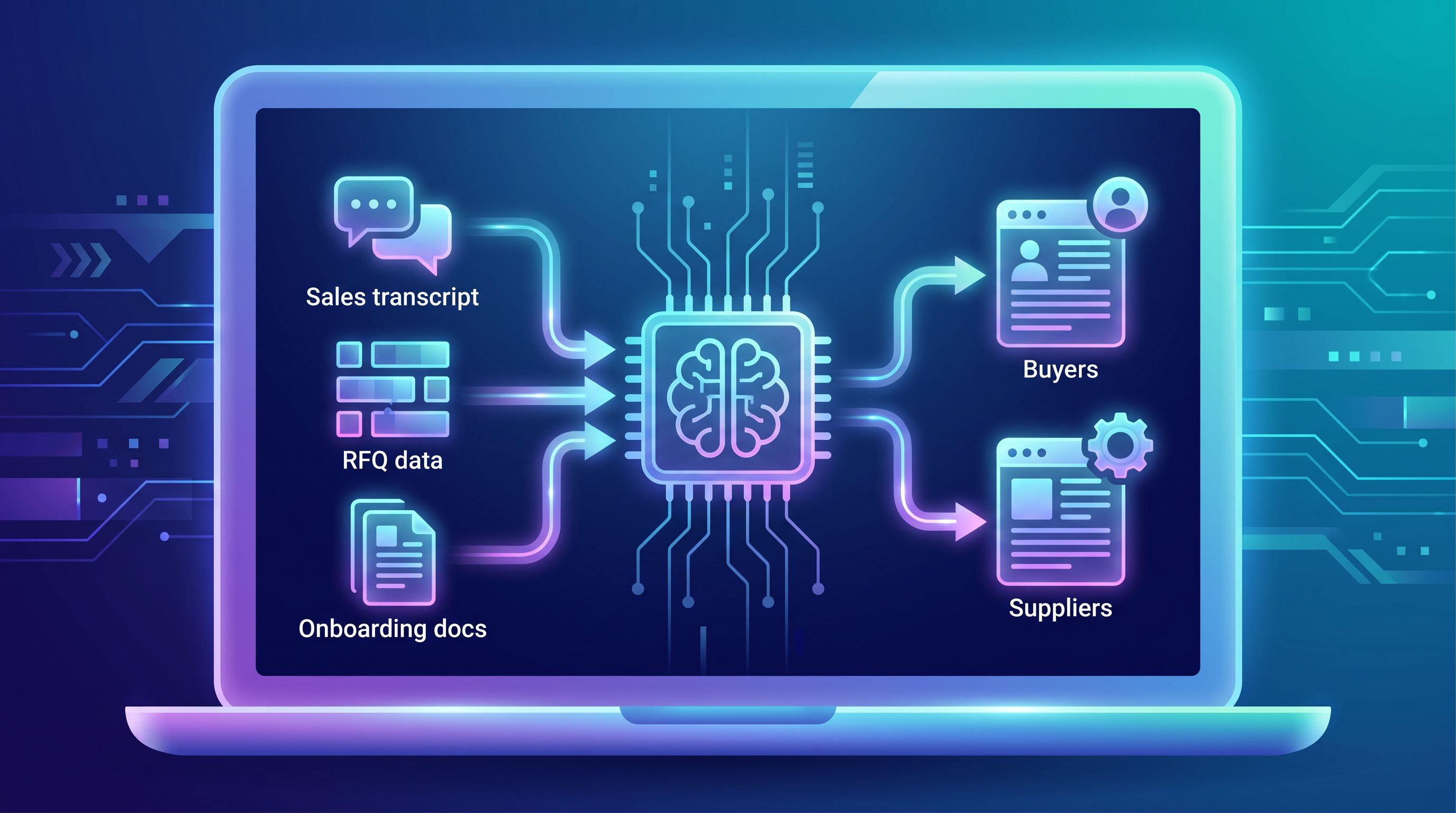
Sales and partner call transcripts
- Objections, comparisons to competitors, internal politics on the buyer side.
You can pipe these into AI in batches to generate:
- Topic lists scored by search intent and business impact.
- Draft outlines tailored for buyer vs supplier personas.
- FAQ sections that mirror real conversations.
If you want a more systematic approach to mining sales and support conversations specifically, see From Sales Scripts to Search Terms: Mining Call Transcripts for Blogg-Ready Topics and SEO Angles.
Step 4: Design Reusable AI Workflows for Each Content Type
To keep quality high while you scale, don’t rely on ad‑hoc prompts. Design reusable workflows for your key content types.
For a B2B marketplace, you’ll typically want workflows for:
-
Category guides (buyer-focused)
- Goal: Help buyers understand options, trade‑offs, and selection criteria.
- Structure: Problem framing → category overview → key specs/criteria → common mistakes → how your marketplace helps.
-
Supplier playbooks (supply-focused)
- Goal: Help suppliers succeed on your platform and prefer it over alternatives.
- Structure: Ideal supplier profile → setup checklist → optimization tips → real examples → metrics to watch.
-
Workflow walkthroughs (two-sided)
- Goal: Explain how a process (RFQ, credit, logistics, returns) works for both parties.
- Structure: Before/after story → step‑by‑step flow → responsibilities by role → screenshots or diagrams.
-
Comparison and evaluation content
- Goal: Help both buyers and suppliers make better channel and vendor decisions.
- Structure: Evaluation criteria → side‑by‑side comparisons (including “do nothing”) → when each option wins.
In a platform like Blogg, you can encode these as templates or flows:
- Input: persona, category, key data points, internal docs.
- Output: SEO‑structured draft with headings, schema suggestions, and CTAs.
Over time, you refine the workflows—not every individual prompt—so quality improves as volume grows.
Step 5: Make Each Post Do Double Duty for Supply and Demand
One of the biggest advantages of a unified content engine is reuse. With a bit of planning, each post can:
- Attract one side via search.
- Reassure and enable the other side via examples and proof.
Here’s how to design that into your posts.
Techniques to serve both sides in a single article
-
Case studies that show both buyer and supplier outcomes
Instead of “how buyer X saved 20%,” tell the story of:- How the buyer consolidated vendors, improved compliance, or reduced cycle time.
- How the suppliers on your marketplace gained new accounts, stabilized volume, or improved forecasting.
-
Shared metrics and dashboards
When you write about analytics or performance, highlight:- What buyers see (on‑time delivery, fill rate, pricing transparency).
- What suppliers see (win rate, quote response time, category share).
-
Mirrored FAQs
Add sections like:- “For buyers: How does this affect your procurement workflow?”
- “For suppliers: What changes in your sales and operations process?”
-
Dual CTAs
Close posts with:- A next step for buyers (e.g., explore a category, start an RFQ, book a workflow review).
- A next step for suppliers (e.g., apply to join, request a catalog review, attend a partner webinar).
When you use AI to draft, you can explicitly instruct it to include these dual elements so they become a consistent pattern across your blog.
Step 6: Don’t Forget the Plumbing (SEO & Indexing)
If you’re going to publish at scale, you need to make sure your content is actually discoverable.
For B2B marketplaces, that means:
- Clear technical SEO foundations – crawlable architecture, clean URLs, canonical tags, proper pagination for category content.
- Schema markup for product, organization, FAQ, and article content so search and AI assistants can parse your material.
- Internal linking from category pages and marketplace UI back to relevant posts (and vice versa).
If you’re planning to ship dozens or hundreds of AI-assisted posts, it’s worth auditing your setup. The ‘Always-Be-Indexed’ Checklist: Technical SEO Must-Haves for High-Volume AI Blogs walks through this in detail.
A platform like Blogg helps here by:
- Enforcing consistent on‑page structures (H1/H2s, meta tags, internal links).
- Managing publishing cadence so search engines see a steady, reliable pattern.
- Integrating with your CMS so content and technical settings stay in sync.
Step 7: Close the Loop With Performance Feedback
The beauty of AI blogging is speed. The risk is publishing a lot of content without learning.
For a B2B marketplace, you want to measure performance on both sides of the market, not just pageviews.
Buyer-side signals
- Organic traffic and impressions to buyer-intent posts.
- Assisted conversions: RFQs started, accounts created, quotes requested.
- Time on page and scroll depth for complex workflow guides.
Supplier-side signals
- Inbound partner applications that mention specific posts.
- Activation metrics for suppliers who consumed onboarding content.
- Win rates or revenue growth in categories with strong content coverage.
Content engine signals
- Which topic clusters drive the most combined buyer + supplier impact.
- Which AI workflows consistently produce high-performing posts.
- Where human editing or SME review improves results the most.
Feed those insights back into your AI system:
- Promote winning patterns into templates.
- Retire or refactor weak ones.
- Update and expand posts that are close to ranking or converting.
If you’re using Blogg, you can treat it like a publishing lab—test titles, intros, CTAs, and structures across posts and let the data shape your future briefs.
Putting It All Together: A Simple Rollout Plan
If you’re starting from scratch, here’s a 60–90 day plan to stand up an AI-powered, two-sided content engine.
Weeks 1–2: Strategy & Inputs
- Define buyer and supplier personas and jobs-to-be-done.
- Audit existing assets: decks, SOPs, onboarding docs, sales scripts, support macros.
- Pull marketplace data: top searches, RFQ patterns, common onboarding questions.
Weeks 3–4: Topic Map & Workflows
- Build your first 3–5 topic clusters (e.g., by category or workflow).
- Design reusable AI workflows for:
- Buyer category guides
- Supplier playbooks
- Workflow walkthroughs
- Configure these workflows in your AI stack or directly inside Blogg.
Weeks 5–8: Production & Publishing
- Generate and review 10–20 posts across both sides of the marketplace.
- Layer in human editing for:
- Accuracy (especially around compliance and pricing).
- Brand voice and examples.
- Publish on a consistent cadence (e.g., 2–3 posts per week) with solid internal linking.
Weeks 9–12: Optimization & Expansion
- Track performance by cluster, persona, and workflow.
- Update posts based on early data (titles, intros, CTAs, internal links).
- Expand into adjacent categories or deeper use cases using the same workflows.
By the end of this cycle, your marketplace has:
- A search-ready library for both buyers and suppliers.
- A repeatable system for turning internal knowledge into public content.
- An AI-assisted engine that can scale with your growth targets.
Summary
B2B marketplaces live and die on trust and clarity—for both sides of the market.
An AI-powered blog, built as a single content engine rather than a pile of disconnected posts, lets you:
- Educate and attract buyers with practical, search-optimized guides.
- Win and enable suppliers with transparent, actionable playbooks.
- Reuse the same assets across marketing, sales, onboarding, and support.
- Scale publishing without scaling headcount, while still protecting quality.
The key is structure:
- Start with clear personas and jobs-to-be-done.
- Build two-sided topic clusters instead of one‑off articles.
- Turn marketplace data and internal docs into AI inputs.
- Use reusable workflows—not random prompts—to generate content.
- Measure impact on both supply and demand, then feed those learnings back into the system.
Do that, and your blog stops being a checkbox—and becomes the connective tissue that keeps your marketplace growing on both sides.
Your Next Step
If you’re running a B2B marketplace and your blog is either empty, sporadic, or buyer-only, this is the moment to reset.
You don’t need a 20‑page content strategy deck to start. You need:
- One or two priority categories.
- A short list of buyer and supplier questions you hear every week.
- An AI engine that can turn those inputs into consistent, SEO‑ready posts.
That’s exactly what Blogg is built for.
Set your audiences, define a few core workflows, and let it handle ideation, drafting, and scheduling so your marketplace can:
- Capture both supply and demand.
- Turn internal knowledge into public proof.
- Build a content moat your competitors will struggle to match.
Take the first step: pick one high-value category, outline a two-sided topic cluster, and run it through an AI-powered workflow. Once you see how quickly that turns into real, search-ready posts, you’ll have the confidence to scale the engine that powers your entire marketplace.