The ‘Minimum Viable Blog’: How to Launch a Search-Ready Content Engine with Just 5 AI Posts


Most teams overcomplicate the start of their blog.
They wait until they have the “perfect” content strategy, 20+ posts in the queue, a new design, and a fully documented tone‑of‑voice guide. Meanwhile, months go by with no content at all—and no search visibility.
You don’t need a full‑blown content program to start earning your place in search.
You need a Minimum Viable Blog (MVB): a tiny, opinionated cluster of posts that:
- Prove to Google (and AI Overviews) what you’re about
- Answer real buyer questions end‑to‑end
- Give you a system you can scale—rather than a one‑off “we finally published something” moment
And you can do that with just five AI‑assisted posts.
Platforms like Blogg exist precisely for this: you define topics, voice, and priorities, and it handles ideation, writing, and scheduling so your blog becomes an always‑on engine instead of a side project.
This article walks through how to design and launch an MVB in a week or two, using AI as your execution engine—and your brain as the strategist.
Why a “Minimum Viable Blog” Works (Even When Everyone Else Has 100+ Posts)
If you read enough SEO forums, you’ll see numbers like:
- “Aim for 24–50 posts in the first 3–6 months.”
- “Sites really start to hum around 50+ focused articles.”
- “Expect 6–12 months before traffic feels predictable.”
Those benchmarks are useful for growth—but they’re terrible for getting started. They make you feel like anything less than 30–50 posts isn’t worth shipping.
Here’s the reality:
- You don’t need dozens of posts to launch. Many SEOs explicitly recommend starting lean with a handful of strong, related posts, then adding content steadily over time.
- Topical focus beats raw volume. Five posts that tightly cover one problem space will do more for your early authority than 20 scattered, generic topics.
- Consistency compounds. Search algorithms reward sites that publish and update regularly. Launching with 5 posts and adding 1–4 per month is far better than waiting six months to drop 25 at once and burning out.
Your MVB is about getting into the game quickly with a structure you can sustain, then letting AI help you scale.
If you want a deeper dive into running a lean, AI‑powered program over time, you might like: SEO Without a Content Team: A 4‑Hour‑Per‑Month AI Blogging Framework for Solo Operators.
The Goal of Your 5‑Post MVB
Before we talk about formats and prompts, it’s worth being explicit about what these five posts are supposed to do.
Your Minimum Viable Blog should:
- Establish topical authority in a narrow, commercially relevant area.
- Answer buyer questions across the journey—from problem‑aware to solution‑aware to product‑aware.
- Be “search‑ready” from day one: clear structure, keyword coverage, internal links, and helpful on‑page UX.
- Act as a reusable template that AI (or a platform like Blogg) can replicate for adjacent topics.
Think of it less like “five random posts” and more like one small, coherent content cluster.
Step 1: Choose a Tight Topic Cluster (Not Just Keywords)
Most new blogs start with a list of keywords. A better approach is to start with a problem theme that maps to revenue.
Ask:
- What’s the main problem our best customers are trying to solve?
- What adjacent questions do they ask before, during, and after buying?
- Which of those questions have clear search intent (you can imagine someone typing them into Google)?
Then, define a single, tight cluster for your first five posts. For example:
- A B2B payments startup: “Reducing invoice friction for agencies.”
- A local med spa: “Long‑lasting, natural‑looking injectables in [city].”
- A dev‑tools company: “Shortening CI/CD feedback loops for small engineering teams.”
Your cluster should:
- Be narrow enough that five posts can cover it meaningfully
- Be close to your product (not just top‑of‑funnel trivia)
- Contain terms your buyers actually say on calls, in support tickets, or in sales emails
If you’re already running outbound or collecting lead lists, you can mine that data for cluster ideas—see: From Lead Lists to Blog Topics: Using AI to Turn Prospecting Data into SEO‑Ready Content Ideas.
Step 2: Define the 5‑Post Blueprint
Here’s a simple blueprint that works across most B2B and service businesses.
Post 1 – The Problem Primer (Educational, Mid‑Funnel)
Goal: Name and frame the core problem your product solves.
Example titles:
- “Why Your Agency’s Invoice Process Is Killing Cash Flow (And How to Fix It)”
- “Why Med Spa Clients Don’t Rebook—and What Your Intake Process Has to Do With It”
What to include:
- Clear definition of the problem, with stakes and consequences
- Symptoms readers will recognize from their own work
- A simple framework or mental model for thinking about the issue
- Soft introduction of your approach (not a hard product pitch)
Post 2 – The How‑To Playbook (Tactical, Solution‑Focused)
Goal: Give readers a step‑by‑step path to improvement—even if they never buy from you.
Example titles:
- “A 5‑Step Playbook for Cutting Your Invoice DSO in Half”
- “How to Design a Med Spa Intake Flow That Actually Increases Rebookings”
What to include:
- Concrete steps, checklists, and examples
- Screenshots or mockups where helpful
- Clear before/after scenarios
- Light mentions of how your product makes each step easier
Post 3 – The Comparison or Alternative Guide (Bottom‑Funnel)
Goal: Capture “vs” and “alternative” searches where buyers are close to a decision.
Example titles:
- “In‑House Billing vs. Outsourced AR: What Growing Agencies Actually Choose”
- “Neuromodulators vs. Fillers: How to Help Clients Choose the Right Treatment Plan”
What to include:
- Honest pros and cons of each option
- When each path makes sense (and when it doesn’t)
- A short section on where your product fits in (or doesn’t)
Post 4 – The Case‑Style Narrative (Social Proof + Story)
Goal: Show your framework in action with a real or composite story.
Example titles:
- “How a 12‑Person Agency Cut Invoice Time by 60% in 90 Days”
- “From One‑Off Appointments to Memberships: How One Med Spa Rebuilt Its Client Journey”
What to include:
- Before → after narrative with specific numbers where possible
- The concrete steps taken (ideally echoing Post 2)
- Quotes or paraphrased observations from the customer
- Clear, grounded outcomes—not hype
Post 5 – The Objection Sweeper (FAQ / Objections)
Goal: Address the questions and doubts that block deals—and that people search for.
Example titles:
- “Agency AR Automation: 9 Common Concerns (And How to Think About Each)”
- “Are Injectables Safe Long‑Term? 11 Questions Clients Are Too Shy to Ask”
What to include:
- A list of 7–15 real questions from sales/support conversations
- Direct, non‑evasive answers
- Links back to the other four posts where relevant
Together, these five posts:
- Cover problem → solution → comparison → proof → objections
- Give Google and AI Overviews a clear cluster of related content to crawl
- Give your sales team assets they can send before and after calls
This is your Minimum Viable Blog.

Step 3: Turn the Blueprint into AI‑Ready Briefs
AI is powerful, but “Write me a blog post about X” will give you generic content.
You’ll get far better results if you treat prompts like mini creative briefs. For each of the five posts, define:
- Audience: Who is this for? Role, company size, level of expertise.
- Outcome: What should they be able to do/decide after reading?
- Key talking points: 5–10 bullets you absolutely want covered.
- Tone & POV: How should it sound? Include 2–3 example phrases you actually use with customers.
- Non‑negotiables: Phrases to avoid, claims you can’t make, legal/brand constraints.
You can feed this structure directly into a general AI assistant, or let a platform like Blogg capture it once and apply it across every post. Blogg vs. Generic AI Writers: What an ‘Opinionated’ Blogging Platform Actually Does Differently goes deeper on why this “system first” approach matters.
If you’re writing prompts yourself, here’s a pattern you can adapt:
“You are writing for [audience] who are struggling with [problem]. The goal of this article is to help them [outcome]. Use a [tone] voice. Include sections on: [list bullets]. Use concrete examples from [industry]. Avoid [list]. At the end, invite them to [next step].”
Run this for each of the five posts, then iterate:
- Ask AI to rewrite sections that feel off‑brand.
- Request more examples or deeper explanations where it’s thin.
- Add your own stories, screenshots, and product specifics.
Step 4: Make Each Post “Search‑Ready” (Not Just “SEO‑ish”)
A lot of AI content technically “mentions the keyword” but isn’t truly search‑ready.
For your five MVB posts, you want to:
1. Map Each Post to a Primary Question
Instead of obsessing over exact‑match keywords, ask: “What question is this post answering better than anyone else?”
Examples:
- “How can a small agency automate accounts receivable without hiring?”
- “What’s the safest way to introduce injectables to first‑time med spa clients?”
Use that question to:
- Shape your H1 and intro
- Guide your subheadings (answer sub‑questions)
- Inform your meta title and description
For a deeper dive on structuring AI posts for search features and AI Overviews, see: The ‘Search‑Aware’ AI Blog: Structuring Posts to Survive SGE, AI Overviews, and Zero‑Click Results.
2. Use Clear, Scannable Structure
For every post:
- One H1 that clearly states the main topic
- Descriptive H2s and H3s that read like questions or outcomes
- Short paragraphs (2–4 lines)
- Bulleted lists where you’re enumerating steps or options
- Callouts for key definitions or warnings
These help both human readers and AI/SEO tools parse your content.
3. Add Internal Links (Even with Only 5 Posts)
Internal links are not just for big sites. With your five posts, you can already:
- Link from the Problem Primer → How‑To Playbook, Objection Sweeper
- Link from the How‑To → Case Story, Comparison Guide
- Link from the Objection Sweeper → all four other posts where relevant
This creates a small but clear content cluster that:
- Helps search engines understand relationships between topics
- Guides readers toward higher‑intent content and conversion points
4. Add Simple Conversion Paths
Even at the MVB stage, every post should make it easy to:
- Book a call or demo
- Start a trial
- Download a checklist or template
- Join a newsletter or “insights” list
You don’t need complex funnels yet. A simple in‑line CTA and a clear end‑of‑post CTA are enough.
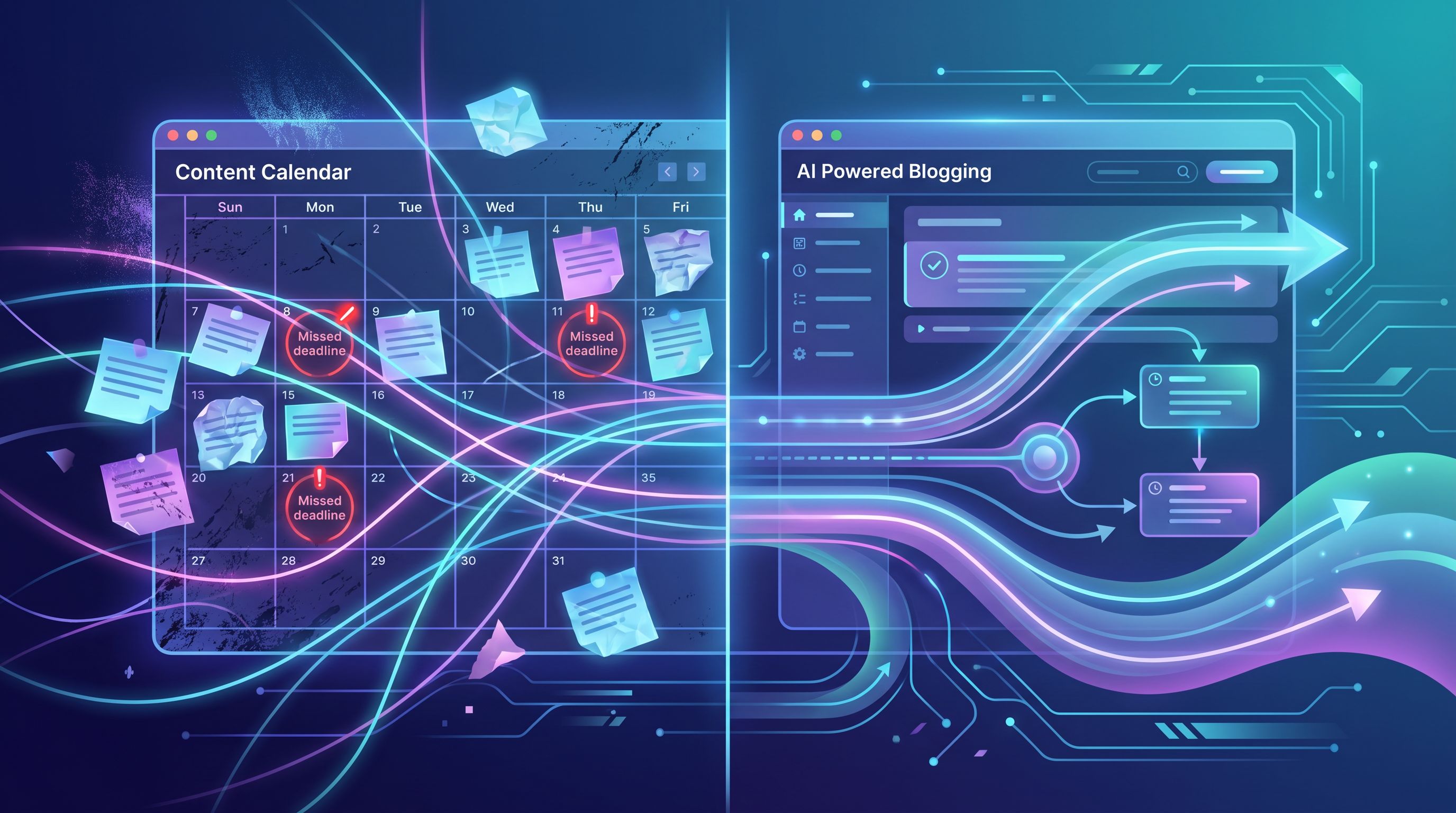
Step 5: Use Automation to Keep the Engine Running
Launching with five posts is the start, not the finish.
The point of an MVB is to:
- Prove the model: “This structure works for our buyers and our team.”
- Give AI a pattern it can replicate across new clusters.
- Build a habit of publishing without turning it into a second job.
Here’s how to keep momentum without burning time:
1. Turn the 5‑Post Blueprint into a Reusable Template
For each new topic cluster, you can repeat:
- Problem Primer
- How‑To Playbook
- Comparison/Alternatives
- Case‑Style Narrative
- Objection Sweeper
Document this once, then:
- Use it as a prompt pattern in your AI assistant, or
- Encode it into an opinionated system like Blogg, which can automatically map new topics into this structure and handle drafting + scheduling.
If you’re curious how to turn that into a true “always‑on” channel, not just a sporadic blog, check out: From “We Have a Blog” to “We Have a Channel”: Turning Blogg Into a Always‑On Content Engine.
2. Set a Minimum Cadence You Can Actually Keep
You don’t need to publish daily. For most small teams, a realistic baseline looks like:
- Month 1: Launch 5‑post MVB
- Months 2–3: Add 2–4 posts/month (one new mini‑cluster)
- After Month 3: Maintain 2–8 posts/month depending on resources
The non‑negotiable: never go back to zero. Even one high‑quality post per month, automated through AI, keeps your site active and compounding.
3. Build a Lightweight Review Layer
AI can handle the heavy lifting, but you still need a human layer to:
- Check for factual accuracy and brand alignment
- Add specific customer examples, screenshots, and numbers
- Ensure claims are compliant and realistic
A simple review workflow:
- AI drafts the post based on your brief.
- A subject‑matter expert spends 15–30 minutes editing and annotating.
- Final pass for links, CTAs, and formatting.
- Schedule and publish.
If you’re scaling to higher volume, you’ll eventually want lightweight guardrails—see: Guardrails, Not Handcuffs: Simple Review Systems That Keep High‑Volume AI Blogs On‑Brand and Low‑Risk.
Step 6: Measure the Right Early Signals
Your five posts won’t turn into a traffic firehose overnight, and that’s okay.
In the first 60–90 days, focus less on “Did we hit 10,000 sessions?” and more on leading indicators:
- Indexing: Are all five posts indexed in Google Search Console?
- Impressions: Are you starting to see impressions for the questions you targeted?
- Average position: Are you landing on page 2–3 for some long‑tail queries yet?
- Engagement: Do readers scroll, spend time, and click internal links?
- Sales feedback: Are reps actually using the posts in their outreach and follow‑ups?
As you add more clusters, these early signals will compound into:
- Steadier organic traffic
- More branded + high‑intent search queries
- Shorter sales cycles (because content pre‑handles objections)
Bringing It All Together
A Minimum Viable Blog is not about doing the least you can get away with.
It’s about doing the smallest thing that actually works:
- Five tightly connected posts that map to a real buyer problem
- Structured in a way search engines and AI Overviews can understand
- Powered by AI so your team doesn’t have to write every sentence from scratch
- Supported by a simple, repeatable pattern you can scale
Instead of waiting until you “have time for content,” you:
- Pick one problem‑centric topic cluster.
- Design a 5‑post blueprint around the buyer journey.
- Use AI (or a platform like Blogg) to draft, refine, and schedule.
- Ship the MVB.
- Repeat the pattern for the next cluster.
That’s how you go from “we really should use our blog” to “we have a search‑ready content engine”—without hiring a content team or turning yourself into a full‑time editor.
Your Next Step
You don’t need to map your entire editorial calendar for the year.
You just need to decide one topic cluster and commit to five posts.
Here’s a simple way to start this week:
- Write down the top 10 questions your best customers ask about one core problem.
- Group them into: problem, how‑to, comparison, proof, objections.
- Turn that into the 5‑post blueprint outlined above.
- Use AI—or connect your site to Blogg—to generate first drafts.
- Spend a couple of focused hours adding your stories, examples, and guardrails.
- Schedule all five posts over the next 1–2 weeks.
Once those are live, you won’t just “have a blog.” You’ll have the first version of a search‑ready content engine—small, focused, and ready to grow with you.
Start there. Let AI handle the heavy lifting. And let your Minimum Viable Blog prove that consistent, strategic publishing is possible for your team right now—not someday when you finally “have time for content.”