The AI Blog Handover: How to Migrate from Inconsistent Posting to Blogg Without Losing Momentum


Most teams don’t decide to “go AI” with their blog from a place of calm.
It usually starts with a pattern:
- A burst of posts during a product launch… then silence.
- A new marketer joins, publishes three strong articles… then gets pulled into “urgent” projects.
- Founders swear this is the quarter they’ll “finally take content seriously”… then the blog sits untouched for months.
Meanwhile, content keeps proving its value:
- Content marketing generates about 3x more leads than outbound and costs significantly less.
- Around 68% of businesses report higher content marketing ROI when they use AI to help.
Consistency is the multiplier on all of that. But consistency is exactly what most small teams struggle to maintain.
This is where an AI-powered system like Blogg comes in. The question isn’t just “Should we use AI?” It’s: How do we hand the blog over to AI without losing the momentum, SEO equity, and brand voice we’ve already built?
That handover is what this guide is about.
You’ll walk away with a practical, step‑by‑step migration plan from:
“We post when someone has time”
to
“Our blog runs on rails with Blogg—and our team only steps in where it really matters.”
Why the Handover Moment Matters So Much
Moving from inconsistent, human‑only publishing to an AI‑driven system isn’t just a tooling change. It’s a compounding decision.
Done well, you:
- Protect and grow your existing SEO equity.
- Turn scattered posts into a coherent content engine (and revenue driver).
- Free your team from the weekly “we really should publish something” guilt loop.
Done poorly, you risk:
- Cannibalizing your own rankings with overlapping AI posts.
- Diluting your brand voice with generic content.
- Confusing subscribers with a sudden shift in topics, tone, or quality.
Think of this as a blog migration, not just “turning on another tool.” You’re moving from:
- Random acts of content → to a system that publishes on schedule.
- Heroic, one‑off efforts → to repeatable workflows.
- Founder‑or‑marketer bottlenecks → to a shared, AI‑assisted engine.
If you’ve ever resonated with the problems in From Random Posts to Revenue Themes: Using AI to Turn Disconnected Articles into a Cohesive Blog Strategy, this handover is your chance to fix them at the system level.
Step 1: Audit What You’ve Already Built (So You Don’t Start From Zero)
Before you ask Blogg to generate a single new post, you need a clear picture of what’s already working—and what’s just taking up server space.
Run a lightweight content audit
You don’t need a 60‑page deck. A simple spreadsheet with these columns is enough:
- URL / slug
- Primary topic / keyword
- Buyer journey stage (awareness, consideration, decision)
- Traffic (last 3–6 months)
- Key conversions (demo requests, trials, email signups, etc.)
- Last updated date
- Notes (e.g., “outdated screenshots,” “thin content,” “top performer,” “overlaps with X post”)
Group posts into rough buckets:
- Keep and protect – Your top 10–20% of posts that drive most of the traffic/leads.
- Refresh and upgrade – Solid topics with outdated or shallow content.
- Consolidate or redirect – Duplicate, overlapping, or underperforming posts.
- Archive quietly – Irrelevant announcements, dead product features, or content that no longer aligns with your strategy.
Aim to understand patterns, not just individual posts. Where have you unintentionally built authority? Where are the gaps?
If you want a deeper framework for this, When Less Is More: How to Use AI to Double Blog Conversions Without Publishing More Posts walks through how to identify and upgrade the posts that actually move revenue.
Step 2: Decide What “Momentum” Really Means for You
You can’t preserve momentum if you haven’t defined it.
For some teams, momentum = publish 2x/week. For others, it’s grow organic demos by 20% over six months.
Clarify 3–5 concrete targets for the next 6–12 months, such as:
- Publishing cadence: e.g., 4 posts/month, every Tuesday.
- Traffic goals: e.g., +30% organic traffic to product‑adjacent topics.
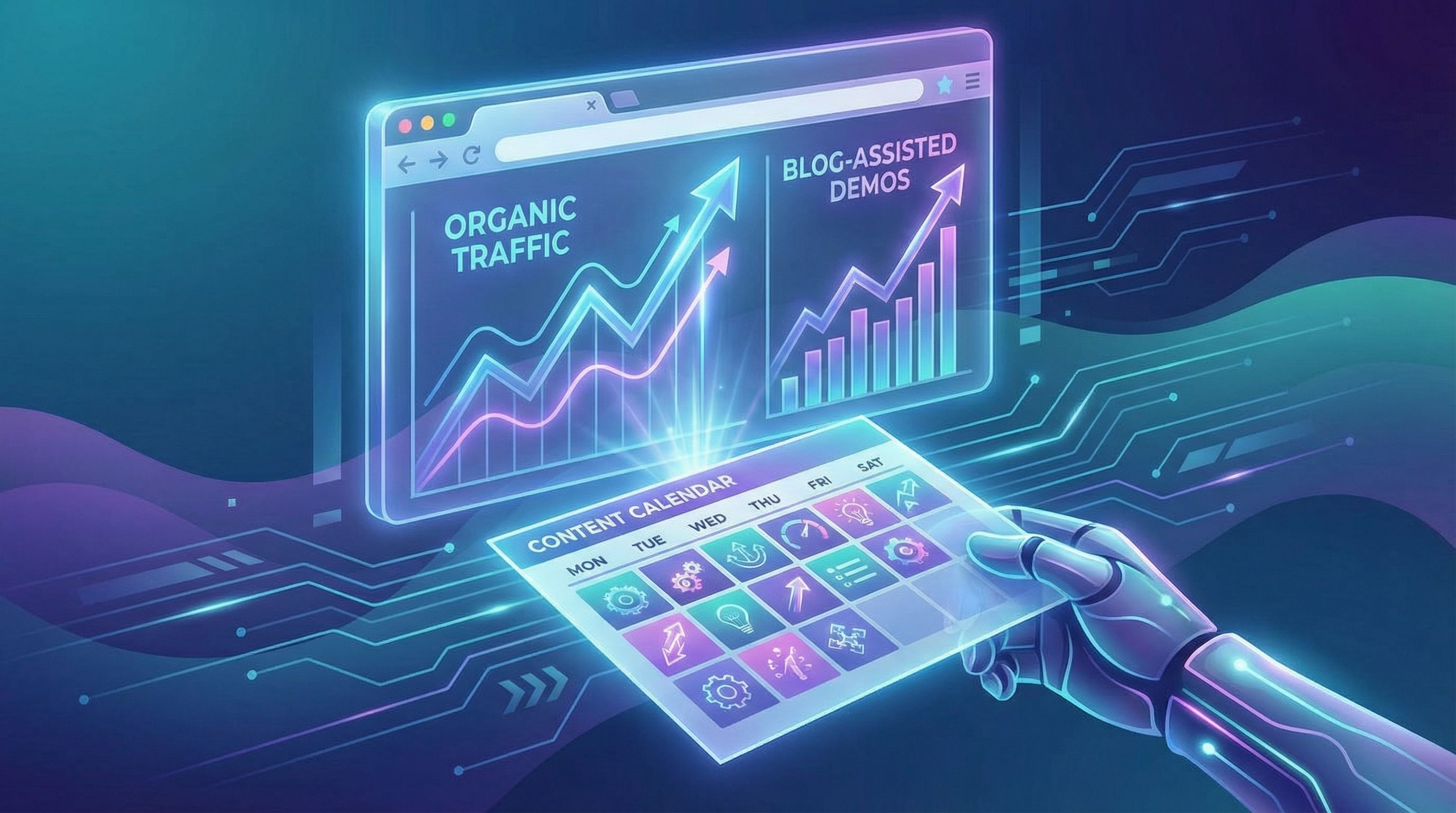
- Lead goals: e.g., blog‑assisted demos up from 10/month to 25/month.
- Topic focus: e.g., 80% of posts within three core themes tied to revenue.
Then decide what you want Blogg to own:
- Net new posts only?
- Refreshes of existing posts?
- Both, plus idea generation and scheduling?
The more specific you are here, the easier it is to set up Blogg so it feels like a natural extension of your current blog, not a separate content universe.
Step 3: Translate Your Blog’s DNA Into AI‑Readable Instructions
If you just say “write B2B SaaS content for founders,” every AI system on earth will give you something that sounds like… everyone else.
You need to encode your blog’s DNA so Blogg can learn and repeat it.
Capture your voice and point of view
Start with 3–5 of your best existing posts and ask:
- What’s the tone? (direct, playful, formal, opinionated?)
- How do we use examples? (real customer stories, hypothetical scenarios, analogies?)
- How do we handle jargon? (plain language vs. heavy technical detail?)
- What are our non‑negotiables? (e.g., “no fluff intros,” “always include real numbers,” “never bash competitors by name.”)
Turn those into explicit instructions for Blogg, similar to the prompt systems described in Prompt Libraries for Blogging Teams: Reusable AI Instructions That Keep Every Post On-Brand and On-Strategy.
For example:
- “Open with a concrete situation, not a generic statement.”
- “Every post must include at least one real‑world example or mini‑case.”
- “Avoid buzzwords like ‘disruption’ and ‘synergy.’ Prefer plain language.”
Define your structural patterns
Document the patterns that make your posts perform:
- Typical length range (e.g., 1,200–1,800 words).
- Preferred section flow (problem → why it matters → step‑by‑step → examples → summary).
- Formatting rules (bullet points every 200–300 words, bold key takeaways, etc.).
Feed this into Blogg as defaults so every new draft starts aligned with your standards.

Step 4: Map Your Old Posts to a New AI‑Powered Strategy
Now you’re ready to connect the dots between what you have and what Blogg will create next.
Choose your revenue themes
From your audit, identify 3–5 themes that:
- Already show traction (traffic, rankings, or conversions), and
- Map directly to how you make money.
Examples:
- “Construction project management templates”
- “Fractional CMO pricing and ROI”
- “SOC 2 compliance for seed‑stage SaaS”
This is where the approach from The ‘Quiet’ SEO Wins: Using AI to Capture Unsexy, High-Intent Keywords Your Competitors Ignore is especially powerful. Use AI to:
- Surface the long‑tail, high‑intent queries your best buyers are Googling.
- Plan clusters of posts around those queries instead of chasing vanity keywords.
Turn themes into a 90‑day publishing plan
For each theme, let Blogg help you generate:
- 3–5 supporting posts (how‑tos, comparisons, checklists).
- 1–2 refreshes of existing posts that already rank but could be stronger.
- 1 anchor guide (a deep, evergreen piece that everything else links to).
Then slot them into a simple calendar:
- Week 1: Refresh existing high‑traffic post + 1 supporting post.
- Week 2: New supporting post.
- Week 3: Anchor guide.
- Week 4: New supporting post + refresh of an older underperformer.
The key: you’re not just “turning on AI.” You’re using Blogg to extend and deepen what’s already working.
Step 5: Set Up a Parallel Run Instead of a Hard Switch
A common mistake is to flip the switch overnight:
Friday: last human‑only post.
Monday: entirely new AI‑driven voice, cadence, and topics.
That whiplash isn’t necessary.
Instead, run a 4–8 week parallel period where:
- Your team continues to publish 1–2 posts using your current process.
- Blogg drafts and schedules an additional 1–2 posts per month.
Use this window to:
- Compare engagement metrics (time on page, scroll depth, conversion rate) between human‑led and AI‑assisted posts.
- Fine‑tune your voice, structure, and topic instructions inside Blogg.
- Stress‑test your review workflow so nothing gets stuck waiting for approvals.
By the end of this phase, your readers should feel like the blog is simply more consistent and useful, not “suddenly robotic.”
Step 6: Build a Lightweight Review and QA Workflow
The goal of migrating to Blogg isn’t to move the bottleneck from “writing” to “endless reviewing.”
Design a review workflow that:
- Protects quality and brand voice.
- Takes 15–20 minutes per post, not hours.
A simple three‑layer check works well:
-
Strategy check (2–3 minutes)
- Does this post clearly support one of our themes?
- Is the target reader obvious?
- Is the CTA aligned with where that reader is in the journey?
-
Substance check (10–12 minutes)
- Are the examples specific enough—or do we need to plug in real customer stories?
- Are there any factual inaccuracies or risky claims?
- Are we actually saying something useful and not just summarizing what’s already on page one?
-
Polish check (5 minutes)
- Quick pass for phrasing, internal links, and formatting.
- Add 1–2 sentences of human POV where it matters most (intro, key takeaway, or CTA).
If you’re a founder or exec who’s been personally proofreading every post, you’ll find a more detailed version of this approach in Founders, Stop Proofreading Every Post: A Lightweight Review Workflow for High-Volume AI Blogging.
Step 7: Protect Your SEO While You Scale With AI
One of the biggest fears in an AI handover is: “Will this hurt our existing rankings?”
You can actually use Blogg to protect and grow that visibility if you’re intentional.
Guardrails to put in place
-
No duplicate topics without a plan.
Before creating a new post, check if you already have something similar. If you do, either:- Refresh and expand the existing piece, or
- Create a clearly differentiated angle (e.g., beginner vs. advanced, strategy vs. checklist).
-
Use internal linking deliberately.
Instruct Blogg to:- Always link new posts back to your anchor guides.
- Reference related posts across themes where it’s natural.
-
Refresh before you rewrite.
For posts that already rank, prioritize updates (new data, clearer structure, better examples) over brand‑new URLs. -
Track a small set of leading indicators.
Don’t drown yourself in dashboards. Watch:- Organic traffic to your top 10 posts.
- Total number of posts within each revenue theme.
- Blog‑assisted conversions (even if it’s just “last touch before demo request”).
As AI‑assisted search and answer engines become more prominent, the principles in Search in 2025: How AI Overviews, SGE, and Chatbots Change the Way Your Blog Should Be Written are worth revisiting. The short version: structure your posts so they’re easy for both humans and AI systems to summarize—and worth citing.
Step 8: Decide What Stays Human
Handing your blog over to Blogg doesn’t mean humans disappear from the process.
In fact, the highest‑leverage move is to be ruthless about what must stay human:
Keep these human‑led (with AI as support):
- Deep founder POV pieces and contrarian takes.
- Sensitive topics (pricing changes, layoffs, industry crises).
- Detailed customer stories where nuance and emotion matter.
Let Blogg take the lead on:
- Evergreen how‑tos and explainers.
- Long‑tail, high‑intent SEO topics.
- Systematic refreshes and expansions of existing content.
- Repurposing posts into social snippets, email intros, or resource roundups.
The outcome: your small team spends its limited creative energy where it has the most impact, while the platform quietly keeps your content engine humming.
Step 9: Make the Handover Visible Internally (and Quiet Externally)
Externally, your audience should barely notice the transition—other than seeing more consistently helpful posts.
Internally, treat the handover as a real change in how marketing works.
Share a simple one‑pager with your team that covers:
- Why you’re doing this now (e.g., “We want our blog to drive pipeline, not guilt.”)
- What Blogg will own vs. what humans will own.
- How to request content (e.g., sales can submit topic ideas tied to common objections).
- How performance will be measured (traffic, leads, assisted revenue, etc.).
This alignment keeps you from sliding back into the old pattern where every team member “just writes something” when they feel like it—fragmenting your themes and confusing your analytics.
Bringing It All Together
Migrating from inconsistent, human‑only blogging to an AI‑powered system like Blogg is less about replacing writers and more about replacing chaos with a compounding engine.
To recap the path:
- Audit what you’ve already built so you don’t start from zero.
- Define what momentum means for your team and your revenue.
- Encode your voice and structure into clear AI instructions.
- Map existing posts to new themes and build a 90‑day plan around them.
- Run a parallel period instead of a hard switch to de‑risk the transition.
- Design a lightweight review workflow that keeps quality high without burning hours.
- Protect your SEO with smart internal linking, refreshes, and topic discipline.
- Keep the right pieces human, and let Blogg handle the rest.
- Align your internal team so everyone knows how the new engine works.
Do this well, and the handover moment becomes a before/after line in your growth story—not just a tooling change.
Your Next Step: Run a 30‑Day Handover Experiment
You don’t need a massive rebrand or a six‑month project plan to start.
Here’s a simple way to take the first step this month:
- Pick one revenue theme you care about most.
- Audit 5–10 existing posts related to that theme.
- Set up Blogg with:
- Your voice and structure guidelines.
- That theme as a focus area.
- Ask it to generate:
- 1 anchor guide.
- 2–3 supporting posts.
- 1 refresh of an existing article.
- Run them through your lightweight review workflow and publish on a clear schedule.
At the end of 30 days, compare:
- How much time you spent on content.
- How many posts went live.
- Early signals in traffic and engagement.
If the results look promising, expand the experiment to your next theme—and let the AI blog handover become a quiet, compounding upgrade to how your entire business shows up in search.
When you’re ready to see what that looks like in practice, start by defining your first theme and plugging it into Blogg. The sooner your system takes over the consistency problem, the sooner your team can get back to the work only humans can do.