Search in 2025: How AI Overviews, SGE, and Chatbots Change the Way Your Blog Should Be Written


Google is no longer just a list of blue links.
Between AI Overviews (formerly SGE), AI Mode, Bing’s AI answers, and chatbots like ChatGPT, Gemini, and Perplexity, more of your buyers are getting summaries instead of scrolling through ten links and picking one.
For your blog, that’s a seismic shift.
If you keep writing posts the way you did in 2019, you’ll increasingly be summarized by AI instead of chosen by humans.
This post is about how to flip that dynamic: how to write (and systematize) content so AI Overviews and chatbots need to cite you, and humans still choose to click through.
Why this matters for your blog in 2025
A few quick data points set the stage:
- Google’s AI Overviews (the evolution of SGE) are now available to more than a billion users and continue to expand globally, appearing when Google thinks an AI summary will help people understand a topic faster.
- Studies through 2024–2025 show AI Overviews appear most often for longer, question-style queries and complex tasks—exactly the kind of searches B2B buyers make when they’re researching problems and solutions.
- Pew Research and other analyses show most U.S. adults have now encountered AI-generated summaries in search results, and a growing share use AI chatbots as part of their information-gathering routine.
In other words:
- Your future buyers will often see an AI summary before they see your brand.
- AI systems decide which sources to cite and link.
- Click-through is no longer guaranteed, even if you “rank.”
That sounds scary, but it’s actually an opportunity if you adapt your content strategy now.
How AI Overviews and chatbots actually use your content
Before you can optimize, you need a mental model of what’s happening.
1. AI Overviews: “Answer boxes on steroids”
When a user searches, Google may:
- Crawl and index pages (as always).
- Use an AI model to read those pages and synthesize a short answer.
- Show that answer at the top of the page, with a handful of cited sources.
Key implications:
- The model looks for clear, scannable explanations. Pages with tight definitions, bullet lists, and structured sections are easier to summarize (and more likely to be used as sources).
- It prefers trustworthy, topic-focused sites. Topical authority, E‑E‑A‑T signals, and clean internal linking matter more than ever.
- You can be cited even if you’re not position #1. AI Overviews may pull from multiple mid-SERP sources if they’re especially clear or unique.
2. AI chatbots: “Meta-readers” of the web
Chatbots like ChatGPT, Gemini, Copilot, and Perplexity:
- Have been trained on large swaths of the public web.
- Often browse live pages when a user asks for up-to-date or niche information.
- Summarize, compare, and synthesize across multiple sources.
For your blog, this means:
- Your content is competing at the sentence and paragraph level, not just at the URL level.
- Original frameworks, data, and examples travel well. Chatbots love to quote and reuse distinctive concepts.
If your blog is a pile of generic “10 tips for X” posts, you’re easy to replace. If you publish sharp, opinionated, structured explanations, you become the thing AI tools lean on.
The new job of a blog post in an AI-first search era
A blog post used to have one primary job: rank and earn the click.
Now a single post has to do three jobs at once:
- Feed AI Overviews and chatbots with clear, accurate, well-structured information.
- Earn the click anyway by promising depth, nuance, or tools that a summary can’t fully capture.
- Convert the visit into a next step—email, demo, trial, or at least another high-intent page.
That’s a lot to ask of one article. It’s also why more teams are moving to systems and automation, using platforms like Blogg to handle ideation, drafting, and scheduling while they focus on strategy and editing.
If you’re still doing everything manually, you’ll struggle to keep up with the volume and structure required.
How to write blog posts that AI and humans can’t ignore
Let’s get practical. Here’s how to adapt your content from headline to CTA.
1. Start with the real query behind the keyword
AI Overviews and chatbots tend to appear for:
- Longer, natural-language queries
- Question phrases (“how do I…”, “what’s the best way to…”)
- Multi-step tasks (“plan a 3-month content strategy for a B2B SaaS launch”)
So instead of optimizing only for a short keyword like content calendar template, design your post around the full question a buyer would type or ask aloud:
“How do I build a content calendar that supports SEO, sales, and launches with a small team?”
Practical move:
- Include that full question (or a close variant) in:
- Your H1 or H2
- The intro paragraph
- An explicit FAQ section
This increases your odds of:
- Being used as a source for AI Overviews.
- Matching the user’s intent when they click through.
If you’re using Blogg, this is where tight topic inputs matter. Pair it with the approach in “AI Topic Research in 30 Minutes” so each post is anchored to a real, question-style query with traffic potential.
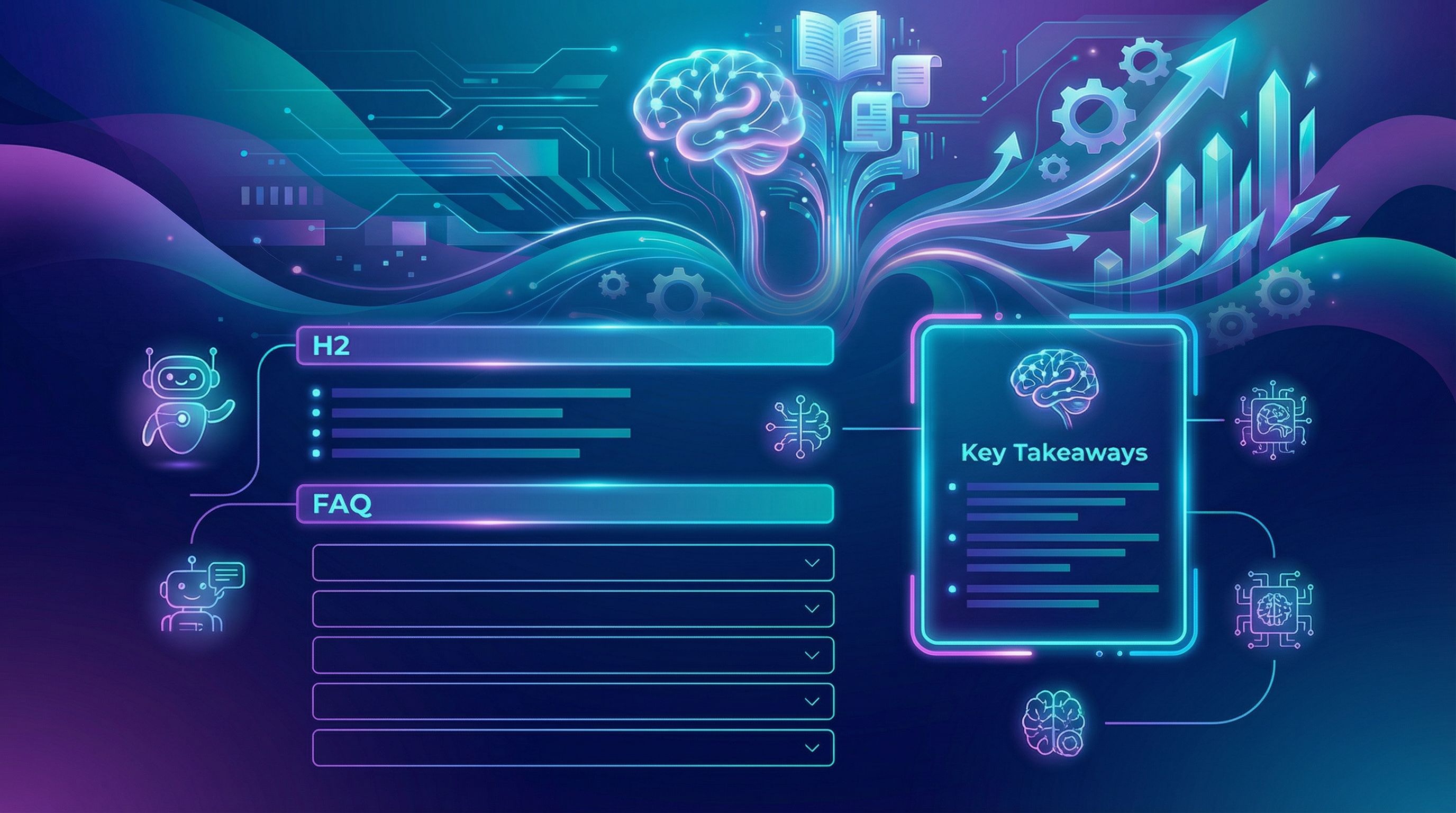
2. Structure your post for “summary-first” search
Think of your article as layers:
- Layer 1 – Quick answer: A concise, high-quality answer that could stand alone inside an AI Overview.
- Layer 2 – Skimmable structure: Headings, bullets, and mini-summaries that make it easy for models (and people) to parse.
- Layer 3 – Depth and differentiation: Stories, frameworks, screenshots, processes, and opinions that go beyond what AI can comfortably compress.
Tactical checklist:
- Open with a 2–4 sentence direct answer to the main question.
- Use H2/H3s that read like sub-questions.
- Example: “What does AI search mean for B2B blog traffic?” instead of “Impact on traffic.”
- Add bullet lists and numbered steps under each heading.
- Include an FAQ section at the end with 3–7 short Q&As.
Well-structured content is easier for:
- AI Overviews to quote.
- Chatbots to summarize accurately.
- Busy buyers to scan and still feel they got value.
3. Make your content “AI-citable” with unique value
AI tools don’t just look for any explanation; they look for high-signal, low-noise content:
- Clear definitions
- Concrete numbers
- Distinctive frameworks
- Step-by-step processes
To stand out, bake in:
- Original terminology or frameworks. Name your process (“The 3-Layer AI Search Content Model”) so chatbots have something specific to reference.
- Simple, quotable definitions. E.g., “AI Overviews are Google’s AI-generated summaries that appear above or alongside traditional search results for complex, question-style queries.”
- Lightweight proprietary data. Even a small internal stat (“Across 50 posts, we saw X…”) makes your page more interesting to both humans and models.
This is where many AI-only blogs fall short: they publish structurally sound but generic content. If you’re using Blogg, pair it with a process like the one in “From First Draft to First Page” so every AI draft gets upgraded with your own insights before you hit publish.
4. Optimize for the post-click experience
AI Overviews and chatbots will continue to answer more surface-level questions directly. Your job is to:
- Give away the “what” freely in summaries.
- Make the “how exactly, for my situation” live on your site.
Ways to do that:
- Include templates and checklists. Offer a simple download or embedded template that AI can’t fully reproduce.
- Use progressive depth. Start with the basics, then add sections like:
- “What this looks like for a 3-person marketing team”
- “How this changes at $10M+ ARR”
- Add contextual examples. Screenshots, anonymized buyer stories, or before/after content flows are hard to compress into a two-sentence AI summary.
And don’t forget conversion:
- Place inline CTAs that match intent (e.g., “Want to automate this entire workflow? Here’s how small teams do it in 30 days.” linking to /from-zero-posts-to-weekly-publishing-how-small-teams-use-blogg).
- Use end-of-post CTAs that invite a small next step: email course, checklist, or strategy call.
5. Build topical authority, not topic chaos
AI Overviews and AI search features lean heavily on sites that show depth and coherence around a theme.
If your blog is a scattershot mix of:
- “What is SEO?”
- “Best office snacks 2025”
- “Our company retreat recap”
…you’re sending weak signals.
Instead, you want tight content clusters around the problems you solve.
Practical approach:
- Pick 3–5 core themes tied to your product and revenue.
- Under each, map:
- 1–2 deep “pillar” guides
- 6–12 supporting posts answering narrower questions
- Interlink them intentionally.
If you’ve ever felt your AI content was turning into a messy archive, you’ll find a deeper walkthrough in “From Topical Authority to Topical Chaos”.
Platforms like Blogg are particularly useful here because you can define themes once, then let the system generate and schedule posts that naturally reinforce those clusters.
6. Write with both humans and models in mind
There’s a temptation to over-SEO for AI: stuffing FAQs, repeating phrases, or over-formatting. Resist that.
A healthy middle ground:
- Plain language first. If a non-expert buyer can’t follow your explanation, AI models probably won’t either.
- Consistent terminology. Don’t call the same thing “AI Overviews,” “AI summaries,” and “smart answers” in one post unless you define them clearly.
- Clean HTML structure. Use real H1/H2/H3 tags, ordered lists, and semantic markup. This helps both crawlers and models.
- Avoid fluff. Long intros that say nothing are bad for readers and make it harder for AI to identify your key points.
You can systematize this with a simple scorecard like the one in “The AI Content Quality Scorecard”, applied to every draft before it goes live.

7. Use AI to analyze SERPs, not just write posts
If AI is reshaping search, you can also use AI to reverse‑engineer what’s working.
For each important topic:
- Search your main query in an incognito window. Note:
- Whether an AI Overview appears
- What kinds of sources it cites (publisher types, formats)
- How it structures the answer
- Ask an AI chatbot to:
- Summarize the current top 5–10 results
- List common headings and subtopics
- Identify gaps (questions not answered well)
- Design your post to:
- Cover all the must-have basics
- Fill the gaps with better explanations, examples, or frameworks
If you want a deeper workflow for this, pair your process with the approach in “SEO Without the Guesswork”.
This is also where an automated platform shines: once you’ve figured out a structure that works for AI-rich SERPs, you can encode that pattern into your briefs or templates and let Blogg apply it across dozens of posts.
8. Systematize, don’t heroic-effort, your publishing
Search is getting more competitive, not less. AI summaries don’t reduce the need for content; they raise the bar for:
- Consistency
- Structure
- Depth
- Internal coherence
Trying to do all of that manually, every week, is a recipe for burnout.
Instead:
- Delegate ideation, drafting, and scheduling to systems.
- Keep strategy, voice, and editing as your human leverage.
That’s the philosophy behind platforms like Blogg: you set topics, guardrails, and cadence; the system keeps your blog alive with fresh, SEO-aware posts that you can lightly edit and approve.
If you’re a founder or one-person marketing team, this is exactly the shift described in:
Treat your blog like a product: define the system once, then let it run.
Putting it all together
Let’s recap the key moves for writing blog posts that thrive in AI-shaped search:
- Design for question-style, complex queries. Write to the full question behind the keyword.
- Layer your content. Quick answer → skimmable structure → deep, differentiated insight.
- Make your pages AI-citable. Clear definitions, unique frameworks, light proprietary data.
- Win the post-click moment. Offer depth, templates, and examples AI can’t fully compress.
- Build tight topic clusters. Show clear authority around the problems you solve.
- Write for humans and models. Plain language, consistent terms, clean structure.
- Use AI for analysis, not just drafting. Let it help you decode SERPs and spot content gaps.
- Automate the grind. Use systems like Blogg so you can focus on strategy and editing.
If you do these things, AI Overviews and chatbots stop being a threat and start becoming distribution. They’ll still summarize—but they’ll be summarizing you.
Your next step
You don’t need to rebuild your entire content strategy overnight. Start small:
- Pick one high-intent topic your buyers care about.
- Audit the current SERP, including AI Overviews. Note what’s missing.
- Create or refresh one pillar post using the principles in this article.
- Set up a simple system (whether in-house or with a platform like Blogg) to publish at least one supporting post per week around that topic.
Give that experiment 60–90 days.
You’ll come away with:
- A repeatable structure that plays nicely with AI Overviews and chatbots
- A clearer sense of how your buyers search in 2025
- A working content engine you can scale across the rest of your blog
The hardest part isn’t mastering AI search—it’s deciding to adapt.
Choose one topic, one pillar post, and one simple system. Then hit publish and let the compounding begin.