
From First Draft to First Page: A Practical Editing Checklist for Turning AI Blogg Posts into Top-Ranking Articles


From First Draft to First Page: A Practical Editing Checklist for Turning AI Blog Posts into Top-Ranking Articles
If you’re using AI to keep your blog publishing consistently, you’ve already solved the hardest part: getting drafts out of your head and into your CMS.
But drafts don’t rank. Finished, focused, edited articles do.
Whether your content starts in ChatGPT, another AI tool, or an automated platform like Blogg, the difference between "pretty good AI draft" and "page-one performer" is what happens in the edit.
This post gives you a practical, repeatable editing checklist you can run on every AI-generated blog post—especially those created through Blogg—so you can:
- Protect your brand voice and expertise
- Improve accuracy and trust
- Align with real search intent (what searchers actually want)
- Earn clicks, dwell time, and conversions—not just impressions
If you’ve already dialed in your prompts and briefs, this is the missing layer between "AI content at scale" and "SEO results at scale." (If you’re still working on prompts, bookmark this and also read When AI Content Backfires: Common Blogging Mistakes (and How to Avoid Them with Better Prompts) next.)
Why editing AI drafts is non‑optional if you care about rankings
AI can generate a 2,000-word post in seconds. Search engines and buyers can also spot generic, shallow, or inaccurate content in seconds.
Without a clear editing process, AI drafts tend to:
- Miss search intent – They target a keyword but not the real job the reader is trying to get done.
- Skim over specifics – They sound polished but lack data, examples, and concrete how-tos.
- Blend into the noise – They read like everyone else in your category.
- Introduce risk – They may hallucinate stats, misinterpret regulations, or oversimplify complex topics.
On the flip side, when you treat AI as a first-draft assistant and layer on a strong edit, you get the best of both worlds:
- Consistent publishing (especially if you’re using Blogg to automate ideation, writing, and scheduling)
- Posts that actually stand a chance at ranking, earning links, and driving leads
If you’ve already built a content flywheel or automated cadence—like we talk about in The Content Flywheel for Founders: Using AI Blogs to Fuel SEO, Sales Enablement, and Email in One Workflow—this checklist is how you keep quality high without slowing everything down.
The high-level workflow: from AI draft to SEO-ready article
Before we zoom into the checklist, here’s the simple workflow you’re aiming for:
- Generate a draft using your AI tool or Blogg, based on a clear brief and target keyword.
- Run the draft through this editing checklist (you can do it yourself or assign it to an editor/marketer).
- Update the post in your CMS with optimized structure, links, and calls to action.
- Publish and monitor: track rankings, clicks, and conversions; feed learnings back into your briefs.
The rest of this post is about step 2.
Checklist Step 1: Confirm the post deserves to exist
Before you spend time polishing, make sure the topic and angle are worth ranking for.
Ask:
- Does this post match real search intent?
- If the keyword is informational ("how to…"), does your draft actually teach, or does it pitch too early?
- If the keyword is comparison or commercial ("X vs Y", "best [tool]"), does it help a buyer evaluate options?
- Is the angle differentiated?
- Would a reader learn or feel something here they couldn’t get from the top three search results?
- Does it fit your SEO structure?
- Does this post support a pillar page or cluster you’re trying to build, or is it a random one-off?
If the answer to any of these is "not really," adjust the angle before you edit. For a deeper dive on this decision-making, see Beyond Keywords: How to Use AI to Match Blog Posts to Real Search Intent (and Filter Out Bad Topics).
Quick fix if the intent is off:
- Rewrite the H1 and intro to clearly state the main problem and promise.
- Add or remove sections so the outline mirrors what searchers expect (how-to steps, comparisons, definitions, FAQs, etc.).
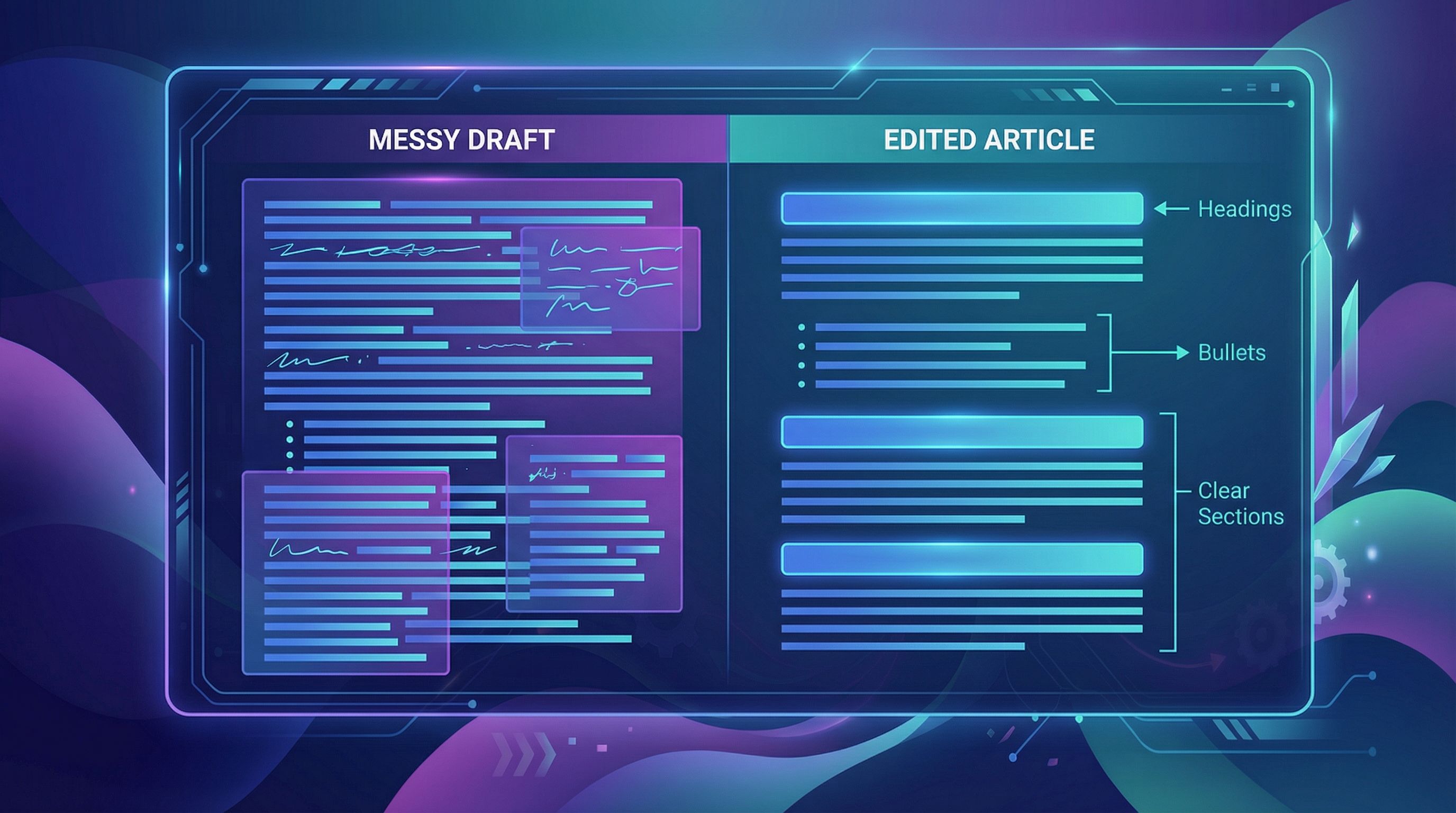
Checklist Step 2: Tighten the structure for skimmers and search
Most readers skim first, then decide whether to commit.
Your job is to make the post instantly scannable and algorithm-friendly:
- One clear H1 that includes your primary keyword naturally.
- Logical H2/H3 hierarchy that:
- Follows a narrative (problem → solution → next steps), and
- Includes secondary keywords where it makes sense.
- Short paragraphs (2–4 lines) and plenty of white space.
- Bulleted and numbered lists for processes, tips, and comparisons.
- Descriptive subheadings, not clever ones. "How to audit your AI draft for accuracy" beats "Check yourself before you wreck yourself."
If you’re using Blogg, you can standardize this structure in your content templates so every AI draft starts 80% of the way there.
Checklist Step 3: Make the intro do three jobs at once
A strong intro is one of the biggest levers for both readers and rankings.
Your first 150–200 words should:
- Hook – Name a pain, tension, or outcome your reader cares about.
- Promise – Explain what they’ll get from the post.
- Position – Show why your perspective is worth their time.
A simple template you can use to rewrite AI-generated intros:
You’re trying to [achieve goal], but keep running into [specific obstacles]. You’ve tried [common attempts], yet [frustrating result].
This guide walks you through [clear promise of what’s inside], so you can [desired outcome] without [thing they want to avoid].
Then add 1–2 sentences that connect to your product or process only if it’s genuinely relevant.
Example for an AI-edited blog post:
You’re using AI to publish more blog content, but you’re not seeing the rankings or leads you hoped for. The drafts look fine at a glance—but something’s not landing with searchers or buyers.
This guide gives you a practical editing checklist you can run on any AI-generated draft, so you can turn "pretty good" into "page-one contender" in under an hour.
Checklist Step 4: Inject your brand voice and point of view
AI defaults to neutral, generic language. That’s the opposite of memorable.
To fix this, run a "voice pass" where you:
- Replace generic phrases with how your team actually talks.
- "Leverage synergies" → "Work together better"
- "Utilize" → "Use"
- Add specific opinions where the draft is lukewarm.
- Instead of: "There are pros and cons to both," say: "If you’re a team under 10 people, X is almost always the better starting point."
- Use your signature phrases or frameworks.
- If you have a "Minimum Viable Blog" concept, reference it and link to The Minimum Viable Blog: A Lean Publishing Strategy for Busy Founders Using AI.
- Tighten tone consistency.
- Decide: are you more conversational or formal? More playful or serious? Edit to match.
If you’ve already built a brand voice guide or "voice in a box," this step is faster. (If not, our post Brand Voice in a Box: Training AI to Sound Like Your Company Across Every Blog Post can help you create one.)
Practical trick: read sections out loud. Anywhere you stumble, cringe, or think "we’d never say it that way," mark it for revision.
Checklist Step 5: Audit for accuracy, depth, and originality
This is where you protect your credibility.
1. Facts and claims
- Highlight all stats, dates, and strong claims.
- For each one, ask:
- Can I quickly verify this with a reputable source?
- Is this still true as of this year?
- If you can’t verify it quickly, either:
- Remove it, or
- Rephrase it as a softer, more general insight.
2. Depth and specificity
AI drafts often describe what to do without showing how.
Upgrade by:
- Adding concrete examples (e.g., show a before/after of a headline, or how a founder might apply the tip this week).
- Including simple frameworks (e.g., a 5-step checklist, a 3-part test, a small scorecard).
- Referencing real workflows in tools your audience uses (e.g., "Create a saved SERP analysis view in your SEO tool, then…").
3. Originality and differentiation
Ask:
- Could this paragraph appear on a competitor’s blog without anyone noticing?
- Where can we add:
- A story from a customer or internal experiment?
- A contrarian angle ("Most advice says X; we’ve found Y works better")?
- A niche use case that only our audience would recognize?
You don’t need to rewrite everything—adding 10–20% of truly unique insight can be enough to stand out.

Checklist Step 6: Optimize for SEO without ruining readability
SEO editing should feel like sharpening, not stuffing.
Work through this mini-checklist:
- Primary keyword appears in:
- H1
- First 100–150 words
- At least one H2
- URL slug (if you control it)
- Secondary keywords and related phrases appear naturally in subheadings and body text.
- Meta title (50–60 characters) that:
- Includes the primary keyword
- Promises a clear benefit or outcome
- Meta description (120–155 characters) that:
- Summarizes the value of the post
- Invites the click with a soft CTA ("Learn how…")
- Internal links to:
- Related posts that deepen understanding
- Key conversion paths (product pages, demo pages, etc.)
- External links to authoritative sources when citing data or definitions.
If you’re using Blogg, you can bake many of these rules into your playbooks so the AI draft starts with:
- Optimized headings
- Pre-filled meta fields
- Suggested internal links based on your existing library
Checklist Step 7: Strengthen CTAs and next steps
AI drafts often end with a vague "In conclusion" and a soft recap.
Instead, your closing section should:
- Summarize the value – 2–3 bullet points of what they just learned.
- Give a concrete next step – a checklist, template, or small action.
- Offer a relevant CTA – aligned with where the reader is in their journey.
For example, at the end of a post like this, a strong CTA might be:
- "Take your next AI draft and run it through this checklist today. If you’re not generating drafts yet, set up a Blogg account and connect your site so you can start testing this workflow end to end."
Tie your CTA to the transformation they care about: from inconsistent, manual blogging to a reliable, AI-powered inbound engine.
Checklist Step 8: Run a quick quality scorecard
Before you hit publish, do one final pass using a simple scorecard. Rate each area 1–5:
- Relevance & intent match – Does this post clearly solve the searcher’s job?
- Structure & readability – Is it easy to skim and understand?
- Accuracy & depth – Are facts checked and examples concrete?
- Brand voice & POV – Does it sound like you and express your opinions?
- SEO fundamentals – Are keywords, meta tags, and links in place?
- Conversion path – Is there a clear, relevant next step?
Anything scoring 3 or below deserves another quick edit. You can formalize this with a more detailed version like the one we walk through in The AI Content Quality Scorecard: A Simple Checklist to Judge Whether a Draft Is Publish-Ready.
How this fits with an automated platform like Blogg
If you’re already using Blogg to automate ideation, writing, and scheduling, this checklist becomes your last-mile quality layer.
Here’s how teams typically implement it:
- Set your strategy once in Blogg: topics, personas, offers, and publishing cadence.
- Let the system generate and schedule drafts based on that strategy.
- Assign an editor (could be you, a marketer, or a freelancer) to:
- Review each upcoming post 2–5 days before publish
- Run it through the checklist
- Approve or request tweaks
Over time, you can feed your edits back into your Blogg playbooks—adjusting briefs, voice settings, and templates—so the AI drafts come out closer and closer to "ready to ship."
This is how lean teams manage to publish weekly (or more) without hiring a full content team, as we covered in From Zero Posts to Weekly Publishing: How Small Teams Use Blogg to Launch a Consistent Blog in 30 Days.
Summary: Your practical editing checklist for AI blog posts
Here’s the condensed version you can copy into your internal docs or project tool:
- Intent & strategy check – Does this topic, angle, and post structure match real search intent and your SEO priorities?
- Structure pass – Clean H1, logical H2/H3s, short paragraphs, and helpful lists.
- Intro upgrade – Hook the pain, promise the outcome, position your POV.
- Voice & POV pass – Remove generic language, add opinions, and match your brand tone.
- Accuracy & depth audit – Verify claims, add examples and frameworks, ensure originality.
- SEO refinement – Place primary/secondary keywords, polish meta tags, add smart internal and external links.
- CTA & next steps – End with a clear summary and a specific action or offer.
- Scorecard review – Rate each area; fix anything scoring 3 or below.
Run this process consistently, and you’ll start to see a clear pattern: AI handles the heavy lifting of drafting and ideation; your edit turns those drafts into assets that actually rank, get read, and generate leads.
Ready to turn AI drafts into page-one performers?
You don’t need a bigger content team to compete with brands that outspend you. You need:
- A reliable way to generate drafts (that’s where Blogg comes in), and
- A simple, repeatable editing checklist (the one you just read).
Here’s your first step:
- Take the next AI-generated draft in your queue—whether it’s from Blogg or another tool.
- Block 30–45 minutes on your calendar.
- Walk through this checklist, step by step.
- Hit publish and track how that post performs over the next few weeks.
Then, once you’ve seen the difference a strong edit makes, systematize it: turn this checklist into a shared doc, train your team on it, and wire it into your AI blogging workflow.
Your blog doesn’t just need more content. It needs content that earns its spot on the first page. This is how you get there—one edited AI draft at a time.


