AI Blogging for High-ACV Deals: Structuring Blogg Content to Support Long Sales Cycles and Multi-Step Evaluations


High-ACV deals don’t fall out of the sky because you published a single “ultimate guide.” They close after months of internal debate, risk assessments, security reviews, and quiet research your team never sees.
That’s exactly where an AI-powered engine like Blogg shines—not just by producing more posts, but by structuring those posts to match how complex deals actually get done.
In this article, we’ll walk through how to design an AI blogging strategy for high-ACV, long-cycle sales: multi-stakeholder buying committees, multi-step evaluations, and buyers who may consume a dozen pieces of content before they ever talk to sales.
Why High-ACV Deals Need a Different Blog Strategy
If your average contract value is measured in five, six, or seven figures, your buyers are:
- Moving slowly. Many B2B buyers interact with 10+ pieces of content before they make a decision or even contact sales.
- Buying as a group. Research from firms like Forrester and Gartner shows complex B2B purchases often involve 8–13 stakeholders across IT, finance, security, operations, and leadership.
- Self-directing the journey. Buyers spend a small fraction of their total journey with your sales team; the rest is independent research, peer conversations, and internal meetings.
That has three big implications for your blog:
- You’re not writing for one persona. You’re writing for a buying committee with different questions, risk profiles, and success metrics.
- You’re not writing for a linear funnel. Buyers loop back, compare vendors, pause for budget cycles, and re-open deals months later.
- You’re not writing for last-click attribution. Many of the posts that move deals forward will never show up in a neat “assisted conversion” report.
Your blog’s job in high-ACV sales is simple but demanding:
Hold the narrative together when sales isn’t in the room.
That means you need an AI blogging system that can:
- Cover the entire evaluation journey, not just top-of-funnel.
- Serve different stakeholders with different depths of detail.
- Stay consistent over months of publishing, even if multiple people are feeding prompts.
Blogg was built for exactly this kind of always-on, structured publishing.
Step 1: Map the Real Buying Journey (Not Just TOFU/MOFU/BOFU)
Before you ask AI to write anything, you need a map of the journey high-ACV buyers actually take.
For long, complex deals, a simple awareness–consideration–decision funnel is too blunt. Instead, think in evaluation phases that reflect what buyers are actually doing:
- Problem Framing – “Do we really need to change?”
- Solution Exploration – “What categories/approaches exist?”
- Shortlisting & Alignment – “Which 2–3 vendors should we seriously evaluate?”
- Technical & Risk Evaluation – “Will this work with our stack, data, and risk posture?”
- Business Case & Approval – “Can we justify this spend and get it approved?”
- Implementation Confidence – “Can this team actually deliver and make us successful?”
For each phase, list:
- Key questions buyers ask
- Key stakeholders who care most
- Key artifacts they need (blog posts, case studies, ROI models, comparison pages, etc.)
This is where your existing conversations are gold. If you haven’t already, check out:
- How to turn raw notes and calls into posts: The ‘Zero-Draft’ Workflow: Letting AI Turn Raw Notes, Bullets, and Voice Memos into SEO-Ready Blogg Posts
- How to mine internal docs and playbooks for buyer-ready content: From Playbook PDFs to ‘Problem Hub’ Posts: Turning Your Best Internal Docs into a Search-First Resource Center with AI
Once you have your phases and questions, you’re ready to design a content architecture that Blogg can execute against.
Step 2: Design a “Buying-Committee-First” Content Architecture
High-ACV deals rarely hinge on a single champion. You’re selling to a network of people:
- Economic buyer (CFO, VP)
- Technical evaluator (architect, ops lead)
- Security/compliance
- Day-to-day users or managers
- Procurement and legal
Your blog should reflect that reality.
Build Content Lanes by Stakeholder Role
For each key stakeholder type, create a content lane:
- Executive lane – strategy, outcomes, risk mitigation, category POV
- Technical lane – architecture, integrations, performance, scalability
- Security/compliance lane – data handling, certifications, controls
- Operations/user lane – workflow improvements, change management, adoption
Then, for each evaluation phase, ask:
“What does this stakeholder need to see or understand at this moment to keep the deal moving?”
Examples:
-
Problem Framing, Executive lane
- “Why revenue teams are stuck with 12-month payback periods on legacy tools.”
- “The hidden cost of manual reporting for enterprise ops leaders.”
-
Technical Evaluation, Technical lane
- “How to integrate X with your existing Y and Z stack without downtime.”
- “Reference architecture: deploying our platform in a multi-region environment.”
-
Approval, Security lane
- “How we handle PII, PHI, and regulated data: a practical guide for your security team.”
With Blogg, you can encode these lanes into your topic strategy so the platform doesn’t just chase keywords—it covers the committee.
Use Jobs-to-Be-Done, Not Just Keywords
For high-ACV deals, keyword lists alone are misleading. A better organizing principle is Jobs-to-Be-Done (JTBD):
- “Get sign-off from security without adding 3 months to the timeline.”
- “Prove ROI to finance with credible numbers.”
- “Minimize risk of implementation failure.”
If you want to go deeper on this, we’ve covered it here: Beyond Topical Authority: Structuring AI-Generated Content Clusters Around Jobs-to-Be-Done, Not Just Keywords.

Step 3: Turn That Architecture into AI-Driven Content Clusters
Once you know the phases, roles, and jobs, you can translate them into structured content clusters that an AI engine can reliably produce.
Think in terms of three layers:
- Pillars – Deep, evergreen guides that anchor a topic (e.g., “The Complete Guide to Navigating Security Reviews for Enterprise SaaS Purchases”).
- Plays – Mid-length posts that address specific scenarios (e.g., “How to Get Your Security Team Comfortable with a New Data Processor in 30 Days”).
- Proof – Case studies, teardown posts, ROI breakdowns, “how X company did Y” stories.
For each pillar, design:
- A primary audience (e.g., security lead, VP RevOps)
- A primary phase (technical evaluation, approval)
- A JTBD it solves
- A set of linked plays and proof posts that support it
Then use Blogg to:
- Generate outlines for each pillar with clear sections for each stakeholder.
- Spin up 5–10 supporting posts that answer more specific questions.
- Automatically weave internal links between them, so buyers can self-navigate.
Over time, you get clusters like:
-
Security Review Cluster
- Pillar: “The Enterprise Security Review Playbook for New SaaS Vendors”
- Plays: “How We Handle Data Residency,” “Our Approach to SOC 2 and ISO 27001,” “Answering Your DPO’s Top 7 Questions”
- Proof: “How ACME Corp Cleared Security in 21 Days,” “Template: Security Review Checklist Your Team Can Steal”
-
ROI & Finance Cluster
- Pillar: “Building a Business Case for [Your Category] That Finance Actually Buys”
- Plays: “From OpEx to Strategic Investment: Positioning Your Project,” “How to Model Payback Period for X,” “Why Finance Blocks Good Deals (and How to Help Them Say Yes)”
- Proof: “How Company Y Hit Payback in 7 Months,” “Sample Board-Ready Deck Slide-by-Slide”
This is where AI shines: once the structure is defined, Blogg can keep filling in the grid without you reinventing the wheel every week.
Step 4: Feed AI the Right Source Material (So It Sounds Like You, Not a Template)
High-ACV buyers can smell generic content from a mile away. If your AI drafts read like everyone else’s, they won’t move serious deals.
The fix is better inputs, not just better prompts.
Feed Blogg with:
- Sales call transcripts where deals were won or lost
- Security questionnaires you’ve already answered
- Implementation playbooks and internal onboarding docs
- Board decks and business cases your champions used
Then use a “single source of truth” approach so every post stays on-message, even as volume scales. We break down how to do that here: The ‘Single Source of Truth’ Prompt: Training Blogg on One Master Doc So Every Post Stays On-Message.
Practically, this looks like:
- Creating a master positioning doc: who you serve, what you solve, key proof points, non-negotiable claims.
- Giving Blogg that doc as a persistent context for every post.
- Layering on deal-specific context (industry, ACV band, common objections) when you brief a new cluster.
Result: AI-generated posts that feel like they were written by someone who has actually sat in your sales calls.
Step 5: Align Posts with Multi-Step Evaluations and POCs
For high-ACV SaaS and services, the real friction isn’t just “getting a demo.” It’s navigating:
- Proof-of-concept (POC) or pilot projects
- Security and legal review
- Integration testing
- Executive and board approvals
Your blog should shadow that evaluation process.
Create Content for Each Evaluation Milestone
Map your typical evaluation steps, then ask:
“What would make this step faster, less risky, or less confusing for the buyer?”
Examples:
-
Before POC
- “Is a POC Worth It? A Checklist for Deciding Between Trial, Pilot, and Full Rollout.”
- “How to Scope a 30-Day POC That Actually Predicts Long-Term Success.”
-
During POC
- “7 Common POC Failure Modes (and How We Help You Avoid Them).”
- “How to Involve End Users in a POC Without Burning Them Out.”
-
After POC
- “Turning POC Results into a Board-Ready Business Case.”
- “How to Translate Technical Wins into Executive Outcomes.”
-
Security & Legal Review
- “What Your Security Team Wants to Know About Our Architecture.”
- “How We Handle DPAs, Data Residency, and Subprocessors.”
Use Blogg to:
- Generate these posts as evergreen resources you can link from sales emails and POC kickoff decks.
- Keep them updated as your product, policies, or typical evaluation process changes.
Over time, you’ll notice the effect: questions that used to eat up 30 minutes of every call are answered asynchronously by content.
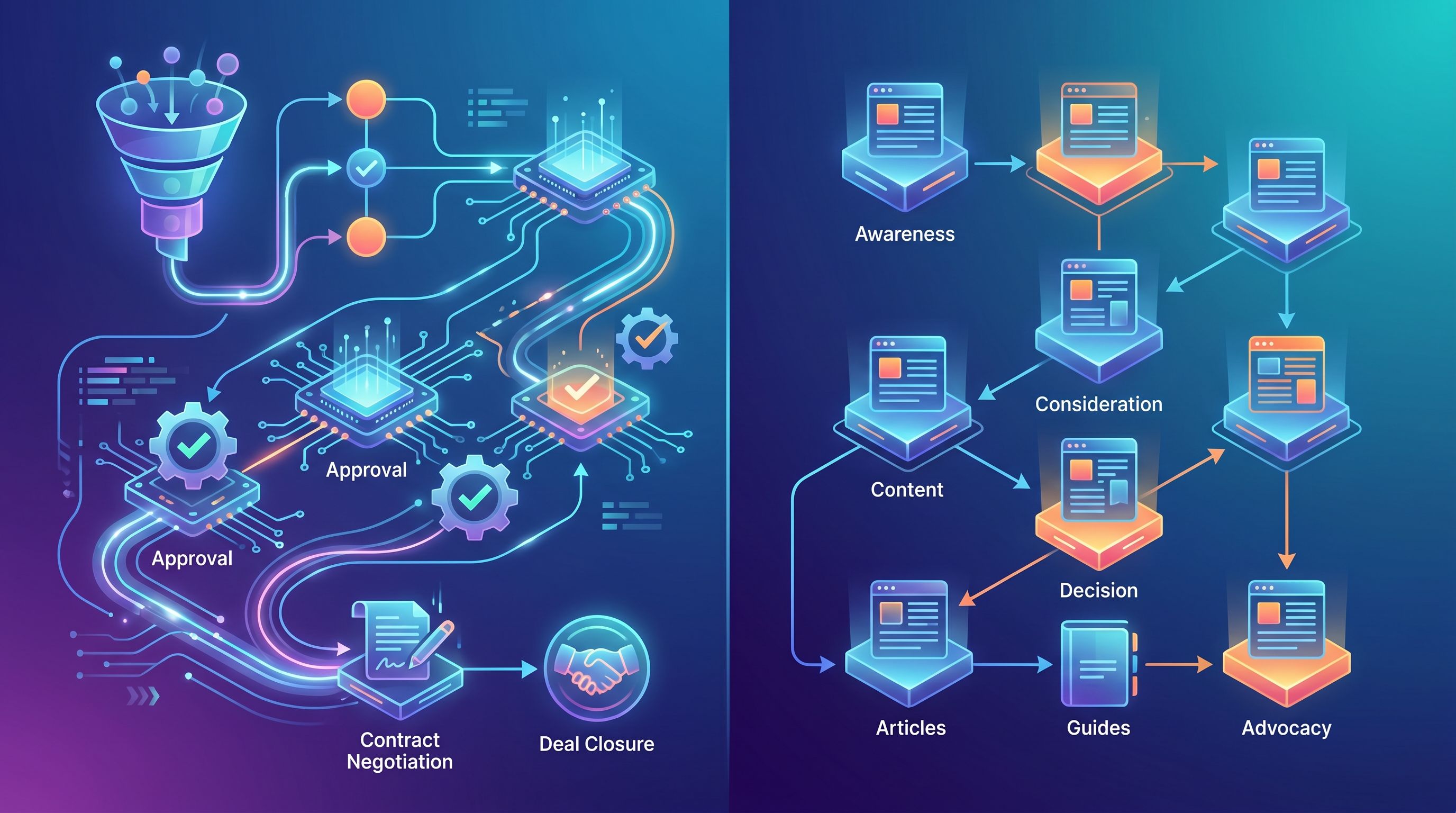
Step 6: Use Internal Linking as a Guided Tour for Buying Committees
For long sales cycles, internal links are not just an SEO tactic. They’re how you:
- Move a technical reader to an executive-friendly explanation.
- Help a champion send the right article to their security team.
- Let a curious manager go deeper without overwhelming them.
Design internal linking intentionally:
- From broad to specific: pillar → scenario → proof
- Across stakeholder lanes: technical deep dive → executive summary; security overview → legal checklist
- Along evaluation phases: problem framing → solution exploration → evaluation → approval
With Blogg, you can bake these linking rules into your prompts:
“When drafting, always include:
- 2–3 links to related posts in the same cluster
- 1 link to a post aimed at a different stakeholder in the same phase
- 1 link that helps readers move to the next evaluation step”
This turns your blog from a pile of posts into a guided tour that supports the whole committee.
Step 7: Measure Influence, Not Just Last-Click Conversions
For high-ACV deals with 6–12 month cycles, traditional attribution undercounts the impact of your blog.
Instead of asking, “Which post got the lead?” ask:
-
Which accounts are consuming content over time?
- Track repeat visits from target domains.
- Watch which clusters (security, ROI, implementation) light up as deals progress.
-
Which posts show up in successful deals?
- Look at content consumption among closed-won vs. closed-lost.
-
Which posts your sales team can’t live without?
- Ask reps which URLs they keep sending to move deals forward.
Blogg can help by:
- Keeping your publishing cadence high enough to show up throughout long cycles.
- Making it trivial to refresh and repurpose posts so your best-performing content stays current.
The goal isn’t a perfect attribution model—it’s confidence that your content is:
- Answering the real questions buying committees ask.
- Reducing friction at key evaluation steps.
- Giving champions the ammo they need internally.
Putting It All Together: A 30-Day Plan
If you want to start supporting high-ACV, long-cycle deals with AI blogging in the next month, here’s a simple plan:
Week 1 – Map the Journey and Committee
- Interview 3–5 sales reps about recent high-ACV wins and losses.
- List the phases of a typical evaluation.
- Identify 4–6 key stakeholder roles.
- Capture the top 5–10 questions each role asks in each phase.
Week 2 – Design Clusters and Lanes
- Choose 2–3 critical journeys (e.g., security review, POC, ROI approval).
- For each, define:
- 1–2 pillar posts
- 3–5 supporting plays
- 2–3 proof pieces
- Set up your stakeholder lanes and JTBD for each post.
Week 3 – Feed Blogg Better Inputs
- Assemble a master positioning doc.
- Gather 10–20 source documents: call transcripts, playbooks, security docs, internal decks.
- Configure Blogg with your single source of truth and initial topic map.
Week 4 – Publish, Link, and Enable Sales
- Use Blogg to draft your first 5–10 posts across clusters.
- Add deliberate internal links between posts.
- Create a simple “content menu” for sales: which posts to send at which stage.
From there, keep iterating: review which posts reps use, which clusters get traffic from target accounts, and which questions still show up on calls. Feed those insights back into your Blogg topics.
Summary
High-ACV, long-cycle deals demand more than generic SEO content. They require a structured content system that:
- Mirrors the real evaluation journey buyers take.
- Serves multiple stakeholders with different concerns.
- Supports POCs, security reviews, and approvals—not just lead capture.
- Uses internal linking to guide buying committees through complex decisions.
- Measures influence on deals, not just last-click conversions.
An AI-powered platform like Blogg makes this operationally realistic: you define the journey, lanes, and clusters once, then let AI handle ideation, drafting, and scheduling—while you and your sales team focus on conversations that close revenue.
Ready to Make Your Blog Work for High-ACV Deals?
If your sales team is working 6–12 month cycles while your blog is still chasing generic keywords, you’re leaving influence—and revenue—on the table.
You don’t need a bigger content team. You need a smarter, structured AI engine that understands your buyers, your committee, and your evaluation process.
Take the first step:
- Map your real buying journey and committee.
- Choose one critical evaluation path—like security review or POC—and design a content cluster around it.
- Plug that structure into Blogg so your blog starts publishing content that actually moves high-ACV deals forward.
Your buyers are already doing the work of evaluating you over months. It’s time your blog did its share of the work too.