The Post-Click Experience: Using AI Blogging to Align On-Page CTAs, Offers, and Follow-Ups with Search Intent

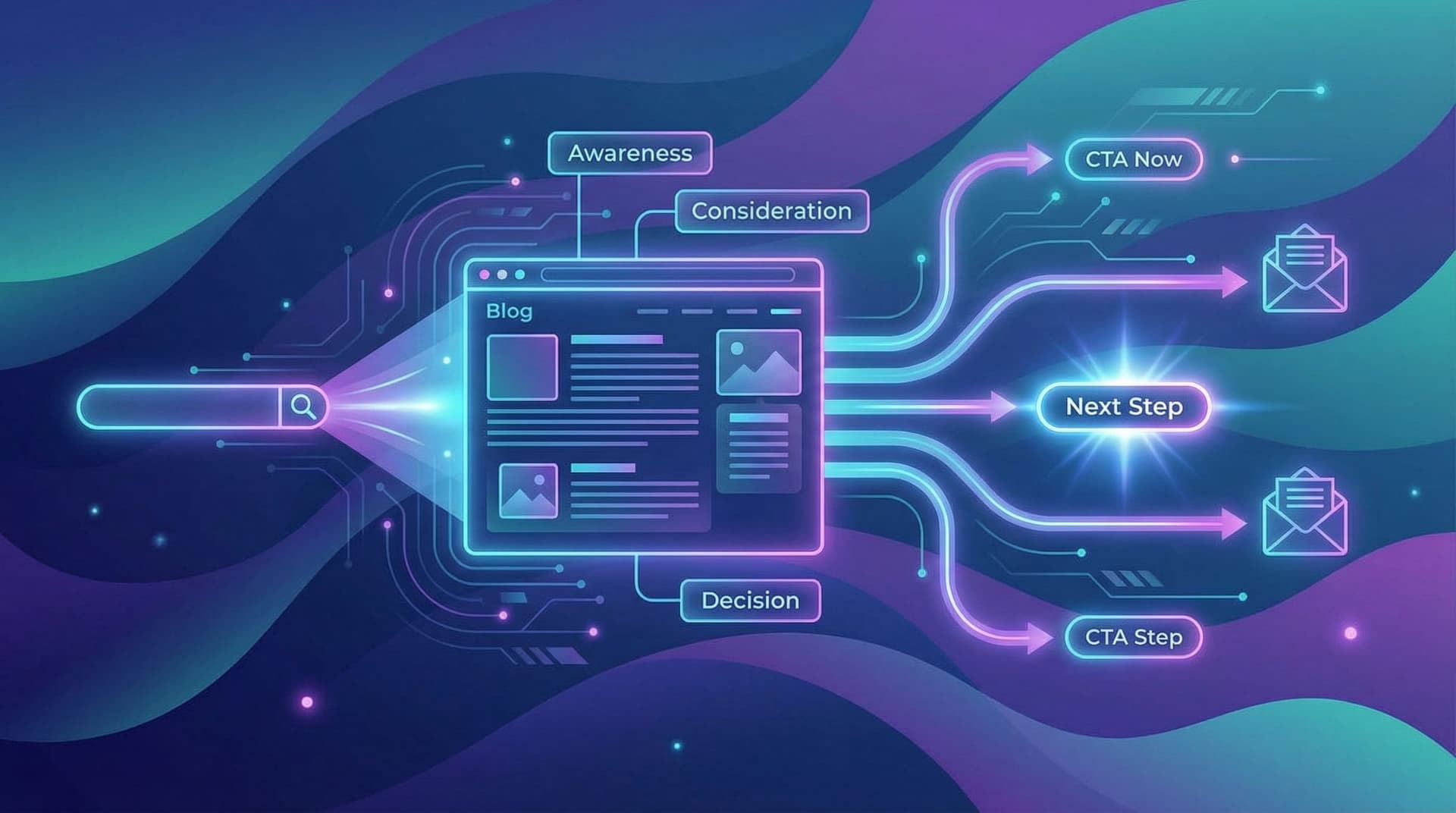
Most teams work hard to win the click.
They invest in SEO, hire writers, spin up an AI platform, and finally start seeing organic traffic grow.
Then… people land on the page, skim for 20 seconds, and disappear.
The problem usually isn’t the content itself. It’s everything that happens after the click:
- CTAs that don’t match why the visitor came
- Offers that are too big a leap from their current stage
- Follow-up emails that feel generic or disconnected from the page they just read
This is the post-click experience—and it’s where a lot of blogs quietly leak revenue.
AI blogging tools, especially a systemized platform like Blogg, can do more than just help you publish more posts. Used well, they can help you align every on-page CTA, offer, and follow-up with the exact search intent that brought someone to your site.
That’s how you turn search traffic into pipeline—not just pageviews.
Why the Post-Click Experience Matters So Much
You’ve already paid the “cost” of the click:
- Time and money spent on SEO
- Hours building content workflows
- Budget for tools, writers, or platforms like Blogg
If the page doesn’t guide the visitor to a next step that matches their intent, that investment stalls.
A strong post-click experience:
- Protects your SEO investment. Ranking is only half the job. Converting that attention into leads and customers is the rest.
- Improves conversion rates without more traffic. A better-aligned CTA on the same page can outperform another 30% traffic increase.
- Shortens the buyer journey. When the next step feels obvious and relevant, people move faster.
- Feeds better data back into your content strategy. When CTAs and follow-ups are tied to intent, you can see which topics and queries actually create revenue.
If you’ve already started using AI for publishing, this is the natural “level up” from “more content” to smarter journeys. It’s the same shift we talk about in posts like From Random Posts to Revenue Themes: Using AI to Turn Disconnected Articles into a Cohesive Blog Strategy.
Step 1: Start with Search Intent, Not Just Keywords
Before you can align CTAs and follow-ups, you need to be brutally clear on why someone searched and clicked in the first place.
A simple, practical framework:
-
Informational intent – “I’m trying to understand or learn something.”
Examples: “what is SOC 2 compliance”, “how to improve sales demo no-shows” -
Problem-aware, solution-curious – “I know my problem and I’m exploring ways to solve it.”
Examples: “reduce customer churn b2b saas”, “alternatives to live onboarding calls” -
Solution-aware, comparison mode – “I’m deciding between options.”
Examples: “HubSpot vs Pipedrive for small teams”, “best time tracking app for construction crews” -
Purchase-ready – “I’m basically ready to act.”
Examples: “book sales training workshop”, “SOC 2 readiness software pricing”
For each target keyword or topic, ask:
- What is the primary job the searcher is trying to get done?
- How aware are they of solutions like yours?
- What’s a reasonable next step that doesn’t feel like a jump scare?
If you’re using Blogg, you can bake this into your topic and outline settings:
- Tag each post with an intent level (informational, solution-curious, comparison, purchase-ready).
- Include a short “searcher job” description in your content brief, e.g., “Trying to understand if they should automate customer onboarding emails.”
This becomes the backbone for everything else: structure, CTAs, and follow-ups.

Step 2: Match On-Page CTAs to Intent (Without Being Pushy)
Once you know the intent, your CTAs stop being generic (“Book a demo”) and start being contextual.
Intent → CTA Matching Cheat Sheet
Use this as a starting point:
1. Informational intent
Goal: Help them understand, earn trust, keep the relationship going.
Best-fit CTAs:
- “Get the full checklist / template / calculator” (email opt-in)
- “Download the step-by-step guide”
- “Subscribe for more practical breakdowns like this”
Avoid:
- Hard “Talk to sales” CTAs as the primary ask
- Overly product-heavy popups that interrupt learning
2. Problem-aware, solution-curious
Goal: Connect their problem to your solution category.
Best-fit CTAs:
- “See how teams like yours solved this with [short case study]”
- “Try the interactive ROI calculator”
- “Watch a 5-minute walkthrough of how we handle this”
These CTAs can start introducing your product, but still feel like education-plus.
3. Solution-aware, comparison mode
Goal: Make it easy to evaluate you.
Best-fit CTAs:
- “Compare [Your Product] vs [Common Alternative]”
- “See pricing and implementation timelines”
- “Get a custom recommendation” (short form or quiz)
4. Purchase-ready
Goal: Remove friction.
Best-fit CTAs:
- “Book a demo”
- “Start free trial”
- “Talk to a specialist about your setup”
On these pages, it’s okay—and often smart—to make the primary CTA more prominent and repeated.
How AI Helps You Scale Intent-Driven CTAs
If you’re publishing a lot of posts using Blogg, you don’t want to hand-edit every CTA.
Instead:
-
Define CTA blocks by intent level.
Create 3–5 reusable CTA modules (copy + design) for each intent type. -
Tag posts with intent in your AI workflow.
In your Blogg configuration, add anintentfield per post. This can be set manually or inferred from the keyword. -
Connect your CMS or design system.
Use your CMS (WordPress, Webflow, etc.) or a component library to automatically drop the right CTA block into the template based on thatintenttag. -
Let AI propose CTA variants.
When Blogg drafts a post, have it also propose:- A primary CTA (headline + subcopy)
- A secondary, lower-commitment CTA (e.g., newsletter, guide)
This keeps CTAs consistent, on-brand, and aligned with why the visitor is there—without you rewriting them for every post.
For more on keeping this kind of system consistent without exhausting your team, see The Anti-Content Burnout Plan: Using AI to Keep Your Blog Consistent Without Draining Your Team.
Step 3: Align Offers with “Commitment Level,” Not Just Funnel Stage
Intent is one side of the coin. The other is commitment level—how big of an ask you’re making.
Think of offers on a spectrum:
- Low commitment: read another article, join newsletter, download a checklist
- Medium commitment: attend a webinar, try a tool, start a free trial
- High commitment: book a sales call, request a proposal, sign up for onboarding
Your job is to make sure the offer feels proportionate to where the visitor is mentally.
Practical Pairing Examples
-
A post targeting “what is SOC 2 compliance” (informational):
- Primary offer: “Download our SOC 2 readiness checklist” (low)
- Secondary offer: “See how [Customer] cut audit prep time by 60%” (medium)
-
A post targeting “best SOC 2 automation software for startups” (comparison):
- Primary offer: “See live pricing and implementation timelines” (medium)
- Secondary offer: “Book a 20-minute SOC 2 strategy call” (high)
AI can help you generate and maintain these offer pairings:
- Have Blogg maintain a library of offers (guides, tools, webinars, trials) with tags for:
- Intent level
- Audience segment
- Commitment level
- When drafting a post, Blogg can:
- Suggest the top 2–3 offers that fit the post’s tags
- Auto-generate the on-page copy for those offers (headline, bullets, button text)
Over time, you get a living catalog of offers that stay in sync with your content library.
Step 4: Design Follow-Ups That Remember the Click
The post-click experience doesn’t end on the page itself. It continues in:
- Email sequences
- Retargeting ads
- Sales follow-ups
- On-site personalization for returning visitors
The key principle: your follow-ups should “remember” the page and intent that started the relationship.
Email Examples
If someone downloads a “SOC 2 readiness checklist” from an informational post:
- Email 1: “You’re here because SOC 2 feels overwhelming. Here’s where most startups actually get stuck.”
- Email 2: “Three ways to cut SOC 2 prep time in half (with or without automation software).”
- Email 3: Soft intro to your product: “When checklists stop being enough: how automation fits into SOC 2 prep.”
If someone requests a “pricing and implementation overview” from a comparison post:
- Email 1: “Here’s your pricing breakdown and a realistic implementation timeline.”
- Email 2: “What usually slows down implementation (and how we help you avoid it).”
- Email 3: “Want a tailored rollout plan? Here’s what we’d map for a company like yours.”
How AI + Blogg Make This Scalable
Instead of writing every sequence from scratch:
-
Standardize a few follow-up arcs.
For example:- Educational arc (3–5 emails)
- Evaluation arc (3–5 emails)
- Implementation arc (3–5 emails)
-
Use Blogg content as source material.
With a library of AI-generated posts, you can:- Summarize key posts into email sequences
- Link back to deeper guides for those who want more detail
- Turn a series like a micro-pillar into a structured nurture path, as we explore in Micro-Pillar Pages with Macro Impact: Using AI to Turn One Core Topic into 12 High-Intent Blog Posts.
-
Tag subscribers by entry post + intent.
When a form is submitted, pass along:- The post slug
- The intent level
- The offer they claimed
-
Let AI generate variations.
Use AI to:- Personalize intros based on the post they came from
- Adjust tone and depth for different segments (e.g., founders vs. ICs)
- Refresh sequences periodically without rewriting from zero
The result: follow-ups that feel like a natural continuation of the page they started on, not a random marketing blast.
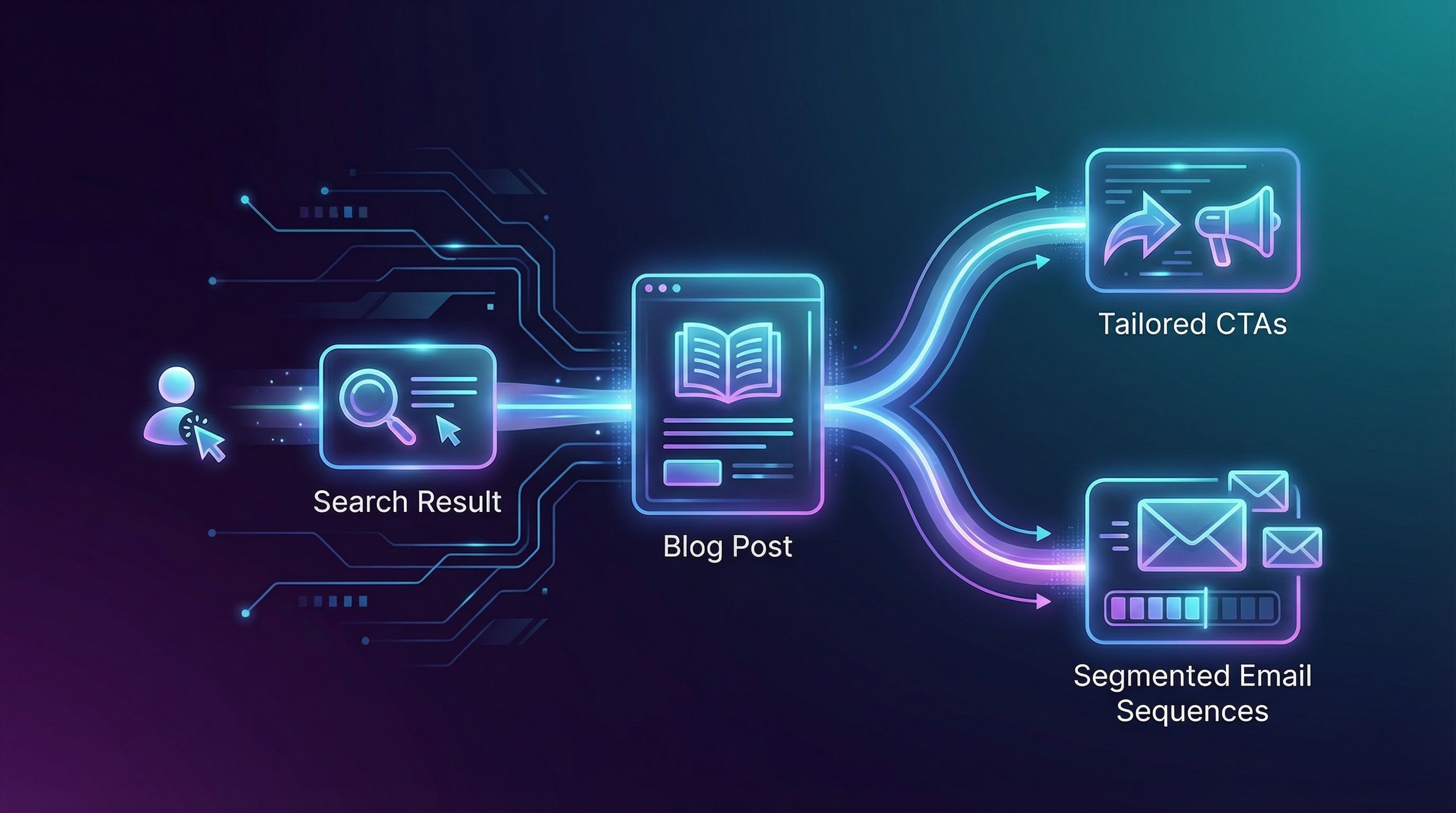
Step 5: Close the Loop with Data (and Let AI Learn)
Once your CTAs, offers, and follow-ups are aligned with intent, you can start asking the fun question:
Which intents, topics, and offers actually create revenue?
To answer that, you’ll want to:
-
Track by intent, not just URL.
- Add an
intentfield to your analytics events (page view, form submit, demo request, etc.). - Use UTM parameters or hidden form fields to capture the originating post + intent.
- Add an
-
Watch micro-conversions as well as macro.
- Newsletter signups from informational posts
- Resource downloads from solution-curious posts
- Trial starts or demos from comparison/purchase-ready posts
-
Feed performance back into your AI system.
With a platform like Blogg, you can:- Prioritize new content around intents and topics that show strong conversion patterns
- Clone high-performing CTA/offer combinations into similar posts
- De-emphasize or rework posts that get traffic but no meaningful actions
-
Iterate CTAs and offers like you’d iterate ad copy.
- Test different CTA language on the same post intent
- Try alternate offers (e.g., checklist vs. webinar) for the same topic
- Use AI to generate variants and summarize test results for you
Over time, you’re not just “publishing more.” You’re building a feedback-driven system where:
- Search intent informs content
- Content informs CTAs and offers
- CTAs and offers create measurable actions
- Those actions tell you what to create next
That’s the loop that turns an AI-powered blog into a growth engine.
Putting It All Together: A Simple Implementation Blueprint
If this feels like a lot, here’s a practical way to get started in the next 30 days:
Week 1: Map Intent and CTAs for Existing Posts
- Pick your top 10–20 organic posts by traffic.
- For each, label:
- Primary intent (informational, solution-curious, comparison, purchase-ready)
- Current primary CTA
- Identify obvious mismatches (e.g., informational post pushing a hard sales call).
- Draft 1–2 better-aligned CTAs per post using AI.
Week 2: Define Offer and Follow-Up Patterns
- List your existing offers (guides, tools, webinars, trials, demos).
- Tag each by intent level and commitment level.
- Map at least one primary and one secondary offer to each intent type.
- Sketch 3–5 email arcs and let AI draft the first versions.
Week 3: Connect the System in Your Stack
- In your CMS, add an
intentfield for posts. - In your forms, add hidden fields for
post_slug,intent, andoffer. - In your email tool, create segments or entry rules based on those fields.
Week 4: Update AI Workflows and Launch Tests
- In Blogg, update your post templates/briefs to include:
- Intent tag
- Recommended CTA structure
- Suggested offers by tag
- Ship updated CTAs on your top posts.
- Turn on at least one intent-aligned email sequence.
You don’t need to overhaul everything at once. Start with your highest-traffic, highest-intent posts and expand from there.
Summary
Winning the click is only step one. The real leverage lives in what happens after someone lands on your blog.
By using AI blogging strategically—not just for drafting posts, but for structuring journeys—you can:
- Map every post to a clear search intent
- Align on-page CTAs with what visitors are actually trying to do
- Pair offers to realistic commitment levels
- Design follow-ups that “remember” the page and intent that started the relationship
- Close the loop with data so your AI system keeps getting smarter
Platforms like Blogg make this practical for small teams: you set topics, intent, and preferences, and the system helps you keep content, CTAs, and follow-ups working together instead of in silos.
Your Next Step
If your analytics show plenty of traffic but not enough demos, trials, or qualified leads, the problem probably isn’t “we need more posts.”
You likely need a better post-click experience.
Here’s a lightweight first move:
- Pick your top 5 organic posts by traffic.
- Label each with a primary intent.
- Ask: “If I landed here with that intent, what’s the smallest, most helpful next step I’d actually take?”
- Rewrite the primary CTA on each page to match that answer.
If you want a system that doesn’t depend on you doing that manually forever, explore how Blogg can:
- Keep fresh, SEO-optimized posts going live automatically
- Tag and structure those posts around real search intent
- Suggest aligned CTAs, offers, and follow-ups as part of your publishing workflow
Start with one intent-aligned journey—from search to post to CTA to follow-up—and let that be the model you scale.