
Repurpose or Rewrite? A Practical Guide to Turning Podcasts, Webinars, and Sales Calls into AI‑Ready Blog Content


You’re already sitting on a goldmine of content.
Every podcast episode, webinar, and sales call is packed with stories, objections, frameworks, and phrases your buyers actually use. The problem isn’t ideas—it’s getting those ideas into polished, SEO‑ready blog posts without turning your week into a content grind.
That’s where the repurpose‑vs‑rewrite question comes in.
Do you lightly adapt what you already have and ship it? Or do you treat your recordings as raw research and build something new from scratch—often with help from AI and platforms like Blogg?
This guide will walk through a practical, step‑by‑step approach to deciding when to repurpose, when to rewrite, and how to turn messy recordings into AI‑ready inputs that produce sharp, on‑brand blog content.
Why This Matters for a Business Blog That Actually Performs
If you’re using AI to keep your blog active, you’re already ahead of most teams. But volume alone doesn’t win. You need content that:
- Reflects real customer language and objections
- Maps to your sales funnel and offers
- Builds topical authority over time
- Stays consistent with your brand’s voice and point of view
Your live content—podcasts, webinars, demos, sales calls—checks all of those boxes. It’s where:
- Founders say the sharpest, most differentiated things
- Prospects ask the questions they really care about
- Sales teams test messaging in the wild
If you can systematically turn those moments into AI‑assisted blog content, you:
- Reduce blank‑page time to almost zero
- Publish content that’s automatically aligned with your funnel (see how this works in more depth in Lead-Ready Content on Autopilot: Using AI to Map Blog Posts to Every Stage of Your Sales Funnel)
- Stop guessing at topics and let your audience tell you what to write (we unpack this further in From Idea to Inbound Engine: Using AI to Turn Customer Questions into High-Converting Blog Series)
The only real question is how you transform those recordings into blog‑ready inputs your AI tools—and platforms like Blogg—can reliably work with.
Step 1: Audit Your Existing Live Content Library
Before you decide whether to repurpose or rewrite, you need to know what you’re working with.
Make a quick inventory of three categories of content:
- Podcasts and interviews
- Founder interviews, guest spots, customer stories, expert panels.
- Webinars and workshops
- Product demos, Q&A sessions, training sessions, co‑hosted events.
- Sales and customer calls
- Discovery calls, demos, onboarding sessions, renewal conversations.
For each asset, jot down:
- Title / topic
- Format (podcast, webinar, call)
- Date recorded (you’ll often want the last 6–18 months first)
- Audience (prospects, customers, partners)
- Key themes (e.g., pricing objections, feature X, use case Y)
You don’t need a perfect database. A simple spreadsheet or Notion table is enough to start.
Aim to identify 5–10 “evergreen” recordings that still match how you sell and what you offer right now.
Step 2: Decide When to Repurpose vs. Rewrite
Not every recording should become a blog post as‑is. Some should be lightly adapted; others should be treated as raw research.
Here’s a simple decision framework.
When to Repurpose (Lightly Adapt)
Repurposing means: keep the core structure and angle, but adapt the format, tighten the messaging, and optimize for search.
Choose repurposing when:
-
The content is already structured
Your podcast episode has clear segments or your webinar followed a logical outline (problem → framework → examples → Q&A). -
The message is still accurate
Your positioning, pricing, and product haven’t significantly changed since recording. -
The topic is evergreen
Think “How to onboard new customers” vs. “What’s new in Google Ads this quarter.” -
You want speed
You need posts this week, and you’re okay with content that closely mirrors the original.
Good repurposing candidates:
- Podcast episodes where a founder shares a repeatable framework
- Webinars that walk through a step‑by‑step process
- Customer interviews with clear before/after stories
When to Rewrite (Use as Research)
Rewriting means: treat the recording as source material, then build a new piece from scratch—often with AI’s help.
Choose rewriting when:
-
The structure is messy
Tangents, interruptions, long Q&A sections, or multiple topics in one call. -
The content is partially outdated
Your strategy evolved, but the underlying stories and objections are still useful. -
The audience is different
The webinar was for partners, but you want a blog post for end‑customers. -
You’re building a strategic series
For example, turning a multi‑episode podcast arc into a topic cluster (see Authority on Autopilot: Using AI to Build Topic Clusters That Rank (and Actually Convert)).
Good rewriting candidates:
- Sales calls full of objections and nuanced answers
- Founder AMAs with lots of off‑the‑cuff insights
- Webinars that mixed strategy, demo, and Q&A in one session
A Quick Rule of Thumb
- If the recording already feels like a talk you’d give on stage → Repurpose.
- If the recording feels like a conversation you’d have over coffee → Rewrite.
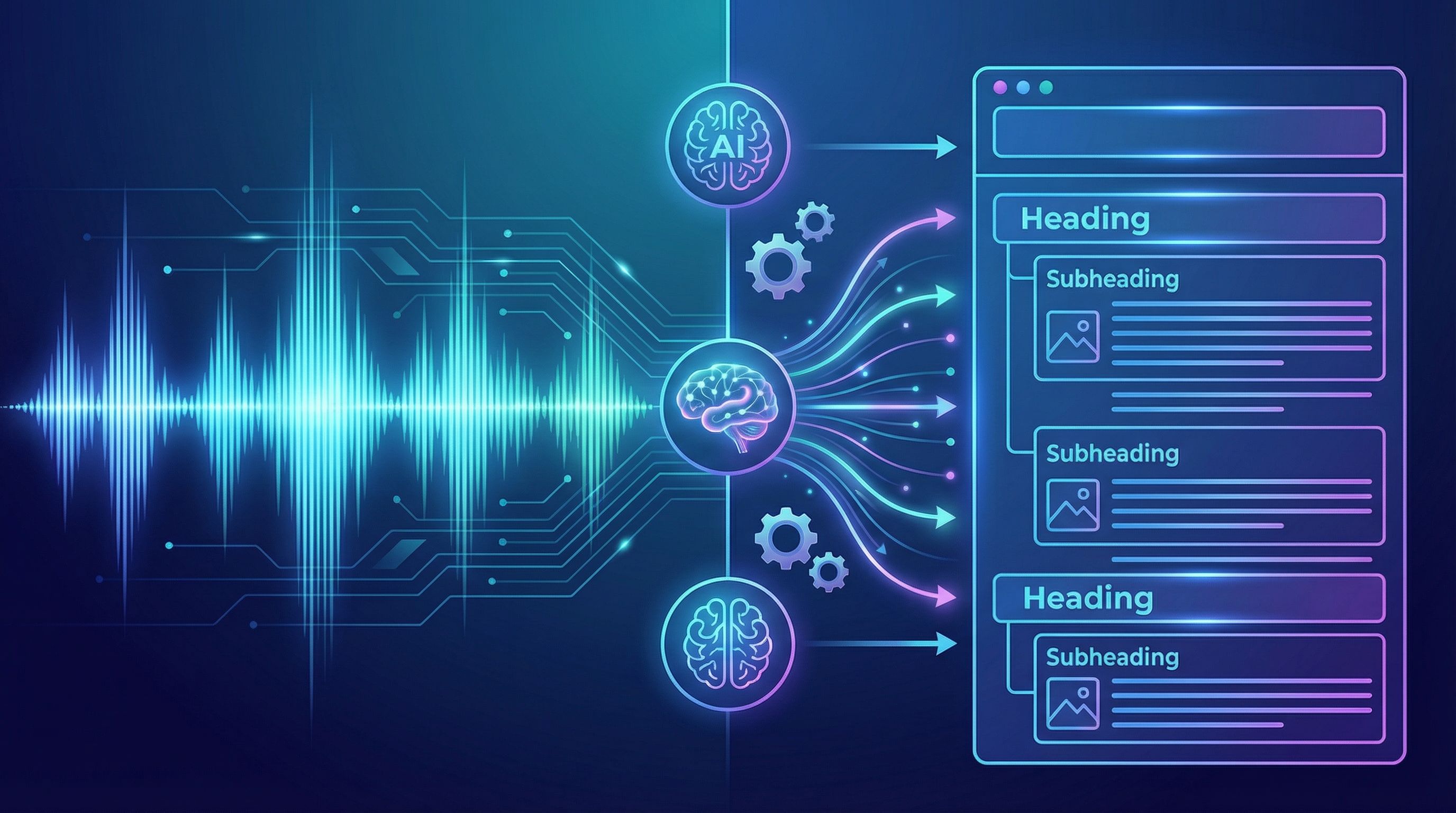
Step 3: Make Your Recordings AI‑Ready (Transcripts That Don’t Suck)
AI can’t work with what it can’t read. The bridge between your recordings and your blog is a clean, structured transcript.
Get Reliable Transcripts
Use tools built for high‑quality transcription such as:
Export transcripts in a format your AI tools—or Blogg—can ingest: usually plain text or .docx.
Clean Up the Raw Text (Lightly)
You don’t need to edit every “um” and “uh,” but you should:
-
Remove obvious noise
Off‑topic chit‑chat, tech issues, unrelated small talk. -
Add basic structure
Insert simple headings likeSection: Problem,Section: Framework,Section: Q&Awhere it makes sense. -
Identify speakers
LabelHost,Guest,Prospect,AE, etc., especially for sales calls. -
Highlight gold
Bold or comment around:- Strong one‑liners and metaphors
- Repeatable frameworks (e.g., “our 3‑step onboarding process”)
- Real‑world examples and mini‑case studies
This light prep dramatically improves what AI can do next.
Step 4: Turn Transcripts into Strong AI Prompts
Whether you’re using a general AI model or a specialized platform like Blogg, the quality of your prompt determines the quality of your draft.
For Repurposing: Prompt AI as a Skilled Content Editor
You’re asking AI to keep the structure but adapt it into a blog post.
Your prompt might look like:
“Here’s a transcript of a 45‑minute webinar about onboarding new customers. Turn this into a 1,800‑word blog post. Keep the core structure (problem → framework → examples → Q&A), but:
- Remove filler and repetition
- Use clear H2/H3 headings
- Add an intro that hooks busy B2B founders
- End with a soft CTA to book a demo
- Preserve the speaker’s voice: direct, no jargon, slightly informal.”
Then paste the cleaned transcript.
For Rewriting: Prompt AI as a Research Assistant
You’re asking AI to extract insights, then build something new.
Break it into two passes:
-
Insight extraction
- “Read this transcript and summarize: main problem, 3–5 key insights, common objections, and 3 memorable quotes.”
-
New draft creation
- “Using only the insights you just summarized (not the full transcript), write a fresh 1,500‑word blog post aimed at [ideal audience]. Use a clear, educational tone and organize it around the 3–5 key insights. Add subheadings, bullets, and a practical checklist at the end.”
Platforms like Blogg streamline this by letting you set topics and preferences once, then feeding transcripts into a consistent writing and scheduling engine, so posts keep shipping while you’re on your next call.
Step 5: Shape Content for Search and the Sales Funnel
Repurposed or rewritten, your post still needs to pull its weight for SEO and sales.
Align with Real Search Intent
From the transcript, pull out:
- Phrases your audience actually used
- Problems they described in their own words
- Outcomes they said they wanted
These become your primary and secondary keyword targets—often long‑tail phrases like:
- “how to onboard enterprise customers without burning out cs team”
- “b2b saas pilot program best practices”
If you want to go deeper on using AI to systematically target these kinds of queries, see Long-Tail Keywords at Scale: Using AI Blogging Tools to Capture High-Intent Search Traffic.
Map Each Post to a Funnel Stage
From your recording, ask:
- Is this problem awareness (top of funnel)?
- Is it solution comparison (middle of funnel)?
- Is it product‑specific (bottom of funnel)?
Then adjust your:
- Headline and intro to match the reader’s level of awareness
- Depth of detail (high‑level vs. tactical vs. product walkthrough)
- CTA (read another guide, join a webinar, book a demo, start a trial)
This is how your live content becomes a structured content engine—not just a pile of “random posts we pulled from webinars.”

Step 6: Edit for Voice, Trust, and Clarity
AI can get you an excellent first draft, but it’s your job to make sure it sounds like you and meets your quality bar.
Focus your human editing time on three things:
-
Voice and personality
- Replace generic phrases with how you actually speak.
- Keep the best lines from the original recording.
-
Specifics and proof
- Add real numbers, mini‑case studies, or anonymized examples from the calls.
- Link to relevant internal resources, like playbooks or product pages.
-
Trust signals
- Attribute quotes (“As our Head of Sales put it on a recent call…”).
- Add author bylines and context (see also E‑E‑A‑T for AI Blogs: Strategies to Make AI‑Generated Content Trustworthy in Google’s Eyes).
If you’re doing this at scale, it’s worth building a simple checklist or using the process from Human + AI Editing Playbook: How to Turn Raw AI Drafts into High-Quality, On-Brand Blog Posts.
Step 7: Systematize the Workflow So It Runs Without You
The real win isn’t turning one webinar into one post. It’s building a repeatable pipeline where every meaningful recording can become:
- A blog post
- A series of posts
- Social snippets
- Email sequences
Here’s a simple operating rhythm you can hand to your team.
Weekly
-
Tag and store recordings
After every podcast, webinar, or key sales call, drop the link into a shared tracker with topic and date. -
Auto‑transcribe
Use your transcription tool of choice to generate transcripts within 24–48 hours.
Bi‑Weekly
-
Prioritize 2–3 recordings
Based on:- Strategic topics or campaigns
- Common questions from sales/support
- Gaps in your funnel content
-
Feed into Blogg or your AI workflow
Decide repurpose vs. rewrite, then run the appropriate prompt.
Monthly
- Review performance and refine
- Which posts from live content are getting traffic, engagement, and leads?
- Which angles or formats resonate most?
- Where are there clear opportunities to expand into a series or topic cluster?
This is where platforms like Blogg shine: you set your themes, preferences, and cadence once, then use your recordings as ongoing fuel. Blogg can handle ideation, writing, and scheduling so that your blog stays active even while you’re busy closing deals or hosting the next webinar.
Quick Summary
If you remember nothing else, remember this:
-
Your best blog content is already being said out loud. Podcasts, webinars, and sales calls are a constant stream of topics, phrases, and stories your buyers care about.
-
Repurpose when the recording is structured and evergreen. Lightly adapt, optimize for search, and publish quickly.
-
Rewrite when the recording is messy but insightful. Treat it as research, extract the gold, and build a sharper, more strategic piece.
-
Transcripts are the bridge. Clean, structured transcripts make AI dramatically more effective.
-
Prompts matter. Tell AI whether you’re repurposing or rewriting—and what role it’s playing.
-
Tie everything to search and the funnel. Use customer language for keywords and map each post to a clear buyer stage.
-
Let AI handle the heavy lifting; you handle the judgment. Tools (especially platforms like Blogg) can write and schedule at scale. You supply the voice, nuance, and quality control.
Your Next Move
You don’t need a massive content team to start doing this. You just need to take the first small, concrete step.
Here’s a simple way to start this week:
- Pick one recent webinar, podcast episode, or sales call you’re proud of.
- Get a transcript using any of the tools above.
- Decide: repurpose or rewrite?
- Feed that transcript into your AI workflow—or into Blogg—with a clear prompt.
- Spend 20–30 minutes editing the draft for voice and specifics.
- Schedule it.
Do that once, and you’ll see how much easier it is than starting from a blank page. Do it every week, and your blog becomes a living reflection of the conversations that actually move your business forward.
If you’d like that process to run mostly on autopilot, explore how Blogg can take your topics and preferences, then turn your ongoing recordings into fresh, SEO‑optimized posts that publish while you stay focused on running the business.
Your calls, webinars, and interviews are already happening.
It’s time your blog caught up.


