From Editorial Chaos to ‘AI Guardrails’: Designing Simple Rules So Multiple Teams Can Safely Use Blogg


If your company has more than one team touching the blog—marketing, product, sales, customer success—you’ve probably felt it:
- Conflicting messages in back‑to‑back posts
- AI drafts that sound nothing like your brand
- Posts going live with the wrong examples, promises, or positioning
Once you add AI into the mix, the stakes go up. You’re no longer reviewing one post a week; you’re overseeing a system that can generate dozens. Without clear guardrails, you don’t just get more content—you get more inconsistency, more risk, and more cleanup work.
The good news: you don’t need a 40‑page editorial bible to fix this.
You need a small set of simple, enforceable rules that make it safe for multiple teams to use an AI platform like Blogg without stepping on each other—or on legal, brand, or product.
This post walks through how to design those rules, implement them inside Blogg, and keep them healthy as your content operation scales.
Why Guardrails Matter More Once AI Enters the Chat
When only one content marketer owned the blog, you could get away with “vibes and judgment.” They knew the brand, the product, and the unwritten rules.
As soon as you:
- Invite multiple teams to pitch ideas and trigger drafts
- Use AI to generate first (or second) drafts at scale
- Publish 3–10 posts per week instead of 1–2 per month
…you’ve effectively created a content factory. And factories run on systems, not vibes.
Without guardrails, teams run into predictable problems:
- Mixed messages – Sales wants bold promises; Legal wants cautious language; Product wants feature depth. AI happily reflects whoever wrote the last prompt.
- Brand whiplash – One post sounds like a friendly operator; the next sounds like a corporate press release.
- SEO cannibalization – Different teams generate near‑duplicate posts for the same keyword or topic.
- Compliance risk – AI “hallucinates” claims, names competitors incorrectly, or invents customer quotes.
Guardrails solve this by making the rules explicit, reusable, and embedded in the workflow—so the system helps people do the right thing by default.
If you’ve already started cleaning up your backlog, you’ve seen the results of not having guardrails. Our piece on using AI to audit and prune old posts without killing SEO is essentially a post‑mortem on what happens when content grows without a system.
Start With Outcomes, Not Rules
Before you write a single guideline, answer one question:
What must always be true about our blog—no matter who writes the post or what AI we use?
Most B2B teams land on a short list like:
- Every post must ladder up to a clear business narrative.
- Every post must be factually accurate and non‑deceptive.
- Every post must help a specific buyer do a specific job.
- Every post must be discoverable (search‑friendly) and connected to related content.
Those outcomes translate directly into guardrail categories:
- Narrative & positioning
- Brand voice & tone
- Product and claims
- Audience & jobs‑to‑be‑done
- SEO & structure
- Legal, compliance, and safety
You don’t need to cover everything at once. Start with the 3–5 categories where your content has actually gone wrong before—then expand.
Map Your “Zones of Control” Across Teams
Guardrails work best when everyone knows who owns what.
A simple way to do this is to define three zones:
- Red (non‑negotiable) – Rules that no one can override without a formal exception.
- Yellow (flexible with judgment) – Guidelines that allow variation by segment, channel, or experiment.
- Green (creative freedom) – Areas where teams can play, test, and adapt.
For example:
- Red
- No fabricated testimonials, logos, or case studies
- No hard performance guarantees (e.g., “We double your revenue in 30 days”)
- Required disclaimers for any benchmarks or third‑party data
- Yellow
- Tone (playful vs. formal) by segment
- Level of product depth by funnel stage
- CTA format (demo vs. newsletter vs. resource download)
- Green
- Storytelling style (narrative, listicle, teardown)
- Examples used (as long as they’re real and on‑brand)
- Visual style for illustrations
Once you have this, you can encode it directly into how your teams use Blogg: red rules become hard prompts and checklists; yellow rules become templates and examples; green rules are left to human creativity.
For more on how this ties into content structure, see our post on structuring AI‑generated clusters around jobs‑to‑be‑done, not just keywords.
Turn Guardrails Into Reusable System Prompts
Most teams make the mistake of writing guidelines in a doc and hoping people will remember them when they prompt AI.
A better approach: treat your guidelines as system prompts and templates that live inside your tooling.
1. Create a “House Prompt” for All Blog Posts
This is the master instruction set that every Blogg draft should inherit, regardless of who triggers it.
Your house prompt might include:
- Brand role & POV
- “You are writing as [Brand], a [category] platform that helps [ICP] achieve [core outcome]. We speak as experienced operators, not generic consultants.”
- Tone rules
- “Use clear, direct language. No hype, no buzzwords. Prefer specific examples over vague claims.”
- Positioning constraints
- “Never describe us as an ‘all‑in‑one platform’ or ‘marketing automation tool.’ We are a ‘[specific category phrase].’”
- Claims & compliance
- “Do not invent customer names, quotes, or metrics. If you need an example, use anonymized or hypothetical ones and label them as such.”
- SEO & structure
- “Every post must have: a clear H1, 3–6 H2s, short paragraphs, scannable bullets, and a short summary section near the end.”
In Blogg, you’d set this as a global configuration or default blueprint that each new post inherits. That way, teams don’t have to remember the rules; they start from them.
For a deeper dive into voice and prompt systems, check out our guide on building a reusable “Voice Vault” so AI posts sound like your brand.

Build Role-Based Guardrails for Each Team
Different teams need different freedoms. A one‑size‑fits‑all prompt is a good foundation, but you’ll get better results if you add role‑specific layers.
Here’s how to do it.
Marketing & Content
Primary goals: narrative consistency, SEO performance, conversion.
Add prompts and rules like:
- “Prioritize search terms from the approved topic list and internal ‘topic trees.’ Avoid creating new keyword targets without checking for cannibalization.”
- “Include at least 2 internal links to relevant posts, ideally within the same content cluster.”
- “Always include a soft CTA that maps to the reader’s stage (e.g., learn, compare, decide).”
This is where systems like our Topic Tree method and the SEO flywheel become powerful. Marketing defines the clusters and keywords; Blogg enforces them.
Product & Engineering
Primary goals: accuracy, nuance, and realistic examples.
Guardrails here should stress:
- “Do not invent product capabilities. Only describe features that exist in our public docs or release notes.”
- “Use real workflows and edge cases from our product documentation. If unsure, ask for clarification instead of guessing.”
- “Avoid roadmap promises. Talk about what’s possible now, not what might exist later.”
You can connect Blogg to your internal source‑of‑truth docs and use that as the reference corpus for product‑heavy posts, as we outline in our piece on turning wiki pages and Notion docs into a “Source of Truth” blog.
Sales & Customer Success
Primary goals: objection handling, use cases, and buyer education.
Guardrails should focus on:
- “Base stories and objections on real patterns from calls and tickets, not on invented scenarios.”
- “Avoid naming specific customers unless they’re approved references.”
- “Keep pricing and packaging references high‑level; do not quote specific numbers that may change.”
Here, Blogg can pull structured prompts from call notes or CRM fields, while your guardrails prevent over‑promising or leaking sensitive details.
Legal, Compliance, and Security
Primary goals: risk management and regulatory compliance.
They don’t need to write posts—but they do need a say in the rules.
Codify their input as:
- Banned phrases (e.g., “guaranteed results,” “zero risk,” “100% secure”)
- Required disclaimers when mentioning certain metrics, industries, or regulations
- Data handling rules (e.g., “never paste customer PII into prompts”) that you add to your house prompt and onboarding
Encode Guardrails in Workflows, Not Just Words
Written rules are fragile. Workflow rules are durable.
When you set up Blogg as your AI content engine, use its workflows and permissions to make good behavior the default.
1. Use Templates as “Guardrail Carriers”
Instead of letting each team start from scratch, create:
- Post templates by intent – e.g., “Problem explainer,” “Comparison post,” “Implementation guide,” each with:
- Pre‑filled prompts
- Required sections
- Notes on what must and must not be included
- Audience‑specific variants – e.g., CFO vs. RevOps vs. end user, each with tone and depth guidance
When someone chooses a template, they’re also choosing the right guardrails.
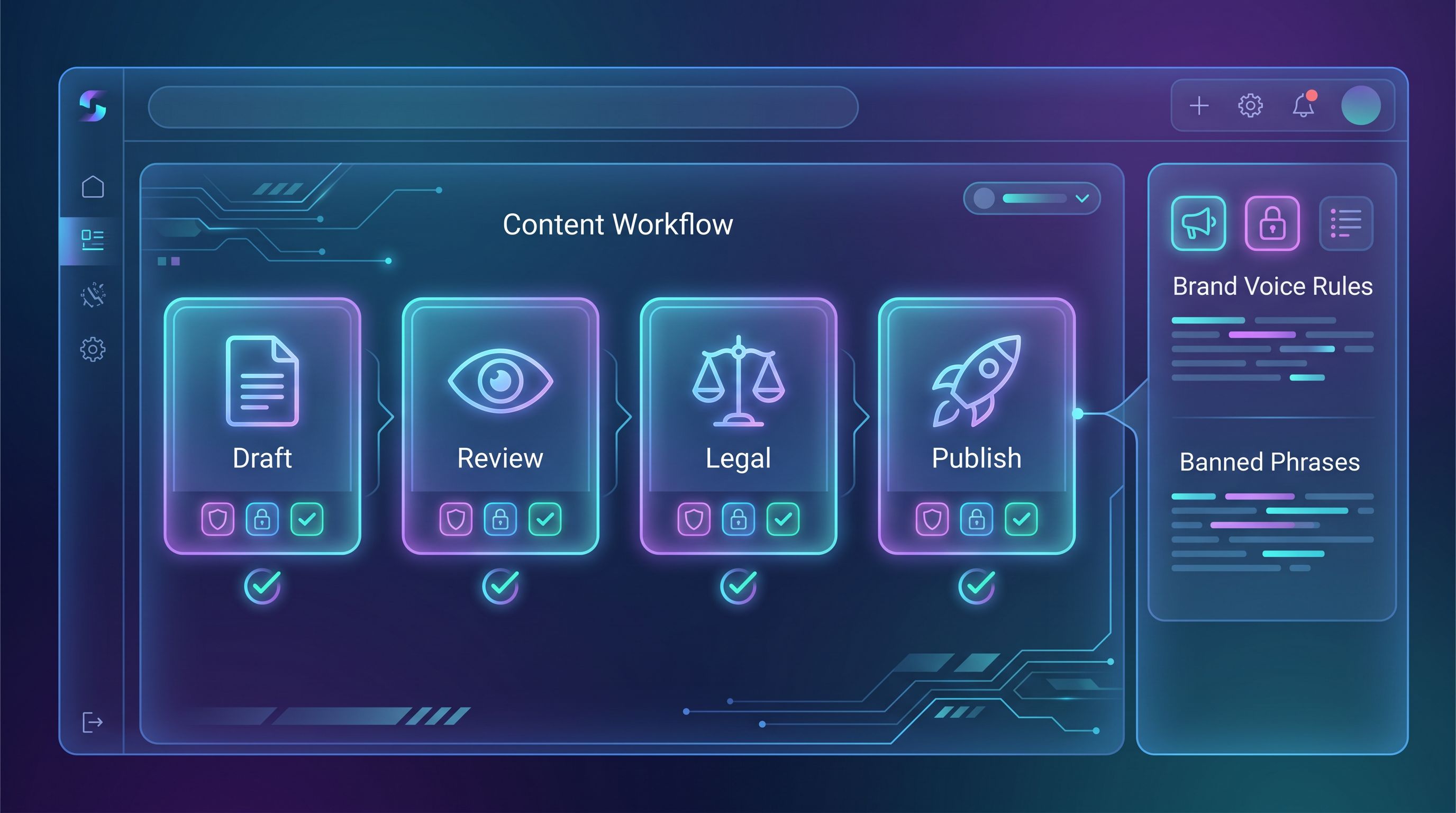
2. Set Up Review Gates for High-Risk Content
Not every post needs the same level of scrutiny. Define:
- Low‑risk posts (e.g., educational explainers)
- Can be auto‑scheduled after a light marketing review
- Medium‑risk posts (e.g., product deep dives)
- Require sign‑off from product marketing or PM
- High‑risk posts (e.g., compliance topics, competitive comparisons)
- Require legal or leadership review
In Blogg, you can reflect this with role‑based approvals and custom workflows, so a CS manager can draft a post, but it can’t go live without the right eyes on it.
3. Bake Checks Into the Final QA
Create a simple, repeatable QA checklist that every post must pass before publishing. For example:
- Positioning – Does this align with our current narrative and messaging?
- Accuracy – Are all product details, numbers, and examples correct?
- Compliance – Are we avoiding banned phrases and including required disclaimers?
- SEO – Is the primary keyword clear, and are we avoiding cannibalizing an existing post?
- Links – Are we linking to at least 2–3 relevant internal resources?
Turn this checklist into a final QA prompt inside Blogg: have AI perform a first pass against the checklist, then let a human reviewer confirm.
For more on turning workflows and QA into a content ops system, see our guide on using Blogg as a virtual content ops manager.
Keep Guardrails Alive With Feedback Loops
Guardrails are not “set and forget.” Your product, market, and messaging will evolve; your rules have to follow.
A lightweight way to keep them healthy:
1. Run a Monthly “Guardrail Retro”
Once a month, gather a small cross‑functional group (marketing, product, sales, legal) and review:
- 3 posts that worked extremely well
- 3 posts that caused confusion, rework, or risk
Ask:
- Which guardrails helped here?
- Where did the AI or humans slip?
- Do we need to tighten or loosen any rules?
Update your house prompt, templates, and QA checklist accordingly.
2. Track a Few Simple Metrics
You don’t need a complex dashboard. Focus on:
- Revisions per post – Are we editing AI drafts less over time?
- Time to publish – Is the workflow moving faster as guardrails mature?
- Error rate – How often do we catch factual or compliance issues in review?
- Cluster health – Are new posts strengthening existing topic clusters instead of duplicating them?
Tie these back to your guardrails. If error rates drop after adding a banned‑phrase list or product‑accuracy prompt, you’re on the right track.
3. Document Exceptions—On Purpose
Sometimes you should break your own rules: a bold thought‑leadership piece, a time‑sensitive announcement, a deliberate experiment with tone.
When you do:
- Label it explicitly as an exception
- Capture why you made the exception and what you learned
- Decide whether any part of it should become a new rule
This keeps your system flexible without turning into chaos again.
Putting It All Together: A Simple Rollout Plan
If this feels like a lot, here’s a 30‑day rollout you can actually ship.
Week 1: Define the Non‑Negotiables
- Clarify your 3–5 outcomes for the blog.
- Map red / yellow / green zones.
- Draft your first version of the house prompt.
Week 2: Configure Blogg Around Those Rules
- Add the house prompt as a global instruction.
- Create 2–3 core post templates (problem explainer, product walkthrough, comparison).
- Set up basic workflow stages and role‑based approvals.
Week 3: Pilot With Two Teams
- Invite marketing and one partner team (e.g., product or CS) to use the new setup for real posts.
- Collect feedback on where prompts were unclear or too rigid.
- Adjust templates and QA prompts accordingly.
Week 4: Expand and Institutionalize
- Roll out to additional teams with a short training session.
- Add your QA checklist and banned‑phrase list.
- Schedule your first monthly guardrail retro.
By the end of the month, you’ll have:
- A shared language for what “good” looks like
- Guardrails encoded into Blogg itself
- A feedback loop to keep improving without slowing down
Summary
When multiple teams use AI to power your blog, you’re not just managing content—you’re managing a system.
Guardrails are how you:
- Protect your brand, product, and legal risk
- Keep your narrative consistent across dozens of contributors
- Make it safe for non‑writers to participate
- Scale content volume without sacrificing quality or trust
The key is to:
- Start from outcomes, not arbitrary rules
- Map non‑negotiables vs. flexible areas
- Turn guidelines into prompts, templates, and workflows inside Blogg
- Maintain a simple feedback loop so the system evolves with your business
Do that, and AI stops being a chaos amplifier—and becomes a consistency engine.
Ready to Turn Chaos Into a System?
If your blog feels like a tug‑of‑war between teams—or if AI drafts are creating more cleanup than leverage—it’s time to put a few smart guardrails in place.
Here’s a simple first step you can take this week:
- Write down your 3–5 non‑negotiables for any post that goes live.
- Turn them into a short house prompt.
- Drop that prompt into Blogg as your default instruction for all new drafts.
From there, you can add templates, workflows, and QA over time. You don’t need a perfect system to start; you just need a clear direction and a tool that can enforce it.
If you’re ready to see how this looks in practice, set up a workspace in Blogg, invite one partner team, and ship your first guardrail‑guided post. Your future self—and your future analytics—will thank you.